Politics & Government
Illinois Projects Reportedly On Trump Infrastructure Priority List
Four projects in Chicago and across the state made a draft list of emergency and national security projects.


Several Illinois projects made a reported list of about 50 infrastructure improvements identified as priority emergency and national security projects by President Donald Trump’s transition team.
The Kansas City Star and McClatchy Washington Bureau obtained the draft list and published it earlier this week. The Trump team reportedly provided the preliminary list of projects to the National Governors Association late last year.
On Wednesday, McClatchy noted that although the White House said the list was not official, a spokeswoman for the National Governors Association said it came directly from the Trump transition team, and the office of Rep. Sam Graves of Missouri, a member of the House Transportation Committee, called the list a "working draft."
Find out what's happening in Chicagofor free with the latest updates from Patch.
The projects total around $137.5 billion nationwide and could create thousands of jobs. But whether all projects will be funded remains to be seen.
Also unclear is whether an executive order to yank federal funding from “sanctuary cities” – like Chicago, which is a self-designated safe zone for undocumented immigrants – could affect funding.
Find out what's happening in Chicagofor free with the latest updates from Patch.
>>>> Trump Cracks Down On 'Sanctuary Cities' Like Chicago
Mayor Rahm Emanuel has emphatically declared that Chicago will remain a sanctuary, saying, "We have always welcomed people of all faiths and backgrounds, and while the [presidential] administration will change, our values and our commitment to inclusion will not."
Here’s a look at the Illinois projects on the Trump team’s reported draft list:
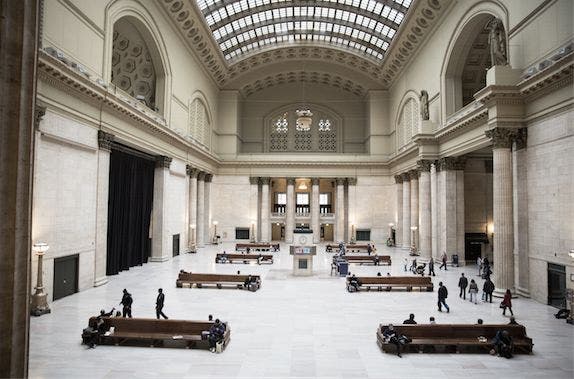
Chicago Union Station Redevelopment
- Cost: $1 billion
- Jobs: 1,000
- Status: Engineering, permitting and funding in progress
The third-busiest railroad terminal in the country, Amtrak-owned Union Station sees more than 300 trains and 120,000 passengers each weekday – on par with the 10 busiest airports in the U.S.
Emanuel has said the plan will “(transform) Union Station into a modern transit hub” and create economic opportunities for the entire city.
Earlier this month, the mayor announced that the U.S. Department of Transportation (USDOT) Build America Bureau and the City of Chicago had entered into an Emerging Projects Agreement (EmPA) to allow the city to work closely with USDOT to seek the $1 billion in funding for the project.
“This modernization effort will improve the experience for everyone who travels through Union Station and tap the potential that the station has to serve as an anchor for further economic development of the West Loop and surrounding neighborhoods,” Emanuel said.
Amtrak spokesman Marc Magliari said it's not certain that the project will be on the final Trump team priority list.
"That list has not been authorized by anybody," he said. Whether the EmPA agreement remains in place will depend on how the new administration feels about it, Magliari also said, adding it's unclear whether Trump's executive order on "sanctuary cities" could impact funding.
"I haven't seen what the rules are," he said.
Improvements that could be funded under the EmPA agreement include:
- Renovation of the Canal Street Union Station Lobby.
- Rehabilitation of the Great Hall skylight and dome structure.
- Renovation and expansion of the Adams Street and Jackson Street entrances.
- Expansion of the Union Station Concourse.
- Improvement of ADA accessibility throughout the station, including installation of an elevator at the Canal Street Headhouse.
- Reconstruction of the Canal Street and Harrison Street viaducts.
- Construction of pedestrian tunnels connecting Union Station to Metra’s Ogilvie Station and to the CTA Blue Line stop at Clinton Street.
- Transit-oriented development, including commercial/residential development of the air rights over the Headhouse and commercial/office/retail uses surrounding Union Station.
Amtrak has said it is nearing the end of its search for a master developer for the project.
Red and Purple Line Modernization, Chicago and Wilmette
- Cost: $2.1 billion
- Jobs: 2,100
- Status: Engineering, permitting and funding in progress
This project would completely rebuild the nearly 100-year-old North Red Line from Belmont to Howard and the Purple Line from Belmont to Linden in Willmette to add capacity and ensure faster rides with less crowding.
According to the CTA, the modernization is its largest capital improvement project ever. “Simply put, the Red and Purple lines have reached the end of their useful life spans," the CTA said on its website.
The project will be completed in phases. The first phase "will rebuild the Lawrence, Argyle, Berwyn and Bryn Mawr rail stations and more than a mile of adjacent tracks and track structure," CTA spokeswoman Irene Ferradaz said. "It will also construct a Red-Purple bypass to improve overall service that will benefit the entire Red Line by improving reliability and increasing capacity so that more trains can be added to alleviate chronic overcrowding during peak travel times."
She said the CTA anticipates breaking ground on phase one in late 2018. Construction will last four to five years, with completion in the early 2020s.
"As always, CTA will work closely with the community throughout construction to mitigate any impacts," Ferradaz said. "Phase One will support an estimated 5,700 direct design and construction jobs," with the impact of future phases yet to be determined.
A $957 million full funding grant agreement with the FTA was signed on Jan. 9, Ferradaz said. "The remaining Phase One funding includes a federal $125 million Congestion Mitigation and Air Quality Improvement (CMAQ) grant from the Chicago Metropolitan Agency for Planning (CMAP), $622 million in Transit TIF funds from the City of Chicago and CTA financing," she added.
WATCH a CTA video on the Red and Purple Line modernization’s first phase:
Locks and Dams 52 and 53 on the Ohio River
- Cost: $3 billion
- Jobs: 1,500
- Status: Construction already under way, with permitting and engineering complete. It is federally funded each year, which constrains the pace of completion.
This is a U.S. Army Corps of Engineers (USACE) project that has been in development for 30 years to address a “choke point” for barge traffic on the Ohio and Mississippi rivers. It is aimed at eliminating delays that increase costs and make the U.S. less competitive in the global commodities market, according to the list.
Locks and Dam No. 52 is located on the Ohio River just downstream of Brookport, while Locks and Dam No. 53 is about 11 miles upstream of Cairo, according to the ACE. The original structures were completed in 1928 and 1929, respectively.
The replacement project, known as the Olmsted Locks and Dam, is currently under construction between Illinois and Kentucky roughly 17 miles upstream from where the Ohio and Mississippi rivers meet.
“The locks are complete and work on the dam is 80 percent complete,” USACE said. “Olmsted will replace locks and dams 53 and 52 and greatly reduce tow and barge delays through the busiest stretch of river in America's inland waterways.”
The new locks and dams are slated to be operational in 2018.
Illinois River Locks, LaGrange and Peoria
- Cost: $640 million
- Jobs: 650
- Status: Engineering, permitting and funding in progress.
Another Army Corps of Engineers project, a preliminary schedule of work has construction slated to happen over a three-year period, with three lock closures and dewatering of two locks along the way.
Both locks opened in 1939; a major rehabilitation was completed on the Peoria lock and dam in 1990.
“The maintenance needs of this aging infrastructure have surpassed annual operations and maintenance funding,” USACE said of the LaGrange lock. “This limited funding has adversely affected reliability of the system and has primarily resulted in a fix-as-fail strategy, with repairs sometimes requiring days, weeks or months.”
Photo Credit: Amtrak / Chuck Gomez
Get more local news delivered straight to your inbox. Sign up for free Patch newsletters and alerts.