Community Corner
LGBT Community's Proud March 'Over the Rainbow' to Chicago
On June 27, 1970, 200 gay libbers gathered at Bughouse Square for the first 'Christopher Street Liberation Day.' The rest in history.


It has been said that when news broke across the Atlantic of legendary star Judy Garland’s death from an accidental drug overdose at age 47 in a London apartment on June 22, 1969, that Fire Island, a popular summer spot for Manhattan’s gay community, was draped in black.
Garland enjoyed a particularly large following of gay men who flocked to her concerts to swoon over her big, belting voice and whose turbulent private life and melodramatic persona had turned her into a camp icon.
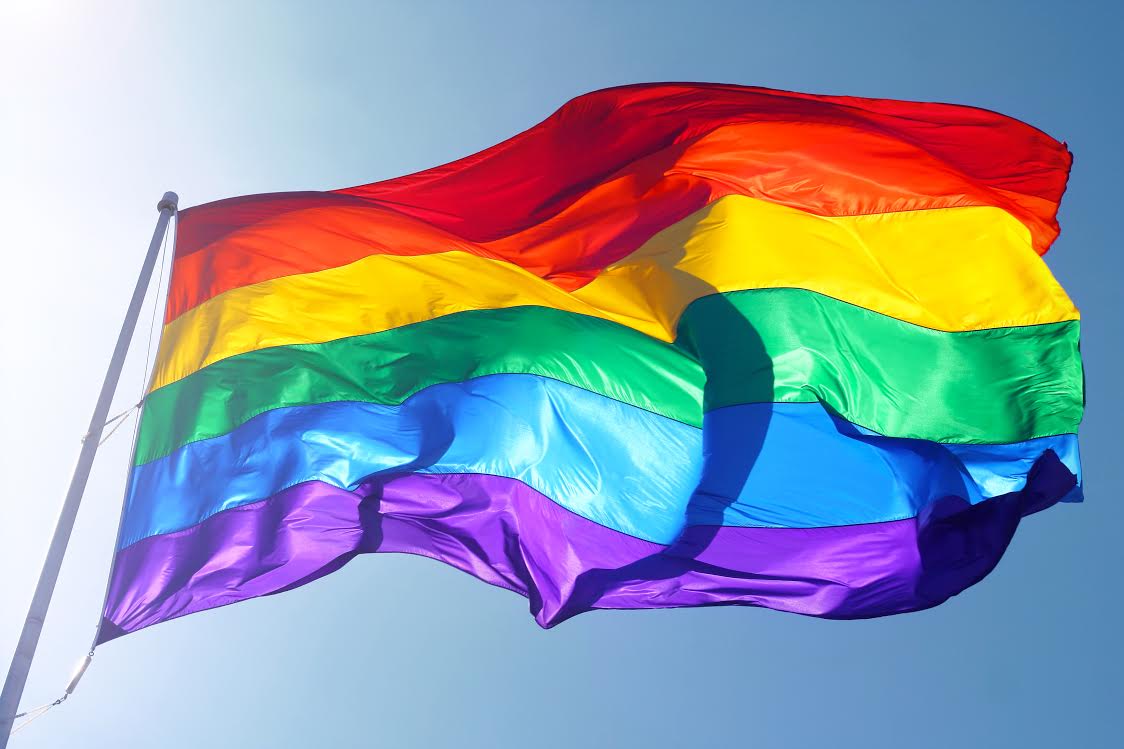
Her poignant theme song ‘Over the Rainbow’ from the classic 1939 movie ‘The Wizard of Oz,’ had also become an anthem of sexual freedom -- a place where if one had heart, courage and brains, gay, lesbian, bisexual and transgender people could live in a spirit of tolerance and acceptance.
Find out what's happening in Chicagofor free with the latest updates from Patch.
At the height of Garland’s career in the 1940s and 1950s, the catchphrase, “Are you a friend of Dorothy?” had become a code among closeted gay men, which meant, “Are you one of us?”
“There were subtle signals,” said St. Sukie de la Croix, author of “Chicago Whispers: A History of LGBT Chicago Before Stonewall” and an inductee in the Chicago Gay and Lesbian Hall of Fame.
Find out what's happening in Chicagofor free with the latest updates from Patch.
“In the 1930s, people used to meet on State Street around 4 in the afternoon walking down State Street with a red tie, that’s how you knew each other. You’d ask someone for a light on Michigan Avenue and it was a code,” de la Croix said.
Garland had often bragged to her friends of her devoted gay fans, saying “when I die, I have visions of fags singing ‘Over the Rainbow’ and the flags at Fire Island being flown half mast.”
Did Garland’s Death Spark the LGBT Movement?
When the star’s body was flown from London to New York for a star-studded funeral, more than half of the 20,000 fans that filed past her open casket at the famed Frank E. Campbell Funeral Chapel were said to be gay men.

Judy Garland's casket is carried out Manhattan's Frank E. Campbell Funeral Chapel on June 27, 1969.
Hours after Garland’s funeral on June 27, 1969 (James Mason, her co-star in ‘A Star Is Born,’ gave the eulogy) about 200 people had crowded into mob-owned Stonewall Inn, a popular gay bar in Lower Manhattan that also drew a number of neighborhood hippies.
“Most gay bars then were owned by the Mafia because homosexuality was considered a vice,” de la Croix said.
In the early morning hours of June 28, 1969, eight New York police officers arrived to raid the joint. Like many gay bars across the country, the Stonewall Inn was frequently raided by police who busted patrons in transgender dress or for same-sex public displays of affection, such as dancing.
Officers lined up 150 patrons, waiting for the police wagons to take them down to the precinct station. Those released waited outside the bar. A lesbian patron being carried out in handcuffs put up such a struggle that it encouraged the gathering crowd to do the same.
The crowd quickly overtook the police, using a parking meter as a battering ram to drive them off, until stunned police retreated back into the Stonewall, touching off three nights of explosive rioting as crowds of thousands gathered on Christopher Street to battle police.
“It was a hot night and people just got fed up with being pushed around,” de la Croix said. “There was that whole thing of rebellion going on. You had Vietnam, women’s liberation, everyone was rebelling against everything.”
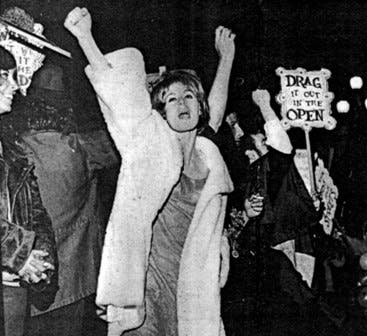
Protesters at the Stonewall Inn riots in June 1969.
While legend attributes Garland’s funeral hours before to sparking the LGBT liberation movement, most historians say it was just a provocative coincidence; still, the large showing of gay men at the star’s public viewing may have galvanized the patrons of Stonewall Inn to stand up for themselves.
De la Croix said police raids on gay bars in the post-World War II era were more a matter of cops searching out gangsters in arrears on their “protection money.”
“Gay people just caught in the middle,” he said.
‘Christopher Street Liberation Day’
On the first anniversary of the Stonewall Inn riots, gays and lesbians in cities throughout the country organized anniversary observances. Chicago’s LGBT community declared its first Gay Pride week from June 21 -28,1970. It was organized by the Chicago Gay Liberation Front and endorsed by Mattachine Midwest and other groups, de la Croix said.
Following a week of consciousness-raising workshops at the Midwestern Gay Lib Conference at University of Illinois-Chicago and infiltration of an American Medical Association meeting to protest a physician noted for his anti-gay writings, June 27, 2016 was declared “Christopher Street Liberation Day.”.
On June 27, 1970, some 200 gay libbers gathered for a noon rally at Bughouse Square across the street from Newberry Library, a popular spot for free speech orators by day and male prostitutes by night.
Writes De La Coix:
“Among the speakers was Sunny King of the Detroit Gay Liberation movement, who told the crowd she had given up her high paying job for gay liberation because ‘freedom was more important than job security.’ Also speaking was ACLU lawyer Jonathan Smith, psychologist Kitch Childs and gay activists Michael Barta and Henry Wiemhoff, who started the Chicago Gay Liberation Front at the University of Chicago."
After the speeches, the Bughouse Square protesters marched spontaneously down the sidewalk past such gay landmarks as the Lawson YMCA and the feared Chicago Avenue police station, notorious for arresting thousands of gays and lesbians. They continued marching down Michigan Avenue, State Street, Wacker Drive and Randolph, to the Civic Center Plaza (now the Daley Center Plaza) for more speeches. The afternoon ended with the marchers joining hands and doing a circle dance around the Picasso sculpture.
“By then the pig quota was up to five squads and two meat wagons,” reported the underground newspaper The Seed.
“It was a dangerous time,” de la Croix said. “Illinois was the first state to legalize homosexuality in 1961 but it was entirely by accident. When [the Illinois General Assembly] revamped the sex laws they forgot to include homosexualty, so you had drag queens and effeminate men flocking to Chicago thinking the law was on their side, but Chicago police, being corrupt, were raiding gay bars and beating up gay men.”
From Bughouse to Lake View
In 1971, Chicago’s gay and lesbian community held its first parade, lining up at Diversey Harbor and marching to North Avenue. The parade consisted of a few bar-sponsored floats and a marching kazoo band. As the city’s LGBT population began moving north, the parade moved to East Lake View.
Richard Pfeiffer was a volunteer marshall for the 1972 and 1973 parades. He took over as parade coordinator in 1974, a role he still holds today. Not everyone along the parade route was so accepting in the early years.
“[In 1972] some neo-Nazis from Uptown came to the corner of Broadway and Belmont and were literally egging people,” Pfeiffer recalled. “Two of our activists, who have since passed away, were just pelted and covered with eggs.”
Pfeiffer reflected back on 47 years, to the first rally in Bughouse Square and impromptu march through downtown Chicago, which he watched from the sidelines as a shy, conservative teenager from the Southwest Side’s McKinley Park.
“Back then, the only gay role models were Liberace and Paul Lynde from ‘Hollywood Squares,’” Pfeiffer recalled. “It was amazing to me as this young kid to see all these LGBT people proud of who they were out on the street. There were like 100 to 150 people, now we’re talking tens of thousands of people. Just the changes I’ve seen in my generation is just incredible.”
Get more local news delivered straight to your inbox. Sign up for free Patch newsletters and alerts.