Politics & Government
Wrigley Field Awarded National Historic Landmark Status
The Ricketts family may now receive tax credits to help cover the cost of hundreds of millions of dollars worth of recent renovations.


CHICAGO — The federal government has designated Wrigley Field as a national historic landmark in the National Register of Historic Places. The move offers an opportunity for its owners to receive millions of dollars worth of federal income tax credits.
Secretary of the Interior David Bernhardt issued a statement Thursday acknowledging the role of the 106-year-old ballpark in the history of professional sports in Chicago.
“The historical significance of Wrigley Field is interwoven into our nation’s story and a key part of what has become America’s beloved pastime for over a century,” Bernhardt said. “It is with great enthusiasm that I designate this iconic national treasure, the site of many legendary events, innovations and traditions in baseball history, as a National Historic Landmark.”
Find out what's happening in Chicagofor free with the latest updates from Patch.
Administered by the National Parks Service, the National Register of Historic Places includes more than 95,000 properties across the country. Only about 2,600 qualify as a national historic landmark. Wrigley Field joins 88 other sites in Illinois with the status.
Neither designation requires a property to be preserved. But it can be revoked, as happened to Soldier Field's national historic landmark status in April 2006 following controversial renovations to the 1924 design.
Find out what's happening in Chicagofor free with the latest updates from Patch.
Wrigley Field has been the home of the Chicago Cubs since 1916. It was also the home of the Chicago Bears from 1921 to 1970, hosting the first National Football League championship game in 1933.
It is the second-oldest stadium in professional baseball, the oldest in the National League and the only remaining ballpark with a connection to the defunct Federal Baseball League — its first owner, Charles Weeghman, first built the ground for the short-lived Chicago Whales, or "Chicago Federals".
Weeghman started the baseball tradition of allowing fans keep balls hit into the stands, and Wrigley was the first ballpark to use an on-site organ for entertainment, according to the Interior Department. Wrigley Field was known as Weeghman Park until 1920 and Cubs Park until 1926.

“Wrigley Field is a special place in the hearts of generations of fans,” said Tom Ricketts, Cubs executive chairman. “That’s why, from our first day as owners, we committed to preserving Wrigley, which will now take its well-earned place in the lineup of American history and culture as a national treasure.”
The Ricketts family, the owners of the Chicago Cubs and the stadium since 2009, applied for the national historic landmark designation in 2013. The next year, they embarked on a roughly half-billion renovation and expansion called The 1060 Project. The project added video scoreboards, new clubhouses amenities and more to the Friendly Confines in the biggest renovation in the stadium's history.
The federal historic preservation tax incentive program, jointly administered by the Interior and Treasury departments, offers a 20 percent rehabilitation tax credit for rehabilitation projects certified as consistent with the historic character of the property without damaging, destroying or covering features that define its character.
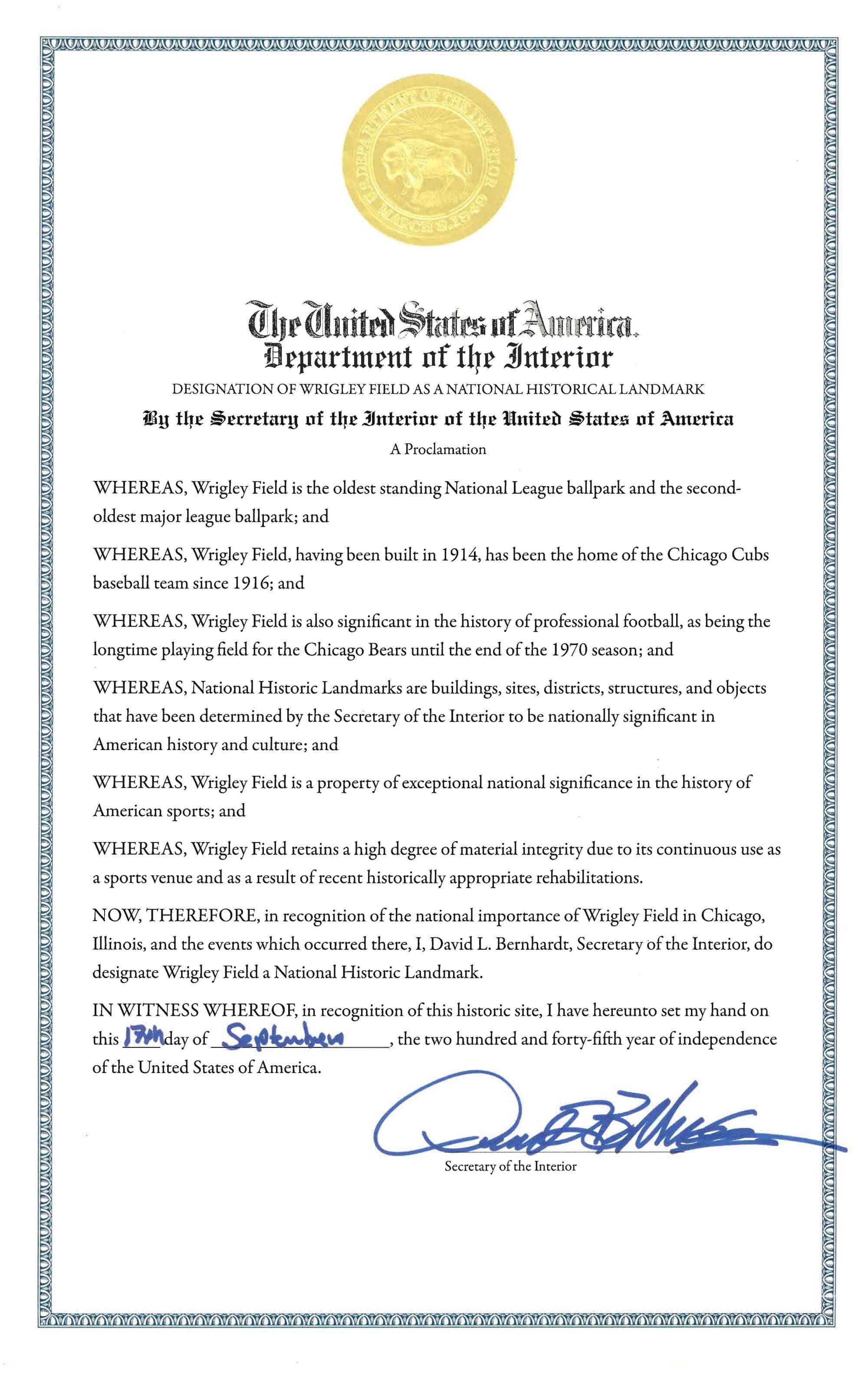
"Wrigley Field retains a high degree of material integrity due to its continuous use as a sports venue and as a result of recent historically appropriate rehabilitations," Berhardt declared in his designation.
The total cost of the renovations to Wrigley Field has been estimated at more than $500 million, but it remains to be seen how much may be eligible for the 20-percent rebate. A team spokesman last year told Chicago Tribune architecture critic Blair Kamin the Ricketts family expected to recoup about between $100 million and $125 million of the cost.
Wrigley Field was already a local historic landmark in Chicago, where local zoning and preservation officials have authority to review changes. Locally, it received more than $8 million in property tax relief through Cook County's Class "L" property tax incentive program.
Bernhardt signed the proclamation on Sept. 17, but it was not publicly announced until Thursday.
Get more local news delivered straight to your inbox. Sign up for free Patch newsletters and alerts.