Neighbor News
Author Rebecca Siegel Visits Mark DeLay School
By Diane Nelson, District Teacher Librarian, Darien School District #61


“The Mayflower was small!”
(Rebecca Siegel, 2022)
Acclaimed author, Rebecca Siegel, visited Mark DeLay School in Darien, Illinois to tell students what it is like to be an author. She has published over 250 books, and one of her newest books is, Mayflower: The Ship that Started a Nation (2020). Her books have been granted numerous literary awards, including the 2021 Eureka! Nonfiction Children’s Honor Book Award, School Library Journal Starred Reviews, and accolades from Booklist, Creative Child Magazine, and Learning Magazine. Rebecca writes under different pen names! One of her pen names is Rebecca Rissman and I was delighted to see that our school library had MANY of her books written under her pen name!
Siegel started her presentation by telling the students, “I do not like boring author talks!” First, she had the students do the ‘wave.’ Then, she shared some interactive signs for crowd control. The students loved it!
Find out what's happening in Darienfor free with the latest updates from Patch.
Siegel told the students that she is a nonfiction writer, a pumpkin carver, and a snow fort builder! The students also learned other facts about her, for example, she learned how to fly a plane for a book she was writing, she always wanted to learn how to do a backflip, and her favorite color is rainbow.
Next, students learned many facts about the Mayflower ship. It was small and could fit inside our gym (about 100 feet long and 25 feet wide). It was ten years old, which was old for a wooden ship back then. It was not built to be a passenger ship - it was built to haul cargo. Siegel explained the different areas of the boat to the students using a cross section diagram. The passengers lived on the gun deck, where 10 cannons were housed. The cannons were needed in case of a pirate ambush, but fortunately, the Mayflower made it across the sea without any attacks. Siegel also told the students about some of the crew’s jobs. For example, the job of the ‘cooper’ was to build and repair the wooden barrels down in the hold, which stored the food and drink. Another job was the ‘swabber’ who cleaned the deck.
Find out what's happening in Darienfor free with the latest updates from Patch.
The ship only traveled at 2 miles per hour! It took 66 days to cross the Atlantic Ocean. The conditions below deck were dreadful. Many people became sick on the ship. The smell was horrid. The food was horrid. A baby was born at sea and named Oceanus. A few people died at sea. The students learned that a chamber pot is where the passengers and crew went to the bathroom.
We also played an imagination game and closed our eyes while we listened to the sounds of the ocean waves crashing and thunder booming. Students imagined they were on the Mayflower sailing into a big storm. Then they opened their eyes and we learned that a big beam had cracked on the Mayflower when it was crossing the Atlantic during an epic storm and the passengers used a woodworking tool to hoist up the beam to keep the ship afloat. Another event that happened during a storm was when passenger John Howland left the gun deck below and came to the main deck for fresh air but was washed overboard. Luckily, he grabbed a rope that was trailing behind the ship and crew members were able to hoist him back on board. John Howland is the direct descendent of the author’s husband!
On November 9, 1620, the Pilgrims finally spotted land! Siegel engaged the audience with a song she wrote and everyone stood up and sang together! We loved it!
Now it is the fall of 1620 and the cold weather is setting in. The Mayflower anchors offshore and the passengers stay onboard for shelter. Some passengers went on land to slowly build houses and develop a small settlement. Many people got sick and about half of the passengers and crew died.
The purpose of Siegel’s book is to show the perspective of the Pilgrims coming to what is now known as America, and the perspective of the Native Americans who lived there already. The students learned that the Wampanoag Tribe inhabited the land that the Pilgrims settled on. The Wampanoags and other Native American Indians reached out to the small Pilgrim group and taught them how to raise crops and live on the land. After a successful year of growing and harvesting food, the groups gathered for what some people call, “The First Thanksgiving (1621).” Siegel used some props for an interactive demonstration to show the students what was possibly eaten at this meal (green beans, cranberries, deer, blueberries, oysters, grapes, turkey, fish, onions, and lobster).
To end the author visit, everyone stood on a taped outline on the gym floor. It was an approximate outline of the size of the Mayflower. We were amazed at how small the boat was, plus, it was another interactive part of the visit! To make it more fun, our technology director brought a drone and took some video footage from above!
An important part of our author preparation during library classes was to practice appropriate behavior for an author visit and practicing thoughtful questions to ask the author.
I held a contest and students illustrated cross sections of the Mayflower. The publisher, Quarto Kids, generously donated 10 of Siegel’s books to use as prizes for the drawing contest. The winning students were delighted to receive a signed copy of her book, Mayflower: The Ship that Started a Nation.
Another activity we did during library classes was to pretend to be a Mayflower passenger for the day! Students chose a passenger’s name from a bucket, taped it on their shirts, and they called each other by that name for the day. We learned that there were about 102 passengers and about 30 children on the ship and that careful records were kept with all the names of the passengers. In addition, there were about 25 to 30 crew members on the ship.
As a wrap up for the author visit unit, students wrote thank you letters and sent them to Siegel. Several copies of her books are housed in our collection so students can check them out and read them at home.
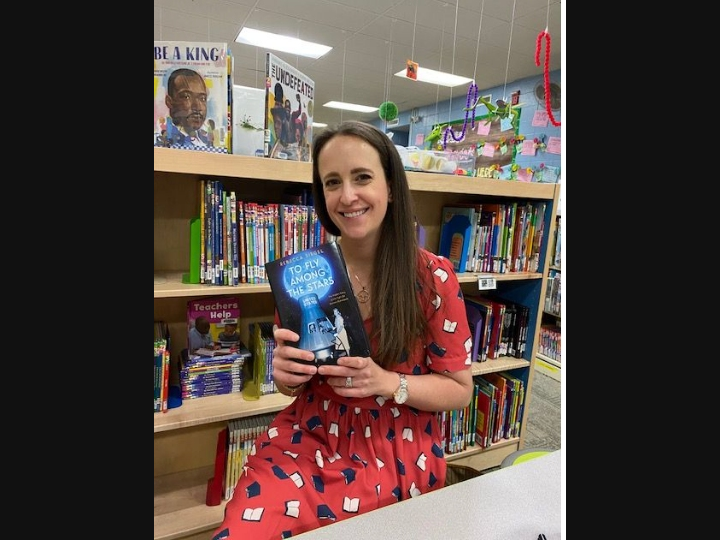
While Siegel and I had lunch during our presentation break, I was able to speak to her about another amazing book she recently published: To Fly Among the Stars: The Hidden Story of the Fight for Women Astronauts (2020). In order to write the book, Siegel conducted extensive research on the women who were chosen to train as astronauts and why they were not selected to go to space. The book gives a chronological account of the early space race and follows the lives of a select group of highly qualified women who wanted the chance to be chosen as NASA astronauts.
Coincidentally, I was chosen to go to Kennedy Space Center for a National Endowment for the Humanities teacher workshop called, “The Space Race on the Space Coast.” I brought Siegel’s book with me and shared it with my colleagues and was also able to learn more about women and the space race while I was at my conference. For example, I visited the Blockhouse bunker where the first satellite was sent into space, and it was a woman, Mary Sherman Morgan, who developed the fuel for that rocket.
If you want to read more about Siegel and her books, here are some links to her information:
https://www.rebeccarissman.com
Finally, the importance of hosting authors is extremely valuable to our school library program. Thanks to the generosity of the PTA, we can bring new and exciting authors to our school every year! Reading for pleasure, reading for information, inspiring future authors, providing positive role models -- these all lead to the promotion of reading and writing.
Diane Nelson
District Teacher Librarian
Darien District #61
dnelson@darien61.org
@d61Library