Health & Fitness
Solar Array Saves Money Now, Lays Groundwork for Next-generation Technology
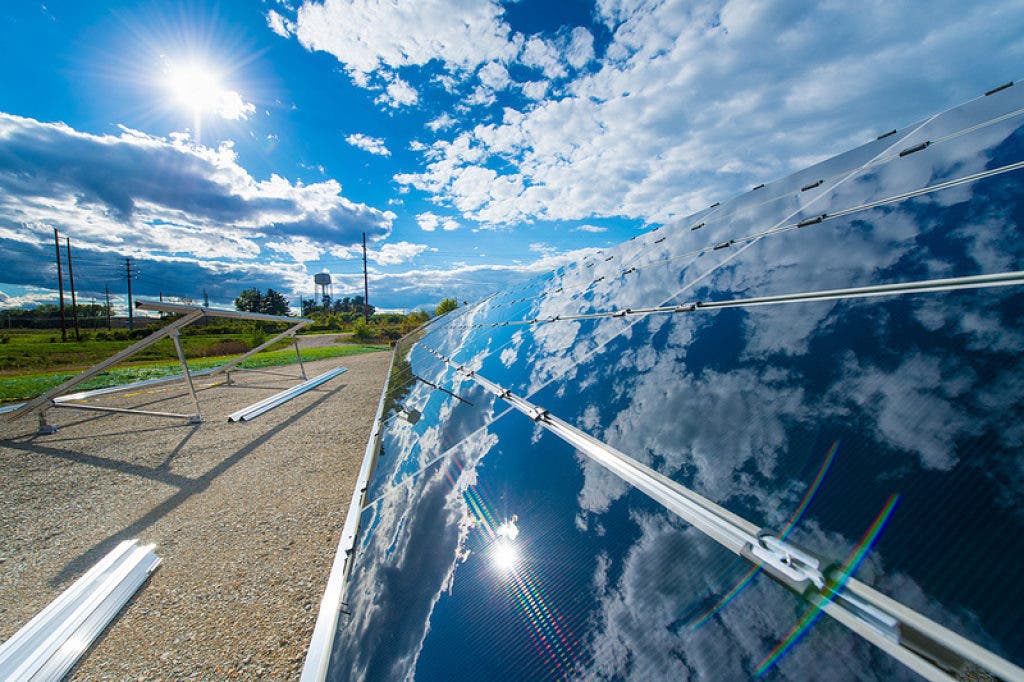
Argonne solar array provides renewable power, saving about $9,400 in taxpayer funds and 94 metric tons of greenhouse gas emissions annually, while doubling as a test bed for scientific research.
By Diana Anderson, Writer/ Editor, Argonne National Laboratory
Argonne National Laboratory recently constructed a 95 kW solar array on its campus. The solar farm provides renewable power for the laboratory's Emergency Operations Center, saving about $9,400 and 94 metric tons of greenhouse gas emissions annually. The solar array also doubles as a test bed for scientific research.
Argonne nanoscientist Seth Darling is using the new solar array to study how various types of solar panels perform in the Midwest region. “There’s an absence of good, objective performance comparative data, particularly in the Midwest,” said Darling. “That sort of information is good for everyone to have — homeowners, business owners, and so on.”
Find out what's happening in Darienfor free with the latest updates from Patch.
Argonne has already partnered with the Illinois Tollway on a joint energy study focusing on solar panel research. Argonne’s Midwest Photovoltaic Analysis Facility Initiative, of which Seth Darling is a part, studies multiple solar panel technologies located at the Illinois Tollway’s Downers Grove headquarters. The goal of the initiative is to evaluate how solar technologies perform in the Midwest region under various environmental conditions.
“We’re using six to eight different types of panel technologies in our research partnership with the Illinois Tollway,” said Darling. “So, we’re getting some good data, but not very strong statistics because there are such a small number of panels in the study.”
Find out what's happening in Darienfor free with the latest updates from Patch.
To alleviate this problem, Darling worked with Argonne’s Sustainability Program Office to have a variety of solar panel technologies installed as part of the laboratory’s on-site solar farm infrastructure. Argonne’s solar array is ten times larger than the array located at the Tollway’s headquarters and it uses three types of panel technologies.
“Argonne’s larger solar array will enable us to collect more reliable data,” said Darling. “We’ve also set up lots of weather data-gathering technology stations as part of the solar array.”
Weather data will be collected as part of Darling’s solar panel performance study. Each solar panel is equipped with a temperature sensor, dynamometers will measure wind, and pyrometers will measure sunlight or insolation — the measure of solar radiation energy received on a surface area.
“One of the things we’d like to determine is which types of panels perform better in higher or lower levels of light,” said Darling.
The Midwest’s seasonal weather fluctuations make solar harvesting a challenging activity, but researchers like Darling are attempting to determine which types of panels perform better in the region. This type of data is essential for determining the future of next-generation solar technology and can directly affect the course of the market to come.