Politics & Government
D86 Digest: Now that No Child Left Behind Is Being Left Behind, What’s Next?
Administrators outline switch to an individual growth model for measuring student achievement that includes an emphasis on student well being.
The U.S. Senate this week is considering a bipartisan overhaul of the federal No Child Left Behind Act that would end the increasingly unrealistic requirement that all students in all public school districts in the country meet or exceed state standards in certain academic areas.
While some of the details in the new legislation remain unresolved, officials believe it will move toward an individual growth model for measuring student achievement, something they said during Monday’s school board meeting they have been working on for some time.
“We look at student growth, as opposed to the snapshot the state looks at, where they compare one class to the next,” Superintendent Dr. Nicholas Wahl said. “Fortunately as a district, we’ve been looking at student growth for many years.”
Find out what's happening in Darienfor free with the latest updates from Patch.
Under the provisions of No Child Left Behind, schools are required to show adequate yearly progress (AYP) toward the goal of 100 percent proficiency in math and reading. For the 2010-2011 school year, AYP was defined as having 85 percent of students meeting or exceeding state standards in those areas as measured by standardized tests.
Both and failed to meet AYP. Hinsdale Central met the target overall, but not in all student subgroups. Specifically, only 50 percent of Central’s special education students displayed proficiency in math.
Find out what's happening in Darienfor free with the latest updates from Patch.
“The current rewrite of No Child Left Behind in the U.S. Senate Education Committee would end that AYP accountability,” Assistant Superintendent for Instruction Dr. Bruce Law said.
Law used a camp analogy to explain the policy shift.
“There was a running camp and for the past 10 years they said every runner will run an 8-minute mile,” he said. “Now that same camp is saying they’re going to take into account the runner’s time going into the camp and other factors in order to determine running improvement.”
Law said the district was continuing to focus on increasing student achievement. As part of that effort, the district was also going to try to increase student well being.
“This represents the whole child,” he said. “This is really why we got into education as educators. … There’s a growing body of research in education that [demonstrates] when you increase student well being, it actually increases their student achievement.”
Law cited a number of studies in a memo to Wahl that was shared with board members.
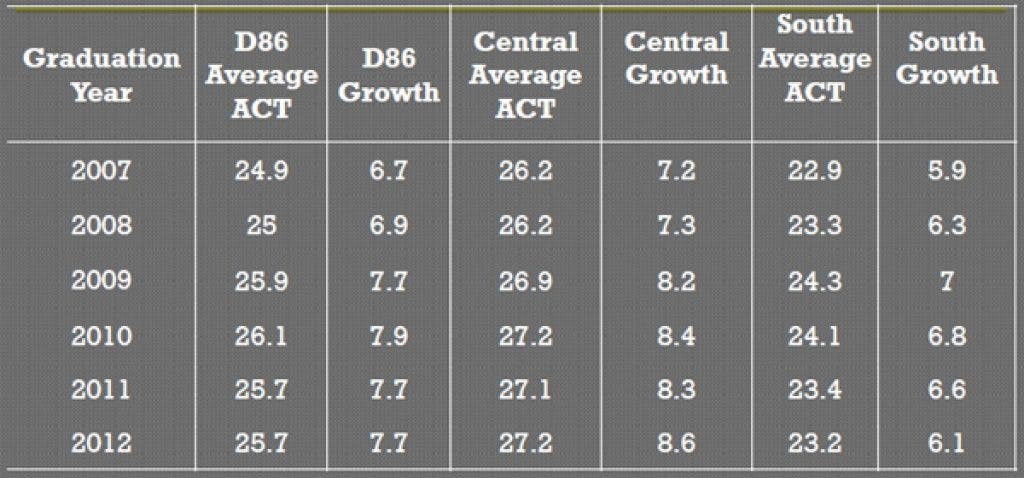
Law said one method of measuring student growth was to compare the results of Explore tests taken by students in eighth grade with the results of the ACT tests they take as high school juniors.
Since 2007, the average ACT score in the district has risen from 24.9 to 25.7. Over the same time period, the growth from the Explore test results to the ACT results has increased from an average of 6.7 points to 7.7 points.
“We also want to increase the opportunities students have for honors and AP courses,” Law said.
In 2011, 51.7 percent of district students took at least one AP course. That was up from 44.6 percent in 2007.
Both district schools have shown growth in this area. The number of Hinsdale Central students taking at least one AP course increased from 50.3 percent in 2007 to 55.9 percent in 2011. At Hinsdale South, it rose from 37.3 percent in 2007 to 46.5 percent in 2011.
Hinsdale Central Principal Michael McGrory and Hinsdale South Principal Dr. Brian Waterman outlined how increasing social emotional learning (SEL) among students would help improve student well being.
“We feel like it’s going to promote in our curriculum the following areas,” McGrory said, “self-discipline, initiative and self-advocacy, good communication skills, teamwork and collaboration, leadership skills, critical thinking and problem-solving, ethical and social responsibility, and a global awareness.”
McGrory said the district was beginning to collect baseline SEL data, which will include a survey examining the climate at the schools that will be taken by students, staff and parents.
“From that data, we’ll then form what our next steps will be as far as our social emotional learning goals,” he said.
Waterman discussed increasing student engagement.
“SEL is still kind of in its infancy nationwide,” he observed. “It’s a concept that has really taken off in the last couple years.”
Waterman said the schools would be examining student participation in extra-curricular activities, noting that research has shown students involved in school activities outside the classroom tend to perform better academically than students who do not take part in extra-curricular activities.
“They’re going top be better people as a result, as well,” he added.
Waterman said they would also be examining office discipline referral data.
“It also is a really good indicator of school climate -- how things are in the school,” he said.