Politics & Government
'False Narrative' About Hinsdale South: Principal Speaks Out
Hinsdale South's enrollment is declining. Its principal disagrees with arguments that Hinsdale Central is treated better.


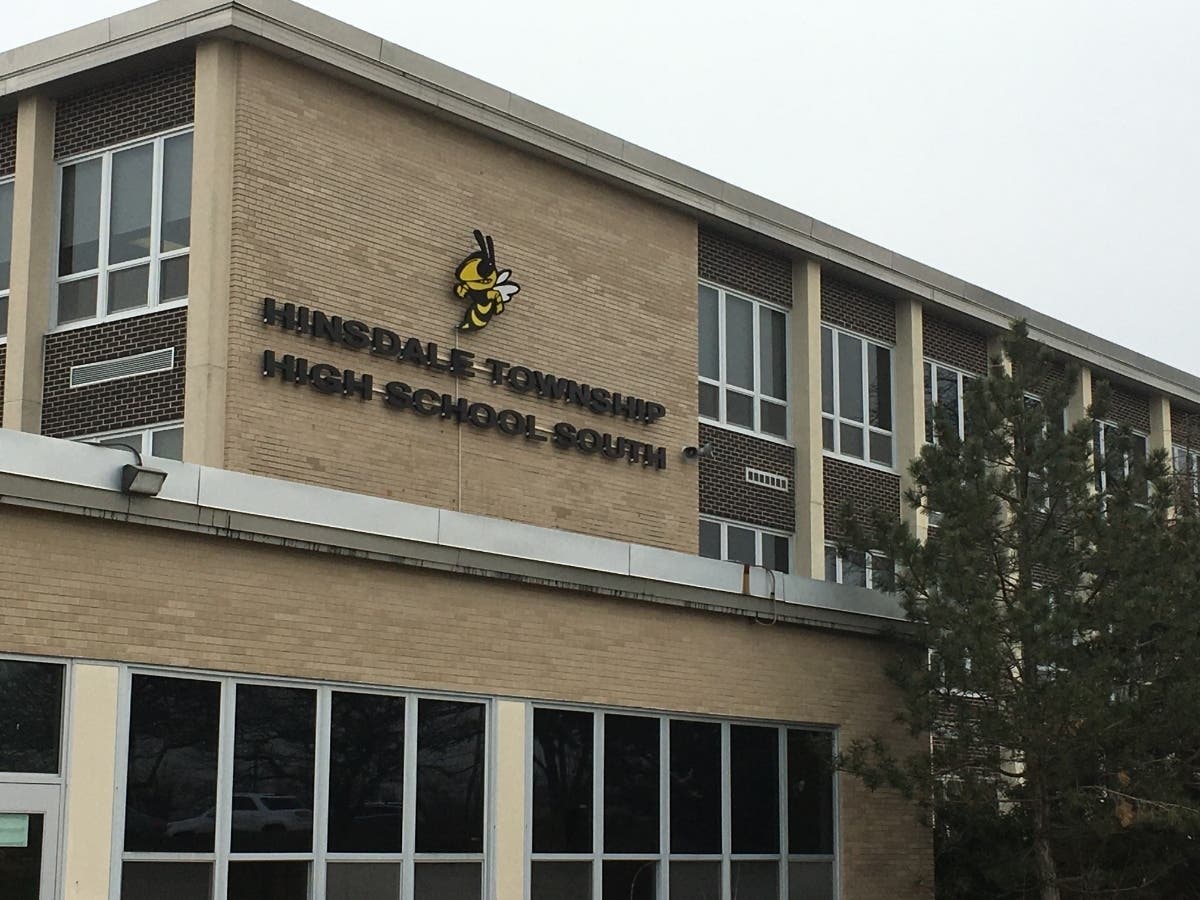
DARIEN, IL — Some parents at Hinsdale South High School contend the school's dwindling enrollment explains the cancellation of some courses. And they say suggestions of remote learning classes in the school district likely mean fewer in-person teachers for South students.
In short, they argue South is getting the short end of the stick when compared to Hinsdale High School District 86's other school, Hinsdale Central. In response to the suggestion of remote learning classes, Burr Ridge resident Alan Hruby took the school board to task at its recent meeting.
"The real question is whether you decided to put students in suboptimal, teacherless classrooms so you can cater to special interests that want to perpetuate cost-inefficient, antiquated boundaries that underlie our ridiculous enrollment imbalances that are, in turn, the root of inequities that we're trying to fix now," he said.
Find out what's happening in Darienfor free with the latest updates from Patch.
By the standard metrics, both schools are superior to most in the state. But Central's demographic is a lot wealthier. At South, 27 percent of students come from low-income families, far lower than the state's average of 49 percent but considerably higher than Central's 6 percent, according to the Illinois Report Card.
South parents note their school's enrollment has been dwindling, while Central's has increased. In 1989, the school district's total enrollment was 3,365 students. Almost half of the students — 49.7 percent — attended South.
Find out what's happening in Darienfor free with the latest updates from Patch.
Thirty years later, in 2019, the district's enrollment was 4,148, a more than 20 percent jump. Of that 34 percent, or 1,420, attended South. Virtually all of the growth over the last three decades went to Central, not South. Since 2006, South's enrollment has dropped by a quarter.
In 1991, the school district established a small attendance buffer zone, which may have played a role in the enrollment imbalance. This zone was an area mainly in Darien and Willowbrook, where families could choose whether to send their children to Central or South. Central was the favorite by far. In the 2018-19 school year, for instance, of the 221 students in the zone, just 15 percent went to South.
In 2018, the school board voted for a phased-in elimination of the buffer zone. The effect of that change will be seen in the coming years.
According to a 2018 report, the school district is aiming for enrollment of 2,515 at Central and 1,704 at South. That's a shift in enrollment of about 200 from Central to South.
South has more space available than Central, according to the district's studies. A 2019 report showed that Central's room utilization rate was 81 percent, higher than South's 70 percent. That same study stated 75 percent of seats were used at Central, compared with 58 percent at South. And South has nearly double the square footage per student than Central.
The 2019 report noted 100 percent capacity was not feasible for a high school. That's because of the variety of classes offered, the need for a lunch period and the reality that enrollment numbers would never divide perfectly into every classroom.
At a recent meeting, South residents told the school board they remembered when South's enrollment was about 1,900, which was the case as recently as a dozen years ago. In those days, one mother said, cancellation of classes was a rarity at South. South's principal, Arwen Pokorny Lyp, recalls that time as well, but not as fondly.
"We were bursting at the seams then. It was very tight," said Pokorny Lyp, who was assistant principal back then. The school has nearly 500 fewer students now.
In an interview, the principal disagreed with the arguments that South is treated unfairly. She said it was the district's job to make sure equity existed between the two schools.
"We believe it's a false narrative that South students are being shortchanged opportunities," Pokorny Lyp said. "You can find examples both ways where students in one school are offered programs that students in the other school are not. The building administrators in both schools cultivate programs based on what is needed and based on student interest."
The principal offered three examples of classes offered at South that are unavailable at Central — human physiology and anatomy, American sign language and woodworking technology. And she said Central has such examples as well. Students at both schools, she said, can go to the other for classes unavailable at their own
The principal noted the district aims to align all of the schools' classes by 2024. For instance, the district's goal is to have human physiology and anatomy at both places.
As for remote learning classes, Pokorny Lyp said the district has given no formal presentation on such a possibility. But she said the district would not let such a program affect one school more than the other. "It's our job to make sure we have equitable opportunities," she said.
District spokesman Chris Jasculca said officials have had no in-depth discussions about remote learning courses. "With that said, we are currently in the first year of a five-year strategic plan, during which we will engage in conversations about how we can best meet the needs of our students, and explore opportunities that will help them down the path toward their ideal future," he said in an email.
As it happens, in the coming years, both schools may see drops in enrollment, if births are an indication. From 2000 to 2013, the number of births dropped 22 percent district-wide, according to a 2015 report by demographer John Kasarda. Hinsdale's births plunged 60 percent in that time, while Darien's decreased by nearly 30 percent.
| Year | South Number | Central Number | Total Dist. Enrollment | South % of Total |
| 2019 | 1,420 | 2,728 | 4,148 | 34.2% |
| 2018 | 1,483 | 2,786 | 4,269 | 34.7% |
| 2017 | 1,507 | 2,765 | 4,272 | 35.3% |
| 2016 | 1,553 | 2,834 | 4,387 | 35.4% |
| 2015 | 1,632 | 2,778 | 4,410 | 37.0% |
| 2014 | 1,710 | 2,777 | 4,487 | 38.1% |
| 2013 | 1,735 | 2,830 | 4,565 | 38.0% |
| 2012 | 1,732 | 2,780 | 4,512 | 38.4% |
| 2011 | 1,807 | 2,721 | 4,528 | 40.0% |
| 2010 | 1,825 | 2,755 | 4,580 | 39.8% |
| 2009 | 1,824 | 2,686 | 4,510 | 40.4% |
| 2008 | 1,882 | 2,624 | 4,506 | 41.8% |
| 2007 | 1,869 | 2,652 | 4,521 | 41.3% |
| 2006 | 1,920 | 2,560 | 4,480 | 42.9% |
| 2005 | 1,913 | 2,465 | 4,378 | 43.7% |
| 2004 | 1,845 | 2,394 | 4,239 | 43.5% |
| 2003 | 1,849 | 2,372 | 4,221 | 43.8% |
| 2002 | 1,732 | 2,322 | 4,054 | 42.7% |
| 2001 | 1,645 | 2,243 | 3,888 | 42.3% |
| 2000 | 1,601 | 2,162 | 3,763 | 42.5% |
| 1999 | 1,584 | 2,051 | 3,635 | 43.6% |
| 1998 | 1,567 | 1,984 | 3,551 | 44.1% |
| 1997 | 1,578 | 1,910 | 3,488 | 45.2% |
| 1996 | 1,651 | 1,821 | 3,472 | 47.6% |
| 1995 | 1,679 | 1,729 | 3,408 | 49.3% |
| 1994 | 1,632 | 1,682 | 3,314 | 49.2% |
| 1993 | 1,540 | 1,685 | 3,225 | 47.8% |
| 1992 | 1,487 | 1,575 | 3,062 | 48.6% |
| 1991 | 1,537 | 1,577 | 3,114 | 49.4% |
| 1990 | 1,581 | 1,607 | 3,188 | 49.6% |
| 1989 | 1,671 | 1,694 | 3,365 | 49.7% |
| 1988 | 1,690 | 1,812 | 3,502 | 48.3% |
Get more local news delivered straight to your inbox. Sign up for free Patch newsletters and alerts.