Arts & Entertainment
Oliver Stone's Secret to Hooking Kids on History: Make It Colorful
The director spoke after a screening Wednesday at Stevenson High School about America's distorted past and hating the word "conspiracy."


LINCOLNSHIRE, IL―It shouldn't come as a surprise to hear Oliver Stone enjoys American history.
The award-winning director has mined this nation's past and the historical figures who populated it for many of his critically acclaimed―and sometimes controversial―films, such as Platoon, JFK and Nixon.
But while Stone finds U.S. history exciting and engaging, he's not a fan of how and what this country's citizenry learns about the subject.
Find out what's happening in Deerfieldfor free with the latest updates from Patch.
More Coverage on Patch:
- 'I'm Shocked!': Even Cubs Fan Oliver Stone Thinks This Is Chicago's Year
- Natural Born Talker: 5 Oliver Stone Quotes on Money, Military and Making Sense of U.S. History
- Oliver Stone to Visit Stevenson High School for Screening
"Most of what we get is popular history by people who make money writing it. ... I think it's a distorted history," Stone told reporters before a screening of an episode of his documentary series, The Untold History of America, on Wednesday night at Adlai E. Stevenson High School. "I think the real, serious history of America is in higher academic classes in colleges. ... It's not widespread."
Find out what's happening in Deerfieldfor free with the latest updates from Patch.
That desire to set America's historical record straight, so to speak, is what motivated Stone and Untold History co-creator Peter Kuznick, a history professor and director of the Nuclear Studies Institute at American University, to develop a 12-part Showtime series in 2012 that re-examines the history of the Cold War and shows how the events of that era have shaped this country's present.
Wednesday's event featured the episode of the series surrounding the decision behind and the aftermath of dropping atomic bombs on Japan at the end of World War II. After the screening, Stone and Kuznick participated in a student-moderated discussion and an audience Q&A for the around 400 people who attended the event in Stevenson's west auditorium.
Get Patched In
- Get News Alerts, Join Facebook Pages and Learn About Patch
- Learn how to create a Patch user account
- Like our Crime page on Facebook
- Live Traffic and Transit Updates
Along with showing the lesser-known side of U.S. history, Stone and Kuznick created Untold History as a way to also present the information in a compelling fashion. The filmmakers thought that was especially important if they wanted to hook high school students, a group Kuznick said wasn't being given a good understanding of its own country's past.
"You have to make history colorful, which is what we did," Stone said about the Untold History series. "We didn't frame history as a Disney movie or Disney World tour."
"Kids are smart," he added. "They just don't have exciting history courses. I know that from personal experience. I don't think kids care about history. ... My three children never got this sense of history."
So how do you get kids interested in history, according to Stone and Kuznick?
"By telling the truth. By making documentaries challenging. By making bad guys really bad. Making good guys really good but pointing out there's something so wrong in our [current] perspective," Stone said.
Here are some of the other highlights from Wednesday's event.
Why Learning History Is So Important
During the moderated discussion, Kuznick suggested that people shape their present and future due in large part by how they understand their past. In fact, he pointed to the success and popularity of Republican presidential candidates Donald Trump and Ted Cruz and what happens when there's a lack of knowledge.
"If you have a distorted view of history, these guys seem like viable options," Kuznick said.
By reaching out to the younger generation and engaging them in U.S. history, Kuznick said he hopes they'll be better equipped to shape the future in a positive way.
In what might have been a hopeful sign for Stone and Kuznick, a graduating Stevenson senior who will be attending American University in the fall ended her question to the two about the inherent morality of war with this capper:
"How can you say guns and bullets are OK, but an atomic bomb isn't?"
Kuznick's response after a beat: "Wow."
Being Critical of the United States
Although Showtime didn't interfere with the making of Untold History, Stone did say that it's hard now to make anything in Hollywood that could be interpreted as criticizing America. Kuznick added that criticism doesn't have to be seen as a negative or as a means to tear this country down.
"We're not saying the U.S. is a bad country," Kuznick said. "It's that it could be better, and it could reshape the world."
Life During Wartime
Stone, who served in the Army during the Vietnam War, says even though the American people are "war weary," the nation's politicians aren't. Politicians like Trump, Cruz and even Democratic presidential front-runner Hillary Clinton are still very hawkish.
But Stone was very critical of that militaristic mindset, especially coming from individuals who have never experienced war up close yet advocate extreme measures such as torture.
"I wish these people [torture] could be done to them," Stone said, with elicited applause from the crowd. "They don't know what it's like."
Connecting With an Audience
"It's exciting when they engage and when you have a receptive audience," Stone said about immediately interacting with people after they've screened Untold History episodes. "We've had so many discussions with people all across the United States, and the reaction has been alive, you know. One gets a sense with our commercial television arrangements, one gets a sense that there's no controversy. There's no ability to open an engagement or a discussion."
What the Series Taught Him About the George W. Bush Years
The two-term presidency of George W. Bush was tough on Stone.
"Those eight years with Mr. Bush to the beginning of Obama were really horrible," he said.
Until he worked on Untold History, Stone thought Bush and his policies were an aberration in American history, the occasional bad apple that pops up in the bushel, not an indication of the what the entire crop from the tree is like.
But working on the series proved that theory wrong for Stone, who found that the things he disliked about Bush's presidency were evident in other eras in this country, too.
"History was always this way," he said.
Held to a Different Standard
Because his films deal with political topics and because they can be political in and of themselves, Stone says he's been strapped with unfair labels throughout his career.
"I'm judged by far different standards than my contemporaries," he said. "I hate having to defend my work. Let the films speak for themselves."
"I'm called a provocateur," he added. "I'm not a provocateur. I'm naturally curious. ... I hate the word 'conspiracy,' but they use it so loosely with me."
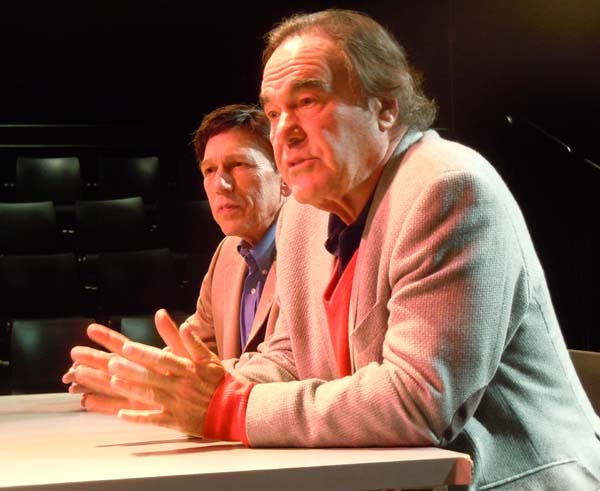
PHOTO: Peter Kuznick (left) and Oliver Stone at Adlai E. Stevenson High School on Wednesday, May 4, 2016. (Joe Vince | Patch.com)
Get more local news delivered straight to your inbox. Sign up for free Patch newsletters and alerts.