Community Corner
Alert Today, Alive Tomorrow, Reveals Cold War History and Propaganda
National traveling exhibition debuts at Elmhurst Historical Museum next week.


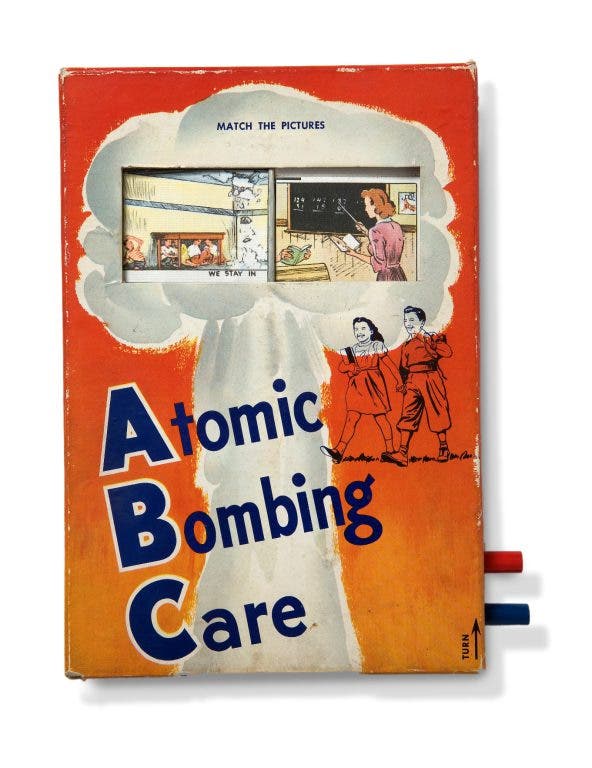


On Aug. 6, 1945, a specially equipped American B-29 bomber dropped an atomic bomb on Hiroshima, Japan. Three days later, another bomb fell on Nagasaki. For most Americans, the immediate reaction to the atomic bomb was relief; it had ended the war. But as the United States celebrated, the country also braced itself for the uncertain future of the Atomic Age. For the next two decades, the looming threat of atomic war dominated American society.
The new national traveling exhibition, Alert Today, Alive Tomorrow: Living with the Atomic Bomb, 1945-1965 at , explores the many ways Americans experienced the atomic threat as part of their daily lives. Co-curated by Michael Scheibach, a Cold War historian and collector, the exhibit features more than 75 original artifacts from the era.
Alert Today, Alive Tomorrow shows how Americans were flooded with messages through images, media and film that depicted the dangers of atomic energy. This heightened public rhetoric was in answer to evolving weapons technologies and shifting global politics. Although the threat of atomic annihilation eventually drifted to the background of American consciousness in the late 1960s, the Atomic Age left a legacy of governmental response and civic infrastructure that remains relevant today.
The Local Connection
Elmhurst Historical Museum’s curator Lance Tawzer has high hopes for public interest in the exhibit.
Find out what's happening in Elmhurstfor free with the latest updates from Patch.
“We chose to bring this exhibit to Elmhurst because we had an opportunity to be the first museum to host it, but more so because the exhibit has a compelling story to tell,” Tawzer said. “Any Baby Boomer will relate to the fear that infiltrated every American community, and the Chicago area was no exception.”
In fact, Chicago was considered a high-profile target for an attack, he said. As a result, local governments in the city and suburbs were on alert to prepare citizens for the possibility of dealing with nuclear fallout.
“We are adding a local aspect to supplement the main exhibit because we found a number of interesting, pertinent stories,” Tawzer said. “At the time, residents were encouraged to build bomb shelters in their homes, and we were able to get video footage of an Elmhurst home where the shelter is still intact as it was in the 1950s. In addition, a few locals shared their memories on camera, and these anecdotes will be featured in an interactive display. We’ve also created a Fallout Shelter Theatre with Civil Defense film clips that exemplifies the propaganda of the times.”
Three Primary Exhibit Themes
The Blast, 1945–1950 covers the years following Hiroshima and Nagasaki. With the U.S. the only holder of an atomic weapon, American response split between popular consensus that the bomb had helped win World War II and a dawning idea that this weapon could destroy the earth. Comic images of the bomb appeared on toys and packaging, while the media and political establishment began declaring “One World or None,” and “Peace, or Else.”
Find out what's happening in Elmhurstfor free with the latest updates from Patch.
Under the Mushroom Cloud, 1951–1956 shows how the scene changed after the Soviets acquired atomic capabilities in 1949. The fears expressed since 1945—that the next war might result in the end of civilization—seemed to be coming closer to reality. This new threat ushered in the Cold War and the age of Civil Defense. While posters and pamphlets advocated parental readiness, children were taught to “duck and cover” by Bert the Turtle.
Nuclear Fallout, 1957–1965 explores this final period of the Atomic Age. While the federal government signed off on the creation of a national highway system to allow speedier escape from threatened cities, a nation trying to cope with the realities of nuclear annihilation wavered between the smiling, reassuring image of the “Civil Defense man” and the fatalistic leer of Alfred E. Newman: “What, Me Worry?”
Special Programs & Events
- Elmhurst Historical Museum is hosting a number of exhibit-related programs in the coming months:
- Espionage: A Cold War Weapon—7 p.m. Thursday, Jan. 26. Werner Juretzko, a former G-2 U.S. Army intelligence operative, conducted undercover espionage missions during the Cold War and was apprehended by the notorious East German police and imprisoned for six years. The program is in the Elmhurst Historical Museum Education Center. Admission is free.
- Movies of the Cold War Era—6:30 p.m. Wednesday, Feb. 5. Columbia College professor Ron Falcone will view and discuss the Cold War film-noir movie, “The Woman on Pier 13” at Elmhurst Public Library. Admission is free, but reservation are required by calling (630) 279-8696.
- Living with the Atomic Bomb, 1945-1965—1 p.m. Thursday, Feb. 23, EHM Education Center. Exhibit collaborator, author and historian Michael Scheibach, who specializes in the history of the Atomic Age from the 1940s to the ‘60s, will discuss the impact of the atomic bomb on the psyche of American children and adults and the ways media, educators and government responded amidst the social and political climate of the Cold War era. Admission is free.
- The Cold War in Our Own Backyard—7 p.m. Thursday, March 15, at the Education Center. Chris Sturdevant, director of the Cold War Museum, Midwest Chapter, brings a local perspective to the nation’s response to the atomic threat by exploring Midwesterners’ attitudes on civil defense efforts, the presence of munitions plants scattered throughout the countryside, and the long-term effect of the Cold War environment. Admission is free.
Alert Today, Alive Tomorrow runs through March 18. For more information, call (630) 833-1457 or go visit www.elmhursthistory.org.
Get more local news delivered straight to your inbox. Sign up for free Patch newsletters and alerts.