Schools
Retired Elmhurst Teacher Got Lost Leading Students In Outdoors
He recounts his experience teaching seventh graders survival skills, including building forts.


David Venetucci, a retired teacher from Elmhurst School District 205, is writing a memoir. Here is the part about his experiences leading students in the outdoors, including getting lost once:
ELMHURST, IL – "I think Mr. V is lost — this is awesome!"
I heard that comment from somewhere behind me in the darkness, from a kid who clearly wasn't crying. I don't remember which wrong turn I'd made, or the second one after that, but I did know this: I was leading a group of between 10 and 15 seventh graders and a fellow English teacher through the pitch-black woods of a southern Wisconsin YMCA camp, on a “night hike” I had run without incident for several school years, and I no longer knew precisely where we were.
Find out what's happening in Elmhurstfor free with the latest updates from Patch.
I had played it cool when I first realized our group had gone astray in the forest. Then a few kids figured it out, word spread, and the group split cleanly along predictable lines—most of the girls started to freak out, while some of the boys thought getting lost in the woods at night was perhaps the single greatest thing that had ever happened in their young lives.
I knew the terrain well enough to know that walking in any direction would eventually land us either on the entrance road or the main meadow, so I went a bit rogue and began bushwhacking through some fairly thick brush, still not using my headlamp, purely out of stubbornness at that point. I remember screams, some crying, and a lot of laughter, sometimes from the same kid within the same 30 seconds.
Find out what's happening in Elmhurstfor free with the latest updates from Patch.
We eventually popped out onto the gravel entrance road, which was good. What was less good: I wasn’t entirely sure, in the dark, which way led back to camp and which way led to a T-intersection and a local road. I picked a direction. We ended up at the T-intersection, and there was more crying, along with joyous hootin’ and hollerin’. Embarrassed, I tried to play it off, and we ambled back up the entrance road, arriving at camp far later than expected and missing that group's next scheduled activity.
I apologized to my teaching colleague for the unplanned detour. She was gracious about it, more than I deserved, honestly, since I probably had given her a real scare. Humbled and less cavalier in my approach from then on, I never got “lost” on a night hike again.
Here’s the thing, though. For nearly a decade, part of my job was teaching middle school students what to do if they got lost in the woods. I wasn’t on this particular night, modeling best practices.
I’m no expert outdoorsman. I’ve done a fair amount of backcountry camping, hiking, and canoeing over the years, which qualifies me as dangerously competent. That apparently was enough, because when a middle school science teacher who ran a wilderness survival activity for many years was about to retire, I gladly took the activity over. I had watched him run it and knew the ropes.
Wilderness Survival was part of Outdoor Ed, a two-day program held each fall in southern Wisconsin at a 132-acre YMCA facility called Camp Edwards. Half of the seventh graders at the middle school where I finished my teaching career went to one session, half to the next. Some teachers rode a school bus up to the camp for a single session, while others — including me — drove in their own vehicles and stayed for both sessions.
In addition to Wilderness Survival, Outdoor Ed featured a variety of daytime and night activities, including canoeing, climbing wall, ropes course, archery, lacrosse, marsh boardwalk hike, tube sliding, bonfire, and night hike.
Students bunked in male and female lodges and ate meals family-style with teachers in a rustic dining hall overlooking scenic Lake Beulah. The boys’ lodge had a spacious commons area with a wood-burning fireplace, along with a stuffed moose head mounted in the stonework above it. A colleague of mine — a veteran social studies teacher with a deadpan delivery I never managed to copy convincingly — liked to ask incoming students how fast that moose was running to get stuck up there. Some kids got the joke. Others took him seriously and shouted out estimated speeds. I used the bit myself whenever he wasn’t around to tell that joke properly.
Wilderness Survival began with 10-15 kids gathering near the boys’ lodge. We’d discuss how both animals and humans adapt to changes in their environment, including concepts like hibernation, migration, and acclimation. Then we’d tromp across the meadow and into the woods to a small wood pavilion next to a stand of mature pines. I’d cover the differences between conifers (trees with needles that don’t drop each year) and deciduous trees (species with leaves that die each autumn and regrow in spring). Then I’d transition and pitch this scenario: Imagine it’s a sunny winter day and you’re out hiking in the woods with a small group of friends. Before you realize it, you’ve somehow become separated from your group and, after searching for several hours, you realize you’re completely lost in the forest. The sun is beginning to set, and it’s getting colder. Panic begins to set in. What do you do?
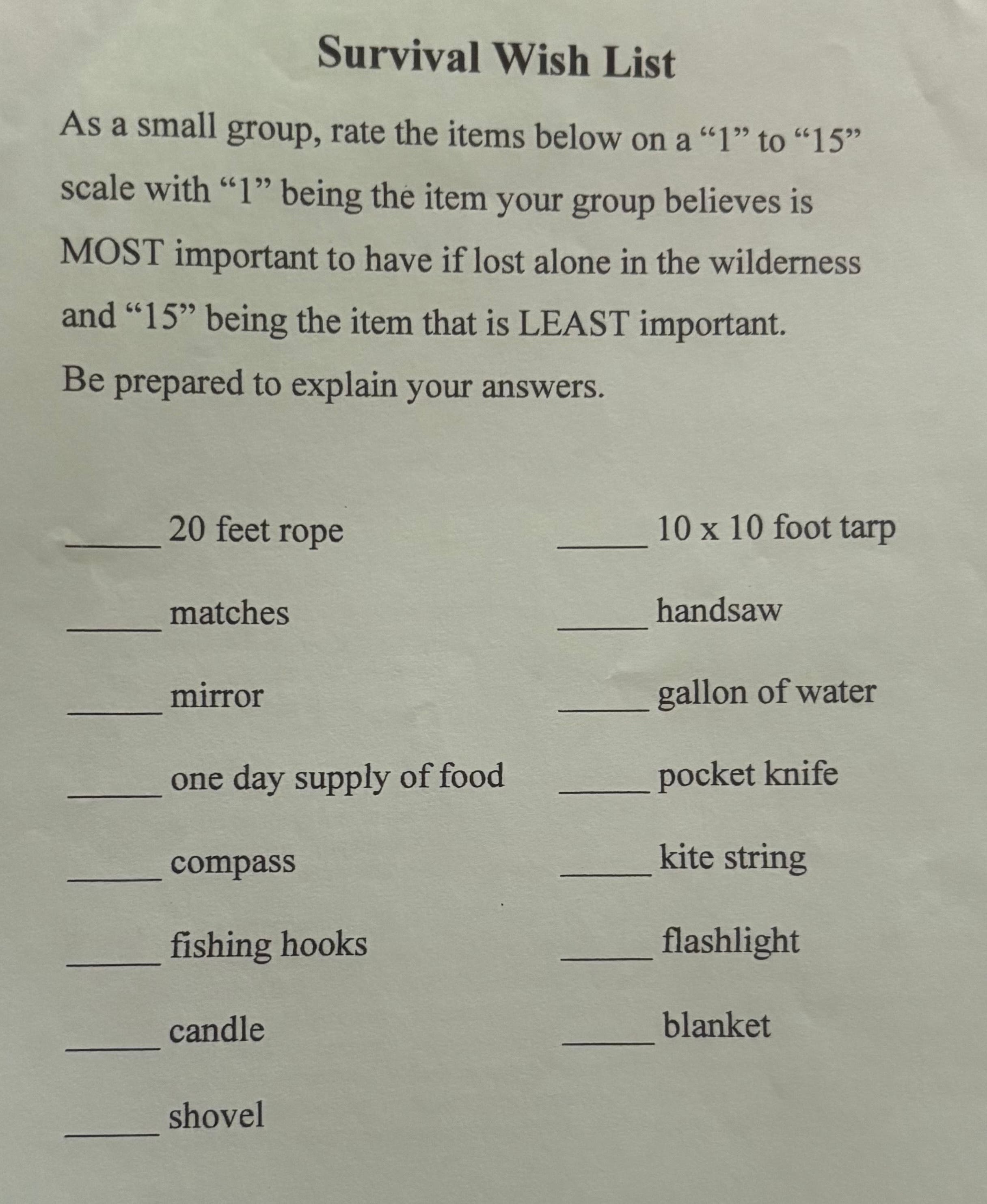
Each randomly selected small group got a handout—a “Survival Wish List” (below) of fifteen items to rank by importance, from a gallon of water to a 10x10 tarp with a candle. Every group, without fail, put food and water at the top. This was my cue to talk about hypothermia: a person can usually go several weeks without food, several days without water, but a single cold night without shelter can kill you outright. What good is having a gallon of water if you freeze to death before you even drink it?
That was the pivot to the main activity — build a shelter using only available “deadfall” wood in 30 minutes, no running, no throwing branches or logs. I told them the only “prize” for this competition was knowing your group made a fort that might keep someone from dying overnight. It was, for sure, a dark joke for that age group, and it landed exactly that way, with an awkward giggle, sometimes.
Next, I yelled, “OK, make those shelters!” and watched chaos happen on schedule: kids sprinting wildly in every direction, screaming like wild banshees, until I bellowed: “WALK…AND WORK TOGETHER AS A GROUP.” Like magic, students stopped running and gathered in small groups to start scouting locations for their forts. I spent the next 30 minutes wandering the pines, adjudicating squabbles, reminding students not to run holding sticks, occasionally nodding or shaking my head at a fort-in-progress, offering encouragement with comments like, “You guys are gonna freeze tonight…” or “Hmmm, that looks survivable, maybe.”
I was impressed with how seriously seventh graders took the activity. I remember often thinking, Damn, teaching in a beautiful pine forest with mostly engaged students is way more fun than the classroom. I could tell the kids felt that way too, unless, of course, the weather was cold and rainy, which, thankfully, didn’t happen too often.
At the five-minute warning, urgency would spike—more frantic running, thrown sticks, more admonishing—and then I’d blow a whistle, and we’d tour the shelters together as a full group. I already knew which shelter was the best, but I made the reveal as suspenseful as possible, more careful with my words, knowing early teens’ feelings bruise easily. I judged the fort, never the kids who built it. Besides critiquing each shelter’s construction, I also commented on the process I observed each group utilize to make their fort, pointing out what approaches seemed to work and what didn’t. I remarked that every fort was unique in its own way, even if you couldn’t spend the night in it without freezing to death.
After the judging, it was time for the kids to carefully tear apart their shelters, putting the woods back the way we'd found them earlier that day.
“Shouldn’t we make the next group work just like you did?” The kids understood immediately and took the take-down part of the activity just as seriously. The worst injuries I ever witnessed were minor cuts and a few bruises. In hindsight, I know how lucky that is.
Once we agreed the next group couldn’t easily tell where forts had been constructed, we headed out of the pine grove and across the meadow. Unless it was time for lunch, the kids journeyed on to their next activity, and I prepared to lead another group into the pine forest for another round of Wilderness Survival.
I participated in two other Outdoor Ed activities: the outdoor amphitheater bonfire and night hike. The bonfires on the first night were always fun, with teachers performing silly skits the kids always enjoyed — they loved seeing their teachers act foolishly. To that end, I often took the stage and led the large group in choral singing of wacky songs, including the 1950s Allan Sherman classic “Hello Muddah, Hello Fadduh.” It was good fun before hitting the sack to prepare for a short second day of activities, with the kids heading back home on the school buses.
The night hike had its own architecture. I’d meet a group at the boys’ lodge once it was properly dark, and march into the meadow — flashlights forbidden, my own headlamp worn, but seldom used. If it was a cloudless night, we’d be privileged by a show of stars some students had never witnessed living in a light-polluted suburban area near Chicago.
Once our eyes adjusted, I’d ask if anyone knew the difference between rods and cones. No one ever did, so I’d explain: rods and cones are the photoreceptors that convert light into the electrical signals our brain uses to enable vision. Rods handle dim light, movement, and shape. Cones handle color and fine detail and work best in bright light. There are roughly 126 million rods and approximately 6 million cones in each eye. The kids were, at best, mildly interested—they were either excited or scared about what came next. Teachers who hadn’t heard this spiel before were, of course, usually impressed with this fascinating information.
I loved being in the woods at night. Not every kid shared that feeling. It came down to trust—trusting the adult in charge not to lead them into danger. That’s easier said than done, of course, as my getting-lost-in-the-woods episode illustrates.
We’d head into the woods to the same pavillion from Wilderness Survival, break into small groups, and I’d hand out packets of colored paper cut into different shapes. The task: identify the color and shape using only the available natural light. Some kids stepped outside the pavilion hoping for a better angle. Others, often too spooked to move, stayed put. Unless the moon was bright and the night clear, most students couldn’t get the paper’s color and shape right—which was the point. We’d debrief standing there among the pine trees, tying it back to what we had just discussed about rods and cones, then pushing on, single file down a narrow dirt path through the forest, in pitch darkness.
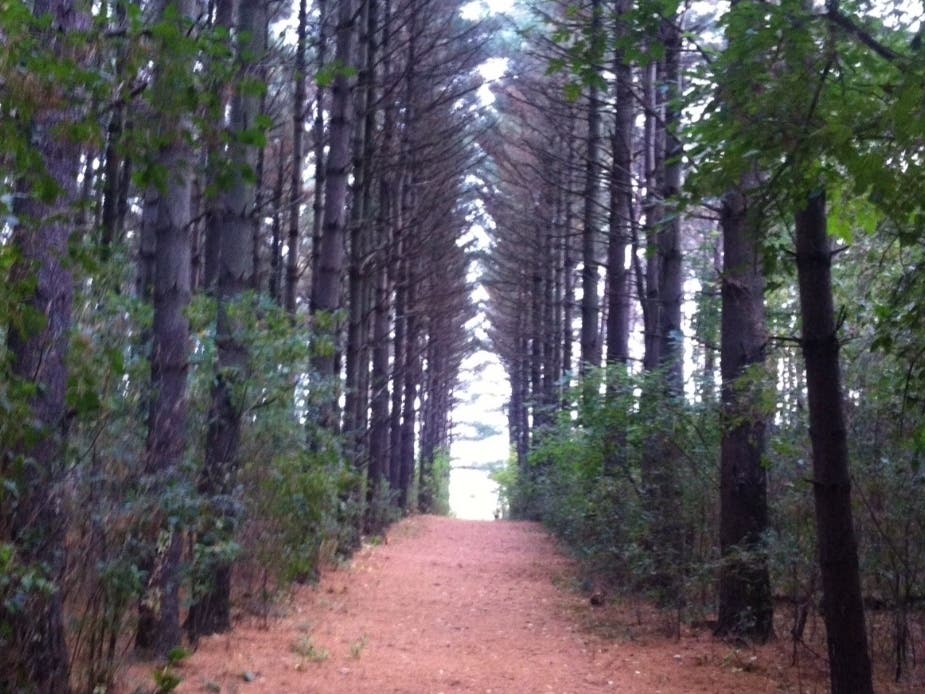
The best part of the night hike—for some, probably the highlight of Outdoor Ed—was the “trust walk.” This terrific team-building activity was staged in an area known as “Cathedral”: a gorgeous quarter-mile, pine-needle-covered path that ran gently uphill or downhill, depending on which end you started from.
I’d gather the group near the downhill entrance to Cathedral and preview the activity. Nervous energy ran through the kids in the darkness, which made perfect sense. We were standing in the middle of the woods at night with only ambient light.
I’d ask the group why they thought this area was called Cathedral. Even in the dark, natural light was enough to make out a path running through the tall, closely set pines, and someone usually landed on the answer. If not, I’d explain it.
Next, I’d lay out the rules: this was completely safe as long as students followed the directions. I’d walk ahead for about 100 yards and wait. The first student would follow 30 seconds behind me. The rest would follow, one at a time, 30 seconds apart, all the way through the group. They could trust the other kids and me to be waiting for them on the path, and trust the cone light receptors in their eyes to keep them roughly oriented on the path through the trees. No talking, the whole way through. I always had at least one other teacher with me, whose job it was to send each kid off, calm the nervous ones, and bring up the rear.
When each student reached me, I didn’t say anything — just a high-five or fist bump in the dark. The kids picked up the same non-verbal greeting for each other as they arrived, one by one. Only a few times was a student too frightened to walk the dark path alone, with another teacher accompanying them. I never lost a student on the trust walk. Not once.
Which brings me back to the time I got lost with a group in the Camp Edwards woods. I think about that evening more than all the nights that went smoothly, truth be told. Maybe it’s the one time the lesson I was teaching and what I was actually doing lined up so poorly — stand up in front of a bunch of 13-year-olds, explain how not to panic when you’re lost in the woods, then quietly panic while lost in the woods with them watching. I never repeated that mistake, and never forgot that a kid thought it was awesome.
I’m no outdoor expert, and I never pretended to be one. I knew enough — how different species survive the winter, how eyes work in the dark, how to get a group of frightened eighth graders out of the forest brambles and onto a gravel road — to run two engaging activities that I loved for nearly a decade, and to occasionally prove, in real time, exactly why those lessons mattered.
I’m hopeful students learned in Outdoor Ed that food and water are nice, but hypothermia is the real killer. And if they ever have to build a fort to survive the night: deadfall wood only, and, for gosh’s sake, no running, please.
Author's notes
I learned recently that seventh graders at the middle school where I used to teach no longer participate in Outdoor Ed at Camp Edwards. Sometime after I retired in 2014, that two-day activity was apparently reduced to a day trip and then, sadly, canceled. Former colleagues tell me the program was eliminated due to staff scheduling complexities, a valid concern. I’m told Outdoor Ed is now part of Elmhurst CUSD 205’s elementary school program, with fifth graders traveling to Stronghold, a retreat and camping center near Oregon, IL, for an overnight adventure accompanied by their teachers. I’m glad Outdoor Ed is still part of the school district’s curriculum in some form. At the same time, it’s disappointing that Elmhurst’s middle school students are now deprived of a special, unique Camp Edwards experience each fall because of staffing logistics. It’s a shame, but — hey, as we all know, life ain’t fair.
••••••••••
The “Survival Wish List” graphic and a photograph of “Cathedral” are original photos.
This piece is Chapter 48 in Dave Venetucci’s memoir, “Mr. V’s Life & Times — An Event-Driven Memoir,” scheduled for publication in 2027 by New Book Authors Publishing in Madison, WI.
Get more local news delivered straight to your inbox. Sign up for free Patch newsletters and alerts.