Research shows promoting social and emotional learning, reduces violence and aggression among students(Cooke, M.B., Ford, J., Levine, J., Bourke, C., Newell, L. & Lapidus, G., 2007). Teaching students these social-emotional skills can also build higher academic achievement, creating an improved capacity for them to absorb information in school.
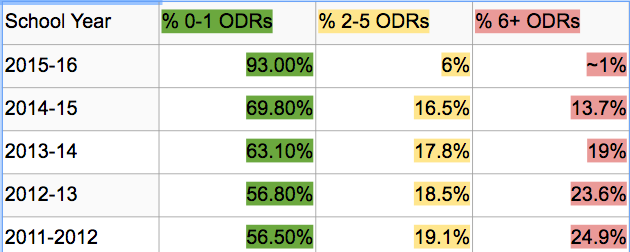
“We’ve had lots of meetings and conversations regarding consistency, celebrations, and disciplinary consequences,” said Evergreen Park Elementary School D124 Superintendent, Dr. Robert Machak. “Over the last four years, the number of students who have received either zero or only one ‘office discipline referral’ ODR (in green highlight) has gone up every year - an increase of almost 37% over the past four years - while the number of students earning multiple (yellow) or chronic (pink) office referrals has decreased annually over that same time.”
“We began to see a shift in our ODR once we put a District Leadership Team in place to evaluate the fidelity of the data we were collecting,” said District 124 Positive Behavior Interventions and Supports/Social Emotional Learning (PBIS/SEL) coach, Patty Johnson.
Find out what's happening in Evergreen Parkfor free with the latest updates from Patch.
“Looking at trends across the entire district has allowed us to plan and predict areas of weakness and then act accordingly to provide support.”
Johnson noted that just before or after seasonal breaks in the school calendar were typically periods where, overall, the district would see a spike in ODR. With that information, the district has implemented “refreshers” for students, mini-lessons on the importance of making the right choices.
Find out what's happening in Evergreen Parkfor free with the latest updates from Patch.
“Our Second Step, social and emotional learning curriculum teaches five competencies,” said Johnson:
· Self-Awareness- recognizing ones emotions
· Self-Management- regulating ones emotions
· Social Awareness- Empathy for diverse backgrounds/cultures
· Relationship Skills- Establishing/maintaining relationships
· Responsible Decision Making- Making constructive/respectful choices.
She explained further, “The lesson units are led by social workers whom go into the classroom while the teacher is present to provide direct instruction from over 20 categories.”
In addition to the PBIS Leadership Team and Second Step, SEL curriculum, having a PBIS/SEL coach in the district has proved to be beneficial.
“With all the initiatives, pilots, trends, and fads of which we are all aware in Public Education, it can be easy for teachers to get frustrated and wonder if all the things they’re being asked to do is making a difference for the students,” said Dr. Machak. “The fact is that our PBIS/SEL work is paying off, and we can see the results in classrooms across the District every day.”
Johnson said she feels being able to provide on the spot coaching makes a difference. ”I’m able to work with teams of teachers to provide training on the spot. Positive supports aren’t delayed by them having to go out of the district.”
She’s also been able to measure the fidelity of the data. “It wasn’t being evaluated on a regular basis and certainly not at a district level,” said Johnson. “Our DLT meets January, March and May and each school has a PBIS team that meets monthly. They’re always looking for parental involvement- parents represent the voice of the community, those interested should inquire with their building principal.”
Dr. Machak swelled with pride about the positive direction of D124. “The changes our teachers have made in their classrooms and in their approach to working with students have helped create more engaged, positive, and peaceful schools across the District,” said Machak. “With the steady improvement in student behavior, we can spend more time focusing on teaching and learning in the classroom.”