
WILL TOWNSHIP – When Paul and Teresa Kwaitskowski bought their home 27 years ago, they also bought a piece of history.
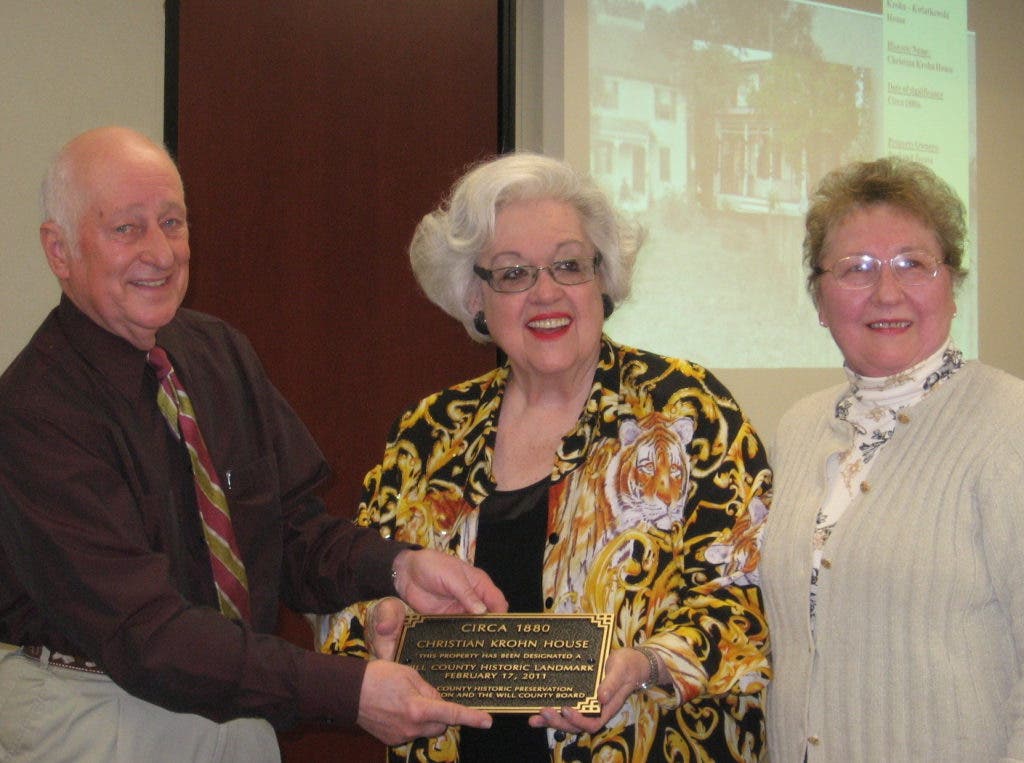
Known as the Christian Krohn House, it recently received County landmark status. The recognition was recommended by the Will County Historic Preservation Commission and approved by the Will County Board. The couple was presented with a bronze plaque to commemorate the historic significance of their home on the Will-Kankakee Counties border during Preservation Month in May.
The house, at 4708 W. County Line Road, was deemed significant due to its architecture. The design is reflective of the Italianate architectural style, which was one of the most popular building styles in the mid-1800s, popular from 1850 to 1880.
Find out what's happening in Frankfortfor free with the latest updates from Patch.
But it also may have ties to the Civil War and mobster Al Capone.
Christian Krohn is said to be the first German Catholic in the area, said Paul Kwaitskowski. It’s also believed that Krohn served in the Civil War, but Paul hasn’t been able to confirm it.
Find out what's happening in Frankfortfor free with the latest updates from Patch.
The house is unique in that it has two front doors. At one time there was one central stairway that led to four bedrooms upstairs. At some point prior to their ownership, the stairway was moved, leaving the Kwaiskowskis with three bedrooms upstairs and one down.
The home is missing the fence of the widow’s walk upstairs and the original shutters have been replaced.
The couple had a big surprise when they installed cupboards in the kitchen. As Paul was drilling he hit glass. Melted glass.
Apparently, the summer kitchen – a popular feature when the house was constructed – burned and a one-room schoolhouse was brought in and attached to the house as a replacement, Paul said. “They’re two very, very interesting buildings.”
The Krohns lost the house in the 1880s. Christian died in 1888. His widow, Dorothea (nee Benning) Krohn lived until 1924.
In the 1920s, during Prohibition, the house changed hands many times, Paul said. It’s during that tenure that it’s rumored that the house was used by Al Capone and his gang.
Whoever lived on the 2.89-acre site, did so in “opulence,” Paul said. The home has hot and cold running rainwater, collected in a 3,000-gallon cistern. It also has a cast-concrete modern basement.
The home is so well insulated that despite having no heat upstairs, the bedrooms don’t get too cold or too hot to be comfortable.
He has not found the underground tunnels rumored to be on the property or a still. But he has found electrical conduit pipes that run underground that could have been used to power the bootlegging operation.
He also found a gold baby bracelet with the letters “AC” engraved on the inside. For Capone’s son Anthony, perhaps, Paul wonders.
Paul plans to keep on researching, trying to find out more about the property and especially Christian Krohn. “I’m living in his house and I’d love to know more about him.”
Landmark designation
The Christian Krohn House is one of 41 landmarks designated in Will County since the County’s 1992 historic preservation ordinance was established. It joins a diverse array of landmarks, including bridges, barns, cemeteries, and churches.
“On behalf of the Commission, I commend the Kwiatkowskis for taking the step to protect their home for future generations. I remain grateful to them and to all of our property owners who have landmarked their properties,” said Historic Preservation Commission Chairwoman Virginia Ferry. “Through this action, Will County property owners continue to show the relevance of historic preservation and how it matters to them and to their communities
Typically, a property must be at least 50 years old to be considered “historic;” however, to be deemed historically significant, a property must meet at least one of the ordinance’s 12 criteria related to historic, architectural and archeological significance.
Securing a spot on the County’s register provides greater assurance that the properties will be protected for future generations. Upon landmark designation, properties become eligible for funding opportunities such as the Illinois Tax Assessment Freeze Program for Historic Residences.
Additionally, the Commission reviews exterior alterations that could alter the historic appearance of a property. Such changes might include siding replacement, window replacement, roof replacement, or additions. Changes such as paint or doorknobs do not require the Commission’s review. Nor do interior changes.
Will County Executive Larry Walsh said, “I congratulate our landmark property owners who have taken such a proactive approach to preserving Will County’s rich heritage. Through their pursuit of landmark designation, County citizens continue to demonstrate their care for and commitment to preserving our wonderful heritage.
“I encourage all Will County citizens who own historic properties to consider the benefits and pursuit of landmark designation. Through continued efforts, we can be assured that our heritage will remain celebrated and protected for generations to come.”
Paul and Teresa enjoy their historic home and learning about those who have lived there before them.
“It’s a fabulous house, and it’s a great place to live,” said Paul. “We’ve never regretted it.”
For more information about Will County’s historic landmark program, go to www.willcountylanduse.com/HPC .