Arts & Entertainment
Zombies Invade U.S. Cellular Field at Odyssey Fun Farm
The sand-sculpted artwork depicting U.S. Cellular Field was painstakingly crafted by a Mokena resident and L-W District 210 grad.


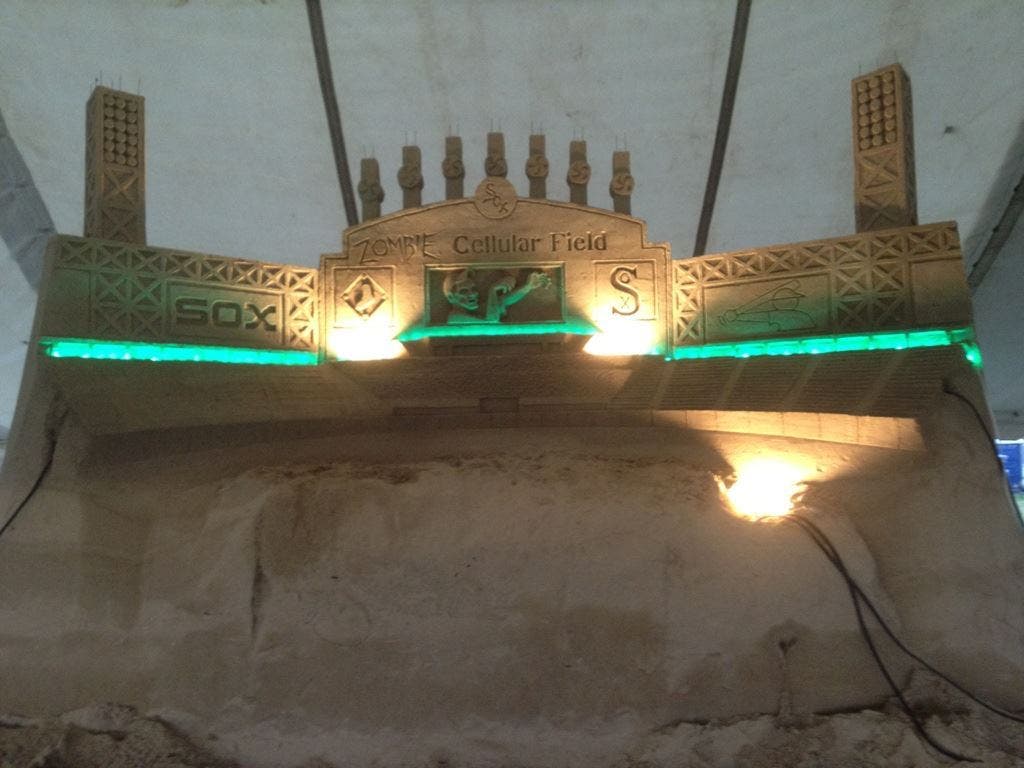
U.S. Cellular Field has been overrun by zombies, in a sand sculpture created by World Champion Sand Sculptor Brian Turnbough at Odyssey Fun Farm, 19111 S. Park Avenue. It took Turnbough 20 tons of sand—and 11 days—to complete the masterpiece.
Mokena resident Turnbough used his 14 years of experiencing molding sand and water to craft the project, which vividly depicts the park’s scoreboard, complete with a zombie on the big screen. The champion creator’s work is just the latest in a string of impressive sand sculpting successes.
The Lincoln-Way Central grad has worked with and competed against many of the world’s best sand sculptors. In 2011, he took first place in the American Championships of Sand Sculpture in Ft. Myers Beach, Florida. In 2013, he and his sculpting partner Joo Heng Tan of Singapore took first in the doubles division at the World Championships of Sand Sculpture in Atlantic City, New Jersey. In addition to sand sculpting, Brian also creates murals and painted artwork for homes and businesses around the Chicago area as owner of his company Walls With Imagination.
Find out what's happening in Frankfortfor free with the latest updates from Patch.
So how did he do it?
First thing’s first! Please don’t touch the sand sculpture or throw any objects at it! Although the sculpture looks very big and solid, any contact will damage the fine details of the carving!
The sculpture is made entirely of sand and water! The best sand sculptures are made from a type of sand that contains some silt-like sand from a river bed or a quarry. This silt has a small amount of clay, unlike sand from an ocean beach which has had all of the clay washed away. Even after it dries out, this sand will retain its strength!
Find out what's happening in Frankfortfor free with the latest updates from Patch.
At the beginning of the project, the sand is placed in strong wooden forms, similar to concrete forms. Then the sand is watered and vigorously compacted using plate compacter machine similar to a jackhammer. As each level is completed, a new form is added, then filled, and compacted. When the wooden forms are removed, a solid block of sand is exposed and then carved to create the artwork you see before you! It’s all about compaction.
No really. HOW did he carve it?
Sand sculptors use all kinds of tools to make their sculptures, but most use a combination of concrete trowels, pastry knives, pallet knives, shovels, and custom-made specialty tools. Sand sculptors often have diverse backgrounds in various art forms, architecture, or even construction, and they each use their individual knowledge to influence their unique styles.
How long until it becomes dust in the wind?
A sand sculpture that is protected from the weather can last for months, or even years. Wind, rain, and freezing temperatures can damage a sculpture, but an indoor sculpture that is protected from the elements and from human interference can last a very long time.
Sculptures that are not created under a tent, as this one is, are often subjected to rain and wind but you would be amazed to see how resilient they are. The sculpture weighs many thousands of pounds, so it isn’t going anywhere! A light rain will not do any damage to a sculpture. A heavy downpour with wind can sometimes wash away the detail of a finely carved sculpture and cause it to look “pockmarked”. It is possible to spray an outdoor sculpture with a thin mixture of wood glue and water in order to help preserve the outermost details in heavy rain, but it is not a foolproof solution, and an outdoor sculpture will not typically survive longer than a couple months.
Odyssey Fun Farm Hours
Open daily, 10 a.m. to 6 p.m., Sept. 27–Nov. 1
Closed Tuesday, Oct. 7 and Wednesday, Oct. 8
Get more local news delivered straight to your inbox. Sign up for free Patch newsletters and alerts.