Arts & Entertainment
In Their Own Words: Geneva Father, Son Are Both Published Novelists
Father and son authors Eckhard and Ulysses Gerdes compare writing, books and process.
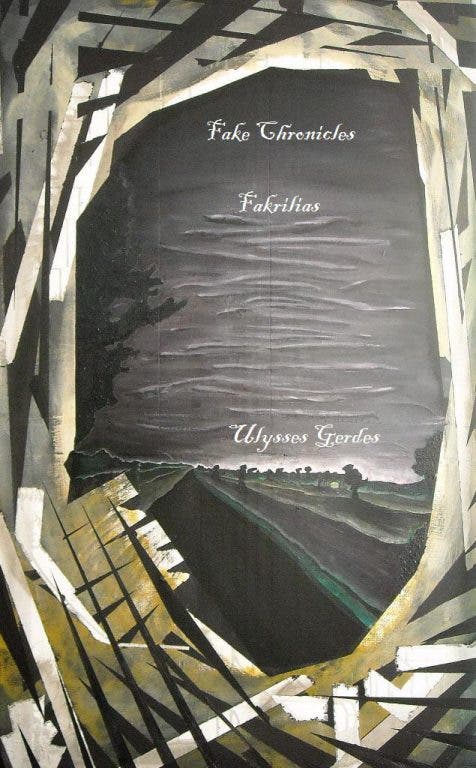


A note from the editor and authors: Eckhard Gerdes and his son are both novelists living in Geneva. Eckhard recently published his 10th novel, a humorous literary work, Hugh Moore, which is published by Civil Coping Mechanisms, a small press based in Niles, MI. (See www.copingmechanisms.net.) Eckhard's son Ulysses is 15 years old, and his novel, a work of dark fantasy, The Fake Chronicles: Fakrilias, was published recently by Shadow Combustion. (See www.experimentalfiction.com.)
Eckhard e-mailed me with that note, so I asked him to try a different approach to telling this father-and-son story. They decided to interview each other, and the result is the Q&A you see here.
For the record, Eckhard also is an adjunct English instructor at Elgin Community College, College of Du Page and Triton Community College. His son attends Geneva High School.
Find out what's happening in Genevafor free with the latest updates from Patch.
* * *
Eckhard: I guess I’ll begin this. Ulysses, you call your work “dark fantasy.” What do you mean by that? Who influenced you, and what is your joy in working in this direction? Do you think being a young novelist is an advantage or disadvantage in connecting to this kind of material?
Find out what's happening in Genevafor free with the latest updates from Patch.
Ulysses: Dark Fantasy is the expression of fantastical material without easing up or censoring certain horrid events or actions, such as death and war. I started in this direction mainly on my own, although I was very inspired by the works of Zack Snyder, J.R.R. Tolkien, and Christopher Paolini, all of whom do not slack in displaying the hardships of their characters and the story.
Being young isn’t an advantage or disadvantage; on one hand, as a younger writer I can easily implement these elements and work with them; however, on the other hand, being younger can also mean one does not know how to display the darkness of their writing in certain areas.
Dad, you began writing in college with The Million-Year Centipede. How long prior to writing this did you know you wanted to be an author? Was there anyone who directly inspired you to take the course of being an author?
Eckhard: Your grandfather has always said that I grew up in a library with sleeping privileges. Growing up surrounded by these miraculous objects known as books, each containing its own universe of ideas, deeply impressed me. I knew early on that I wanted to make books. I started writing a novel in sixth grade with a friend of mine, and I then began writing poetry.
In junior high and high school I must have written a thousand terrible poems. One of my teachers, after reading my poetry, said to me he wondered if perhaps my talent didn’t really lie in prose because, as he said, my poetry was so narrative. I saw his point, started to connect my poetic impulses, and called it fiction.
When you are writing, do you “see” the events taking place? I love how your novel is filled with interesting visual details. Would you say the visual is your primary sense?
Ulysses: I do not “see” the events take place as much as I “sense” them. I feel something going on, and I write it down. I am blind in the world of my writing, but still can detect what is happening around me. That being said, I don’t try to make the visuals the most important method of relaying the story, rather I try to make the feel of it the most important.
I try to be lax when describing something, in order for the reader to get a feel to it themselves. As shown in my novel, I tend not to thoroughly describe my characters, except for certain defining features. This allows the reader to “see” the world in her or his own eyes as he or she would, but also detect it and feel for it as I would.
Why do you write experimental fiction as opposed to other, more mainstream genres? Do you feel that experimental fiction fits you better as an author?
Eckhard: Actually, experimental fiction is the only writing that is not a genre. It defies genre just as it questions everything else. I am a big advocate of Ben Franklin’s idea that "it is the first responsibility of every citizen to question authority."
I also believe in the power of the individual. So I always look at a piece of writing with one question in mind: Is this something that only this person, of all people on Earth, could have written? I think the best writing is unique. It has the imprint of its creator on it, and that interests me much more than cookie-cutter Sally-kisses-Sam fiction.
Do you move the characters like chess pieces, or do you let them move on their own and just follow along and write down what they do?
Ulysses: I don’t believe a true writer moves his or her character. A true writer doesn’t make the story; he or she relays it from his or her mind to the paper. The writer’s the messenger from this world he or she alone has detected, and thus the characters are all alive inside his or her head moving about freely, without interference from the actual writer.
How do you view yourself as an author? You do not write for the general public, instead you write for the experimental fiction community. Do you feel this has shaped you as an author?
Eckhard: I use a mirror. No, actually, I do write for the general public. Unfortunately the general public has been systematically brainwashed by ill-informed albeit well-meaning teachers who tell students that there’s only one way to read and one way to write. I understand that they do that in order to dumb concepts down for their lesser students.
It’s like the math teacher who tells students that parallel lines never meet. That’s hogwash, of course, unless you believe that we are living in a flat, two-dimensional plane. But the teachers figure that their students aren’t smart enough for 3D mathematics. I write 3D fiction, which everyone should be able to read. I think of the novel Ulysses by Joyce, the book for which you are named, and I always marvel that people think it is elitist or difficult when in truth it is the perfect novel for the common man.
What are some of the major themes you pay attention to in your writing?
Ulysses: I tend to use realism within my novels. Yes, it is a fantasy series, but I try to make a character as real as possible, with how they think, act, and speak. I don’t have them as brilliant, all-powerful and wonderful people, as those are few in life. I give them each strengths and weaknesses and see how these affect them in their travels. As well as realism, I try to give a certain bitterness to the world.
The citizens of my novels live in a world full of violence, corruption and death, and because of this the people tend to be stronger, tougher, and not so morally obligated to set a higher standard of ethics.
Scuff Mud is an interesting addition to JEF (Journal of Experimental Fiction). Instead of doing another published book, you turned to spoken word and alternative, creative music. This was also present in Attoho. Do you feel that Scuff Mud and Attoho were creative improvements, or were they merely different directions for JEF?
Eckhard: I have always enjoyed reading my work in public. Getting instant feedback is a rare treat for a writer, and it is valuable. But also my literary heroes, Kenneth Patchen, Raymond Federman, Jack Kerouac, and others, put out such wonderful recordings that I wanted to do that as well.
It’s not a replacement for the writing, but it is an augmentation, a furthering. It gives the reader a different way to connect to the material. Plus recordings with musicians, such as the Scuff Mud recordings, which were done with Omaha’s Shelf Life, are wonderfully collaborative projects.
I really enjoy interacting with other artists. Writing can be a very lonely, isolating profession, so artistic interactions are invaluable. Thank goodness there are places like in Geneva that support independent music the way Town House Books in St. Charles supports independent literature.
What does writing mean to you?
Ulysses: Writing is the means by which one can tie this world to the worlds inside one’s head. It is the means by which one can move what one thinks into reality and do so in a perfect manner. It is the purest form of art, the base form of expression, and the overall most brilliant means by which one can leave this plain and go to another.
Aasvogel as well as Parkour on Mars, your current in-progress novel, seem to be reaching more toward the general public rather than being isolated to the community of authors you find yourself in. Was this done deliberately or is this merely a coincidence? You keep many elements from your previous works in these two novels. Do you feel they are a new direction for your writing?
Eckhard: Well, I guess they are more character-driven than some of the earlier works, and the story might be a bit more interesting. You don’t get to be my age without learning a few tricks. It’s not a conscious decision, really, but reflects, perhaps, a general change in my sensibilities.
What do you think literary art should do?
Ulysses: The literary art and literature itself should give what another cannot. Concepts and stories are meaningless; they have all been used before. It is near impossible to come up with an original concept, and thus the job of a writer and literature has become more sacred.
A book should be a prophet from an unknown world. It should spread its word deep into our hearts and perform miracles within our minds. We should never read a novel and think, “I’ve read something very similar to this before,” because then the novelist and the novel itself would have been a failure. Essentially, the duty of the literary art is to continuously innovate, time after time, in order for expression and creativity to live.
The Aasvogel tetralogy seems to be where you are moving at the moment. What direction do you believe you will go from there? Will you change to write in this more public way, or will you return to writing for the select few?
Eckhard: Every project takes on a life of its own that I cannot predict. All I can do is commit myself to the project and then go forward from there. Because the tetralogy is going to be occupying much of my time, that’s the only novel project I have going. At this point I have no idea what I am going to do with fiction beyond that. I am going to do a great deal more with the Journal of Experimental Fiction, not only with the annual anthology, but with the book series I am publishing.
Books by Frederick Mark Kramer and Dominic Ward have been recently published, and others by James Hugunin, Brion Poloncic, Erik Belgum, and Robert Casella are coming soon.
Do you prefer to write longhand or on the computer?
Ulysses: I enjoy both. At a certain point, I stop writing longhand and focus mainly on typing; however, with longhand you can accurately portray your story, and then touch it up on a computer. I constantly change what I wrote longhand on the computer, seeing what I wrote longhand as inferior. Longhand allows you to see your story, and typing allows you to fix it.
Attoho and Scuff Mud are very innovative in terms of spoken word and music. !Evil Scuff Mud has recently been published under another label. Will you continue to release albums such as those two as JEF?
Eckhard: Bryan Day and I together did a lot of work on Scuff Mud and then on !Evil Scuff Mud. It just kind of made sense to release the first one as a JEF publication and the second on Bryan’s Eh? Records label, which is a subsidiary of his Public Eyesore Records label. Attoho was a project Portland writer and performance artists Mike Daily and I worked on for a while, but I think he’s too busy these days to do a second. I’m slowly gathering material for Attoho 2 on my own. I definitely want JEF to continue to have a presence in spoken word recordings.
Is the art in the doing of the work, or is it the product of the work?
Ulysses: Both. The journey is always brilliant, and one always learns things along the way, and after the journey is over one realizes what one has been through and can analyze this. Both are the core essence of art and passion. Without the two processes the journey would be meaningless.
Dad, you have recently developed the Kenneth Patchen Award. If met with success, how far will you expand this? Do you believe that through this award, you may be able to expand the experimental fiction community to new heights? Where will this award take us?
Eckhard: Well, first of all, I owe Kenneth Patchen a huge debt for my own writing. What an inspiration his work is! Anything I can do to keep his work and legacy vital is important to me to do. Miriam, his widow, bless her soul, very kindly and generously gave me a foreword for Hugh Moore a few years ago, so that is another deep connection I want to honor.
I would love for the award to inspire people to write their books the way they want to write them and stop writing like finger-puppets being controlled by literary control-freaks who believe all writing has to be generic.
How should a reader approach your book, Fake Chronicles: Fakrilias?
Ulysses: With an ability to contemplate what is going on. With my writing, the novels are never the whole story. Something happened before what is going on, something will happen after, and something is happening simultaneously to the event described. The story has many different plot elements, side stories, and characters, all of which are thoroughly developed
I do not usually go into much depth of what has happened in a character’s life unless they are one of the main characters, but for each one, even for characters appearing only on a single page, I have extensive back stories, events, and personalities for them. A reader must be ready to have these stories thrown at them and to find that one of these past tales may very well affect the main story line.
Lastly, being the founder and runner of beloved JEF Books/Depth Charge, where do you think the company is headed? It is already well known within the underground movements of experimental fiction and bizarro fiction, but do you believe it will achieve mainstream popularity at some point? Even with that aside, in which direction do you want to take it and how do you wish to expand JEF as well as experimental fiction?
Eckhard: I think much of what we publish is actually far more accessible to the common person than the run-of-the-mill MFA cookie-cutter stuff is that is produced by elitist trust-fund kids who are trying on fiction writing like it’s a new cashmere sweater. I can’t wait for things to heat up so that those trust-fund kids lose interest in writing and decide instead that they want to be professional golfers or polo players and leave fiction writing to those who are dedicated to more than the money it can generate.
If we could strip away the elitist lies, the regular person who see that this kind of writing is directly for him or her. That, I think, will make it inevitably successful. You can’t keep the populace down forever. You can’t force them to eat pabulum for the rest of their lives. They want full meals, too. We offer full meals. The currently popular fare is all cotton candy. Cotton candy is OK, but you can’t survive on a diet of it.
Your novel is the first in a series. Can you tell us a little about the books to come?
Ulysses: The series will continue its path of being dark and strong. I don’t wish to go into much detail, but we will see many characters added, some taken away, and wars and deaths go by quickly. The series has a very exciting future. There are many secrets within the world, and many of these will be uncovered in the next couple of novels.
But, as with some novels and stories, the problem is the concept of a single vile entity. I have several, many in fact, vying over power, many of whom are at the same point and in the same area.