Health & Fitness
Be safe: Learn how to tell when you need new tires
Tires that are worn or are in poor condition affect your vehicle's safety and handling. Here are some tips for knowing when you need new ones.

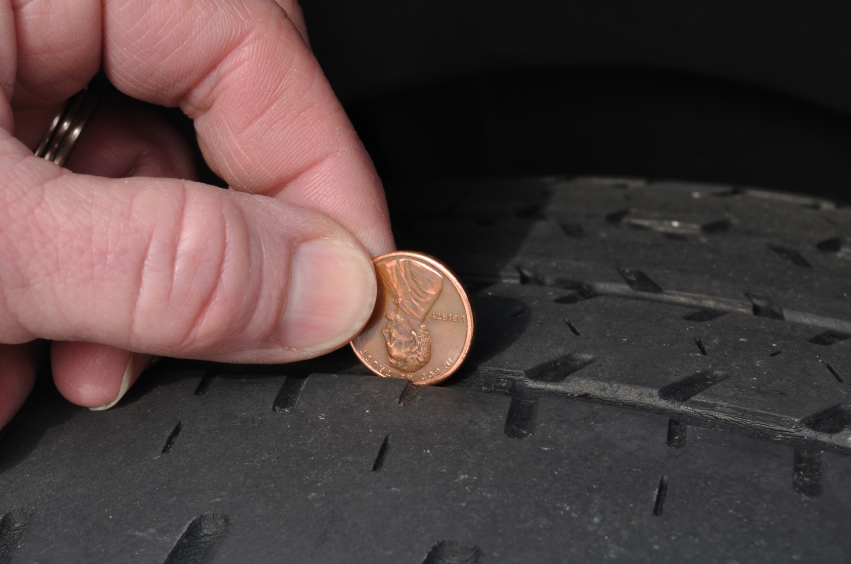
Question: My tire tread looks fine to me, but my coworker made a comment the other day about needing new tires before winter. How can I tell when it's time for new tires?
Answer: Tires can last anywhere from 30,000 miles to 80,000 miles. And how long they last depends on your vehicle, your driving and braking habits, road conditions, and how old the tires are (regardless of miles driven).
Here are several ways to determine if you need new tires.
Find out what's happening in Glenviewfor free with the latest updates from Patch.
1. Check the tread depth. Legally, you must have 2/32 inch tread on the tires, which you can check with a penny. Place a penny into several tread grooves across the tire. If part of Lincoln’s head is always covered by the tread, you have more than 2/32 inch of tread depth remaining. But a new study shows that it’s safer to conduct the same test with a quarter instead, which provides 4/32 inch tread depth.
Wonder how much difference the different tread depths make? The Tire Rack team measured the stopping distances from 70 mph with vehicles equipped with sets of new tires and compared them to tires with about 4/32" of remaining tread depth and sets with the legal minimum of 2/32" depth. Vehicles equipped with the 2/32" minimum tire tread depth took about 100 more feet to stop and were still traveling at about 45 mph at the same distance the vehicles equipped with the 4/32" deep tires had already come to a complete stop.
Find out what's happening in Glenviewfor free with the latest updates from Patch.
2. Check the tread wear indicators. Most tires have these bars of hard rubber that appear across the treads as the treads get worn down. When these bars are flush with the adjacent areas of the tire, that means you have 1/16th of an inch of tread left, which is the legal limit in most states. When you start seeing those bars become more obvious, it's time to think about new tires.
3. Beware of bulges, bubbles or protrusions of any kind. A bubble in any part of the tire indicates that the inner liner has been damaged to the point that it's allowing air to escape. This means there's not much between you and a blowout. It's a major safety issue that should be addressed immediately.
4. Don't forget the sidewall. Check for tracks, cuts or grooves in the sidewall, which could mean the tire is developing a leak or is about to blow out.
When you need new tires, purchase a set of four tires at CARS and you’ll get free lifetime tire rotations and free tire repairs.*
As a CARS’ client, you’ll also receive a free annual wheel alignment inspection, which helps ensure you maximize the life and mileage of your new tires.
*Up to six years and 2/32 tread wear. Any tire with less than 2/32 of tread is beneath industry standards and should be replaced
Brian Blohm is the Service Manager and Managing Partner - Operations CARS of America in Glenview. He is an ASE-Certified Automotive Service Technician and ASE-Certified Service Advisor with more than 25 years of automotive experience. A graduate of Triton College with an associate's degree in Automotive Technology, he has continued his training and education with the Automotive Training Institute and RL O'Connor. You can reach Brian via email at brianb@carsofamericainc.com or by phone at (847) 961-4363.