Politics & Government
North Shore Towns To Save Money With New Community Solar Project
Local governments subscribed to Illinois' first community solar project are guaranteed 10 percent savings off retail electricity prices.


ELGIN, IL — Six North Shore towns subscribed to the first community solar project in Illinois will see discounts of 10 percent off retail electricity prices for all power they purchase from a recently completed rooftop installation in Elgin for the next 20 years.
The 3,730-panel Rainy Solar array that came online in August is connected to the ComEd grid and will create an estimated 1.3 million kilowatt hours every year. That means it currently generates about 1.2 percent of all solar power produced in Illinois and offsets the equivalent of the carbon dioxide produced by burning more 1 million pounds of coal, according to its owner.
"We are proud to have the first built and operated community solar project in the state. Community solar will be a key driver in the new energy economy In Illinois," Rainy Solar CEO Ken Buckman said in a release.
Find out what's happening in Highland Parkfor free with the latest updates from Patch.
The array will provide power to Elgin, as well as Deerfield, Glencoe, Glenview, Highland Park, Lake Bluff, Lake Forest, Oak Park and Park Forest, Buckman said. The project was built on spec by his Elgin-based company before it was selected in a lottery program administered by the Illinois Power Agency earlier this year, one of 78 out of 433 proposed community solar projects in ComEd territory to receive state funding in this year's funding cycle and the only one that has already been built.
The framework for community solar projects was established in the Future Energy Jobs Act, adopted by state lawmakers in December 2016. The act allows consumers of electricity to receive net metering credits against their monthly bills for all power generated through new renewable energy sites, including community solar projects — mid-sized solar facilities shared by multiple subscribers.
Find out what's happening in Highland Parkfor free with the latest updates from Patch.
The agreements signed by suburban municipalities taking part in the pilot program guarantee 10 percent savings on all energy purchased through the program, even if market rates for electricity change. Local governments can pull out of the arrangement with 30 days notice at no cost.
According to staff memos, Deerfield and Highland Park anticipate saving $9,000 every year — or $180,000 over the 20-year term of the agreement — by purchasing about 150,000 kilowatt hours every year. Highland Park has subscribed to purchase 15 percent of the project's electricity and Deerfield has signed up for 14 percent, according to Buckman.
Glenview has subscribed to 13 percent of the Rainy Solar project, but has so far only signed up one of its nearly two dozen municipal accounts. An analysis from the Metropolitan Mayors Caucus found the village could save from about $6,800 to $20,500 every year if it eventually manages to subscribe all of its accounts to community solar projects.
Village officials in Lake Bluff, which subscribed to only about 1 percent of the project's output, expect to save an average of $615 a year over the life of the agreement, according to a release from the village.
"This is a practical way for Lake Bluff to help our environment and act as good fiscal stewards at
the same time," Village President Kathy O'Hara said in the release. "We appreciate our many partners in government and industry who facilitated this groundbreaking project."
City officials in Lake Forest expect to save as much as $375-a-year, on average, over the life of the agreement. The city is signed up to buy 4 percent of the project's electricity output — enough to power eight homes for a year.
Lake Forest Mayor George Pandaleon said in a release that the city's participation in the pilot program demonstrates its commitment to regional collaboration on sustainability initiative.
"For nearly the past decade, the City of Lake Forest has partnered with other communities on the North Shore to promote renewable energy initiatives, and we are delighted to be among the leaders to promote Community Solar and participate in this project," Pandaleon said. "It will not only save tax payer money, but will support the growth of solar energy businesses in Illinois."
In Glencoe, which has subscribed to 11 percent of the project's electricity, village officials expect to be able to cover about 10 percent of the village's annual municipal energy use for things like street lights, traffic signals and operations at Village Hall with carbon-free renewable energy from the new Elgin solar array. A village spokesperson has yet to respond to a request for information about how much annual savings it expects to realize, but future community solar opportunities could allow the village to have up to 22 percent of its energy load covered by shared solar power, according to a release.
Elsabé Schimmelpenninck van der Oije said the village sustainability task force she chairs is enthusiastic to be among the first local governments in the state to subscribe to a community solar program.
"Glencoe is committed to encouraging environmentally sound and economically viable practices," van der Oije said in a release. "We look forward to future opportunities to further reduce the carbon footprint of our local government bodies, businesses and residences."
Outside of the North Shore, Oak Park has subscribed to 14 percent of the project's power, Elgin signed up for 13 percent and Park Forest will receive 9 percent, according to Buckman, the serial entrepreneur behind the Rainy Solar project.
The Metropolitan Mayors Caucus partnered with the Power Bureau to help implement community solar plans by creating a pilot program allowing municipalities to take part. Local governments are ideal customers for such programs because, unlike residential or commercial electricity consumers, they rarely relocate and provide a relatively large and stable energy demand.
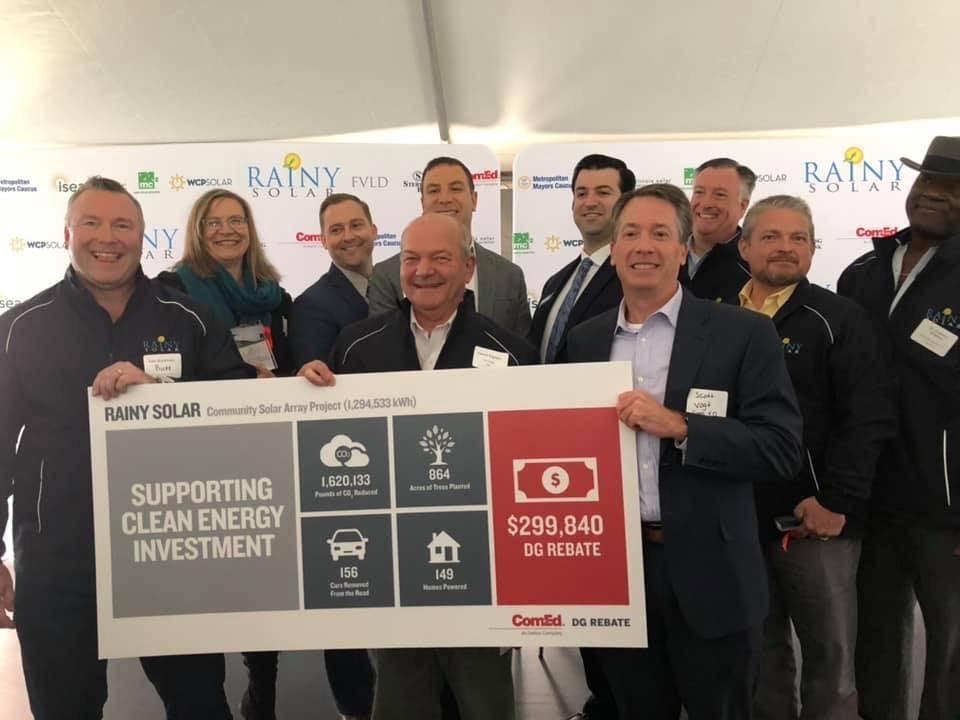
Rainy Solar held an event Thursday morning at the Elgin solar array to dedicate it as the state's first community solar project. Municipal customers will begin receiving solar power from its panels as soon as their paperwork is processed.
Get more local news delivered straight to your inbox. Sign up for free Patch newsletters and alerts.