Politics & Government
Pritzker Forms Pension Task Forces Ahead Of First Budget Proposal
The governor wants recommendations on pension fund consolidation and using state assets to reduce over $135 billion in unfunded liabilities.


SPRINGFIELD, IL — As he prepares to present his first budget proposal to lawmakers with next week's State of the State address, Gov. JB Pritzker Monday appointed leaders to a pair of committees tasked with providing recommendations for repairing the state's ailing pension funds.
Pritzker's administration said the new task forces have been created to make specific recommendations in two areas — reducing administrative costs by consolidating small pension funds and reducing unfunded liabilities by moving state assets onto the books of pension systems to reduce the level of unfunded liabilities.
Illinois' unfunded pension liability is more than $134 billion and rising. The state's five pension funds are collectively funded at about 40 percent. Annual pension payments are will rise to over $9 billion in fiscal year 2020 — due to consume about a quarter of the state's general funds budget — but payments still falling short of the amount needed to stop the unfunded liability from growing, according to Moody's Investors Service.
Find out what's happening in Highland Parkfor free with the latest updates from Patch.
As the pension obligations have grown, inflation-adjusted spending on public safety, education and other services has declined, while the state has continued to rack up deficits and unpaid bills. Meanwhile, Illinois is the only state in the country to see its population decline in each of the past five years. According to Census data released in December, the state lost 45,000 people in the year ending in June 2018.
“The enormity of Illinois’ pension problems at all levels of government cannot be overstated, and these two task forces will provide concrete recommendations on two ideas that will improve the health of pension funds around the state: potential consolidation of funds to achieve the highest investment returns and transferring valuable state-owned assets to the pension funds to help address our nearly $134 billion in unfunded liabilities,” said Dan Hynes, Pritzker's deputy governor overseeing economic issues.
Find out what's happening in Highland Parkfor free with the latest updates from Patch.
The state currently has 671 separate public pension funds, all but 15 of which are suburban and downstate public safety pension funds regulated by the Illinois Pension Code. Supporters of consolidating the funds say the smaller funds wind up paying higher fees and wasting money with duplicative administrative costs, resulting in higher property taxes and less money for public services.
Pritzker's Pension Consolidation Feasibility Taskforce will be co-chaired by Bill Brodsky, former chairman and CEO of the Chicago Board Options Exchange, Pat Devaney, president of the Associated Fire Fighters of Illinois, and Lemont Republican Christine Radogno, the former Illinois Senate Minority Leader. The group's mandate is to begin with an evaluation of downstate police and fire pension funds and look at ways to improve the value for pensioners and taxpayers from the state's own pension funds, which cover teachers, state employees, state university employees, judges and lawmakers themselves.
Opponents of consolidation, like the Illinois Public Pension Fund Association, have warned it would take years to recoup the cost of consolidating all funds into a single pension system. However, the calculation used by the association would only apply to a cost-sharing multiple-employer plan (one big pool of money) and not to an agent multiple-employer plan (shared administrative costs and individual pools of money, like the Illinois Municipal Retirement Fund, which has more than 3,000 participating local governments and is about 93 percent funded.)
The other pension task force is due to analyze the state's tens of billions of dollars in real estate and infrastructure assets, things the Illinois Lottery and Illinois Tollway, to examine how they could be used to reduce the unfunded liability of more than $135 billion. If the ownership of some assets were to be transferred from the state's books onto the ledgers of the pension funds the annual contribution could be reduced.
The Asset Assessment Taskforce will be co-chaired by Jaqueline Avitia-Guzman, head of corporate development for Sears Holding Corporation, and Jamie Star, chairman of the investment firm Longview Asset Management and director if Equity Commonwealth, a public real estate investment trust.
"Illinois has a long way to go to dig out of the fiscal mess we inherited, but with discipline and focus, we can take commonsense steps that will make life better for the hardworking people of this state and restore fiscal stability,”said Hynes, who will receive the task forces' recommendations.
The Pritzker administration Friday released a document entitled "Digging Out: The Rauner Wreckage Report." It described a budget deficit of $3.2 billion, 16 percent more than the final estimate from the Rauner administration in November. Hynes, the author of the report, said it would take years for the state to "dig out of the fiscal mess this administration inherited."
“The Pritzker administration will be honest and transparent about the challenges we face and put forward long-term plans and investments that will get our state on firm financial footing," Hynes said. "Despite these challenges, we will propose a balanced budget that invests in education and human services that were decimated under the previous administration.”
Former Highland Park Mayor Michael Belsky, executive director of the University of Chicago’s Center for Municipal Finance, served on the budget and innovation committee of Pritzker's transition. He has advocated asset transfers as a way to reduce annual payments and unfunded liabilities at the same time.
"I think it's really good that Pritzker's doing this. He's recognizing that it's a serious problem that it's affected our state's economy, its reputation, we're having net out-migrations of population and I'm sure there are companies that aren't coming here just because of the uncertainty of our finances," Belsky said.
"It's a tough pill to swallow. You don't want to increase taxes because that can dampen economic development, but I would argue the flipside of that is: given that there's so much uncertainty about the state's fiscal condition, and that nothing's really been done to shore it up, that's hurting us equally as any sort of tax increase would, or maybe worse."
But Belsky warned of the risk of issuing bonds to pay down the unfunded pension liability, which relies on the cost of borrowing remaining below the return on pensions. He said the state's current "ramp-up" of ever-larger mandated payments every year until pension funds would hypothetically reach 90 percent funding in 2045 needs to be addressed as soon as possible.
"We have been, basically, borrowing to pay our bills because we don't have enough revenue because [it's] being consumed by these pension payments," Belsky said. "On top of that the pension payments are not adequate so if you keep going with that ramp you're just exacerbating that situation."
The budget transition committee on which Belsky served was chaired by Hynes, a former Illinois comptroller, and included fellow Highland Park resident Michael Sacks, the senior adviser to Pritzker's transition.
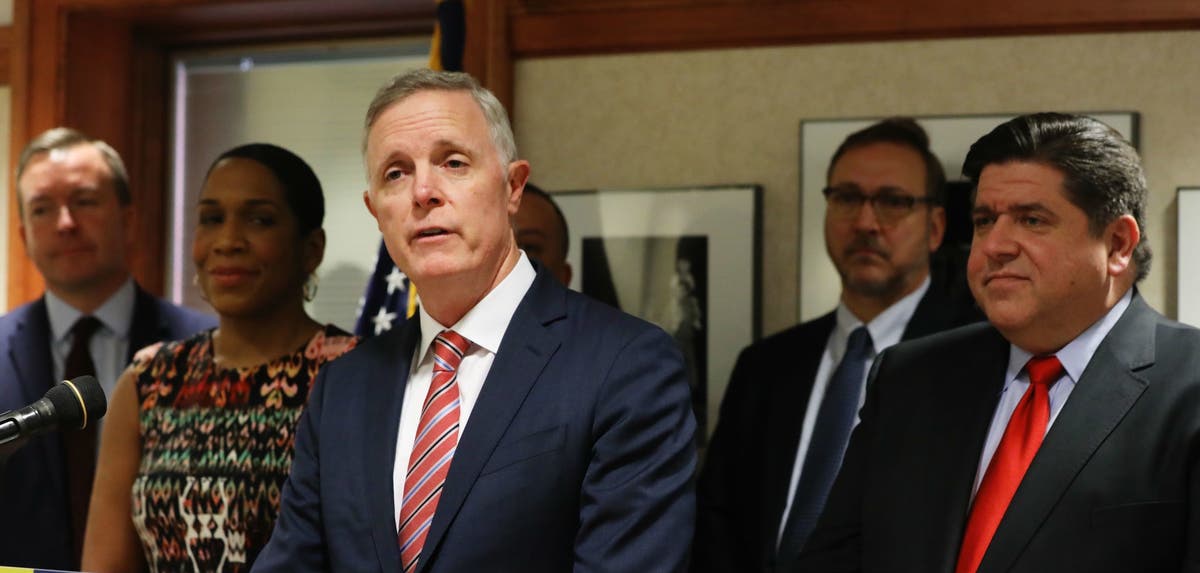
The committee found the state would be able to improve the long-term funding of its pensions and meet its budget needs in the short term with a new amortization schedule fixing annual state contributions at a sustainable level. It would need to be taken in conjunction with funding increases or other improvements to convince "that Illinois is serious about comprehensively solving the pension funding deficiency," according to the committee's transition report.
Business group the Civic Committee of the Commercial Club of Chicago released an economic plan called "Restore Illinois: A Foundation for Growth" to address the state's structural budget shortfall and massive unfunded pension liability. It recommended $2 billion in spending cuts and $6 billion in revenue increases over the next 5 years.
The proposal includes an 1 percent increase in personal and corporate income tax, a new tax on retirement income and expanding sales tax to services. Cost savings would come through reducing the cost of the state's group health insurance plan, operational improvements and a comprehensive review of the state's budget.
Leaders of the group, composed of senior executives at the region's largest businesses, said the problem is solvable and the present political environment in Springfield — a Democratic governor with supermajorities in both legislative chambers — provides a unique opportunity to move to resolve the state's financial crisis.
“Illinois’ fiscal problems are negatively impacting our economy and our ability to create a robust and competitive jobs climate,” said Civic Committee Chairman Rick Waddell, announcing the plan. “Economic and job growth needs the certainty that will come only from a credible plan that solves the fiscal problem and is faithfully implemented over time.”
Moody's, which currently rates Illinois one step above junk bond status, said the state's credit would improve with any efforts to boost current contributions.
"Increasing the state’s financial flexibility by creating new revenue streams or instituting a more flexible income tax regime should be credit positive," Moody's said in a report, "provided that new revenues help address the state’s pension liabilities and that any adverse economic impacts are minimal."
According to the Civic Committee, about a third of the growth in the state's unfunded pension liability can be traced to the 3 percent a year compounded automatic increases in many state pension plans. In December, Chicago Mayor Rahm Emanuel proposed a constitutional amendment to address the growth rate. Pritkzer said he opposed it. His office has not responded to queries about the pension task forces.
Pritzker, who campaigned on a constitutional amendment to allow for a progressive income tax he called a "fair tax," has previously said he does not support a constitutional amendment to reduce promised compounded 3 percent annual increases to pension benefits, regardless of inflation.
The governor is scheduled to deliver his first State of the State address and present a budget proposal to state lawmakers on Feb. 20.
Get more local news delivered straight to your inbox. Sign up for free Patch newsletters and alerts.