Politics & Government
District 86 Settles Free Speech Lawsuit
Board says it was wrong to silence speakers at meeting. It pays residents' legal bills, which amount to $21,000.


HINSDALE, IL — In December, Nancy Pollak, then-president of the Hinsdale High School 86 board, suggested three residents file a complaint if they disagreed with her decision to block them from speaking during a board meeting. They did, and it didn't end well for the district.
On Thursday, the school board voted 5-1 to settle a federal lawsuit with the three residents, who contended the board violated their First Amendment rights. The new board president, Kevin Camden, voted against the settlement.
Under the settlement, District 86 must pay the residents' $21,000 in legal costs and publicly acknowledge it should have allowed them to speak.
Find out what's happening in Hinsdale-Clarendon Hillsfor free with the latest updates from Patch.
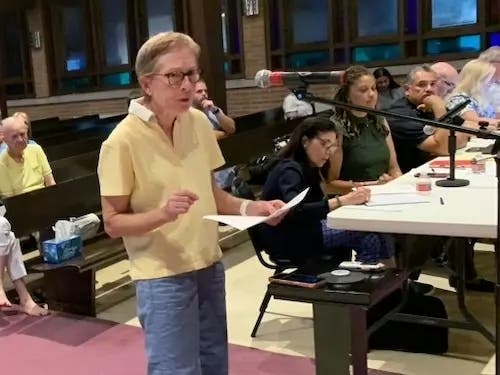
At the December 12 board meeting, residents Meeta Jain Patel, Kara Kuo and Kim Notaro tried to read a letter by resident Dan Levinthal that alleged Carol Baker, the assistant superintendent of academics, opposed cutting course offerings in another district but supported doing so in District 86. But Pollak stopped each of them from speaking, saying they were not allowed under the rules to speak about specific personnel.
"It's inappropriate. I'm sorry," Pollak told Kuo at the meeting.
Find out what's happening in Hinsdale-Clarendon Hillsfor free with the latest updates from Patch.
"I'm sorry, too. You're violating my First Amendment rights," Kuo replied, prompting Pollak's suggestion that she file a complaint.
In February, the residents filed a federal lawsuit claiming violations of the First Amendment and the state's open meetings law. They named Pollak and the board as defendants.
Represented by attorney Joshua Burday, the residents argued the board had no right to discriminate between viewpoints. They gave examples in which the board allowed praise of top officials in the district, yet prohibited criticism, according to the lawsuit.
In the December meeting, the residents were voicing their objections to changes in the school district's science curriculum, a controversial issue.
As part of the settlement agreement, the residents are allowed to read Levinthal's letter before the board at a meeting of their choosing before May 30, 2021.
Camden, an attorney, said he opposed the settlement because it was "disingenuous and hypocritical" to have policies against bullying and harassment yet accept an agreement that he contended allowed residents to criticize employees personally.
Still, he said that as board president, he would make sure the district follows the settlement's terms.
"I'm not trying to sway anyone's vote," he said, "but I just have a problem sitting here and suggesting it's OK for employees in this district to be subjected to verbal abuse."
Board members Keith Chval and Erik Held said they voted for the agreement to make the lawsuit go away. Chval called the lawsuit a "huge waste of money" for the district, while Held said board members, not employees, should take public criticism at board meetings.
Under the settlement's terms, the board must allow Maryam Judar, executive director of the Elmhurst-based Citizen Advocacy Center, to speak at the October board meeting about the First Amendment and the state Open Meetings Act. She will be given 40 minutes to speak, followed by a 20-minute question-and-answer session.
Also, as required under the settlement, board President Camden read a statement on behalf of the board, "The board acknowledges that under the First Amendment and Open Meetings Act, Meeta Patel, Kara Kuo and Kim Notaro should have been allowed to read Dan Levinthal's letter at the 12/12/2019 board meeting."
In a news release Friday, the residents' attorney, Joshua Burday, said Camden continued to show "disdain and disrespect" toward residents' First Amendment rights.
“In light of the apparent misunderstanding of the First Amendment shown by three of the board members at last night’s meeting, it is obvious that this board is in dire need of the First Amendment education required under the terms of the settlement agreement,” Patel, one of the residents, said in the release.
The residents said in the statement that their lawsuit ensured that residents will at least be heard in the future.
“We are hopeful that despite the commentary made by Board President Camden at last night’s meeting, the community will understand that the fault for the lawsuit lies entirely with the members of the board, three of whom are practicing attorneys," the statement said. "As everyone who has followed this case knows, after former Board President Pollak ordered the microphone stripped from the first public speaker at the December board meeting, she goaded the three Plaintiffs to file a complaint if they didn’t like it."
Last year's debate over the science curriculum became bitter, with many people expressing their opposition during meetings. It apparently spilled over online as well. In February, Camden announced at a board meeting he would no longer respond to constituents' emails about issues because his previous messages had been taken out of context, especially in relation to the science curriculum. He said he would refer communications to the district's spokesman.
He said he understood that his new policy would stymie communication between board members and the community. "Be that as it may, that's where we find ourselves," he said.
In late March, though, Camden told Patch he had, in fact, responded to emails from the public related to the school board. He said he hadn't answered all of them and has never done that.
Camden and Pollak did not return messages for comment Friday. Spokesman Chris Jasculca said the district had no further comment.
Get more local news delivered straight to your inbox. Sign up for free Patch newsletters and alerts.