Politics & Government
Lawmaker Pushes 5G Rules To Help Hinsdale And Other Towns
State Rep. Mazzochi says she wants local involvement in placement of antennas.


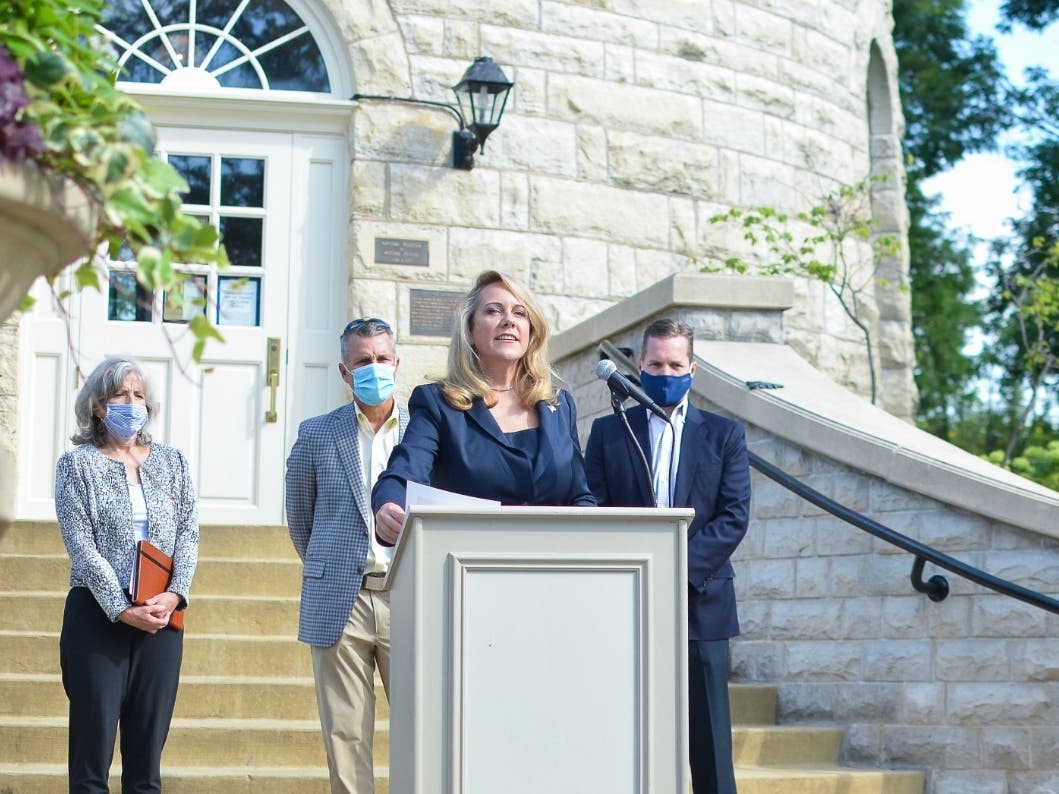
WESTERN SPRINGS, IL — State Rep. Deanne Mazzochi, R-Elmhurst, has drafted new legislation to protect local residents from the proliferation of controversial 5G wireless equipment in suburban communities, according to a news release from her legislative office.
“Our neighborhoods welcome technological advances,” Mazzochi said in a statement Thursday in Western Springs. “But those same neighborhoods also need the right to decide at the local level whether certain aesthetic or safety costs are worth it."
The possibility of 5G antennas — known as small wireless facilities — have become an issue in Western Springs, Hinsdale, Clarendon and La Grange, among other towns.
Find out what's happening in Hinsdale-Clarendon Hillsfor free with the latest updates from Patch.
According to the news release, several neighborhoods in Mazzochi’s district have served as pilot communities for various categories of 5G wireless small cell units, and they are not happy with the early rollout results.
After hundreds of Western Springs and Hinsdale residents called for expanded local control over 5G sites, Mazzochi filed House Bill 5818, the “Protect Me From 5G Act.” Mazzochi said she hoped the bill would be considered in the General Assembly’s fall veto session in November.
Find out what's happening in Hinsdale-Clarendon Hillsfor free with the latest updates from Patch.
When the original small cell wireless bill was debated in 2018, communities and legislators were told most new 5G installations would be on existing poles, Mazzochi said. Since then, local villages have been inundated with permit applications for new towers in front of houses in parkways, neighborhood street corners and playgrounds, the release said.
Mazzochi, who took office after the small cell wireless bill was passed, reiterated that “our local municipalities and residents were not informed of the real-world implementation plans under the prior legislation.”
With wireless companies converging on neighborhoods to build new installations over the objections of homeowners, Mazzochi said, “The time to reexamine this legislation is now, and we must give more authorities to communities and homeowners at the local level with the ‘Protect Me From 5G Act.’”
The Western Springs Village Board approved a resolution in support of the legislation and worked with Mazzochi to draft language that would suit local residents’ needs.
“It's so important to keep our residents informed on this issue and to do what we can to establish as much local control as possible," Village President Alice Gallagher said in a statement.
The “Protect Me from 5G Act” has the following key elements:
- Radio frequency monitoring — Requiring a monitoring plan and tracking and recording daily levels of radio frequency emissions produced by 5G equipment.
- Noise monitoring — Requiring a written report that analyzes acoustic noise levels for small wireless facilities and all associated equipment
- Environmental protection — Requiring a certification of a federal environmental assessment.
- Equipment restrictions — Requiring equipment, when replaced, to be swapped with the smallest commercially used and available equipment.
- Alternate location authority — Allowing local governments to propose new small wireless facilities be installed on existing poles within 200 feet of requested location of a new proposed pole, in order to protect aesthetics and limit the number of new poles.
- Closing application loophole — Clarifying that wireless service providers must submit new applications when seeking to replace existing small wireless facility equipment with significantly different equipment
- Below ground devices — Allowing local governments to require small wireless facilities and related equipment to be below ground as new technology for doing so becomes available.
- Easement rules — Requiring proof of authority when wireless service providers seek to use easements outside the public way
At an event promoting the legislation in Western Springs, other villages voiced their support.
“We welcome all efforts to increase transparency in this process and provide our residents with more information on new technology,” said Hinsdale Village Trustee Luke Stifflear. For Hinsdale, Trustee Stifflear handles all matters related to small cell wireless technologies and installation. “This is about ensuring we have a say about what goes on in our own community, ensuring we have local control here in Hinsdale.”
“Our aim is twofold: both to bring back local authority for our villages and to give our residents answers to some of their questions about this new technology,” Clarendon Hills Village President Len Austin said in a statement. “We’re looking for a more transparent process moving forward.”
Get more local news delivered straight to your inbox. Sign up for free Patch newsletters and alerts.