Politics & Government
Consultant Explains Huntley's Electric Aggregation Plan
First of two public hearings on new program held Thursday.

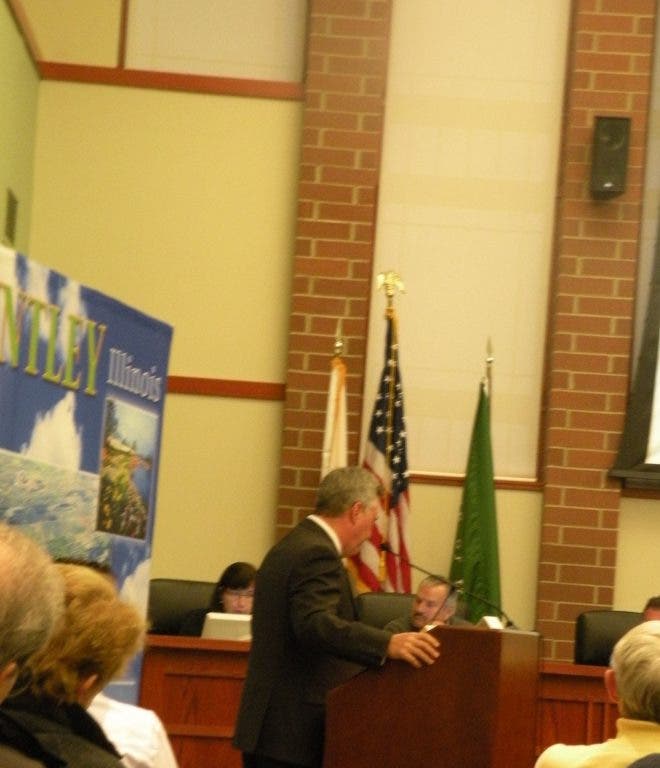


A consultant told a crowd of Huntley residents the village’s electric aggregation program could save households and small businesses from 25 percent to 30 percent on their electric supply costs.
Mark Burns, president of Independent Energy Consultants, Inc., said the savings could amount to $200 to $300 yearly.
Electric aggregation allows governments to bundle together households and small businesses for purposes of negotiating a lower rate from an electricity supplier.
Find out what's happening in Huntleyfor free with the latest updates from Patch.
Huntley voters approved a referendum in March granting the village authority to create an electric aggregation program. The village is joining with five other communities where the same referendum passed under the Northern Illinois Governmental Electric Aggregation Consortium to purchase electricity from an alternative retail electric supplier on behalf of residents and small businesses.
Burns outlined how the program will work and what residents need to know.
Find out what's happening in Huntleyfor free with the latest updates from Patch.
There is no fee or cost to enroll, he said.
The process includes developing a list of households and small businesses that qualify for the program, Burns said. Letters will then be sent out, along with an opt-out card, explaining which alternative retail electric supplier was chosen and the new rate. Any customers who decide they do not want to participate in the aggregation plan can fill out the card to “opt out” of the program and continue to purchase their electrical power directly from ComEd. The opt-out card must be sent in within 21 days, he said.
The contract Northern Illinois Governmental Electric Aggregation Consortium negotiates will likely be for two to three years, Burns said.
Most Huntley residents will be eligible for the electric aggregation program, Burn said, unless they already have an individual contract with an alternative retail electric supplier.
Switching suppliers will be smooth and will not cause any disruption in service, he said.
ComEd, which is the distributor of electricity, will send a confirmation to customers asking if they agreed to enter into the electric aggregation program. Residents and businesses would have five days to change their minds about participating in the program, Burns said.
If residents already have chosen a supplier, the village can’t interfere with that contract, he said. Residents would have to check with the supplier to see if there are any early termination fees if they decided they want to join the village’s program anyway.
Audience members and trustees questioned how Northern Illinois Governmental Electric Aggregation Consortium knows an alternative retail electric supplier is credible. Burns said an alternative retail electric supplier must be licensed as a supplier and must register with ComEd.
“Whoever we choose will be a reliable supplier, rest assured,” Burns said.
Another question Burns fielded at the hearing: Why doesn’t ComEd offer cheaper rates? He said the government regulates ComEd’s rates while alternative retail electric suppliers are deregulated. ComEd makes money by distributing the electricity.
“Deregulation is good,” Burns said, adding it brings lower prices and innovation. “If we didn’t deregulate Ma Bell, we wouldn’t have cellphones right now.”
A second public hearing will be held at 7 p.m. Thursday, April 12, in the Village Boardroom.
Burns recommended a few websites that contain more information about electric aggregation programs:
Get more local news delivered straight to your inbox. Sign up for free Patch newsletters and alerts.
