Crime & Safety
CPR Guidelines To Change for First Responders
Old CPR methods should still be used for now.
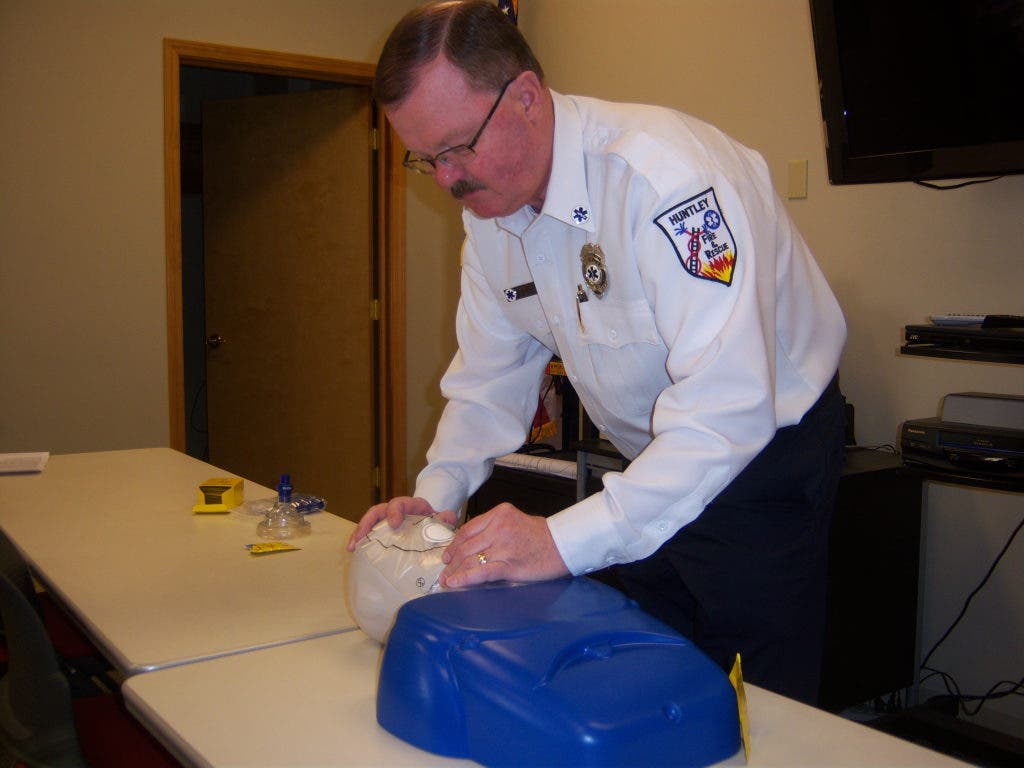


Nationwide the ABCs of CPR are changing with instructors expecting to spell out the changes locally later this year. The change in how the life-saving procedure is performed is a result of the American Heart Association revising its guidelines last October.
“I don’t have all the material that they want us to teach yet,” said Lieutenant William Kresal, the Huntley Fire Protection District Director of EMS. “I think some of the changes they’ve made over the years have been very good.”
Traditionally, CPR (cardiopulmonary resuscitation) begins with tilting the victim’s head back to clear the airway followed by mouth-to-mouth resuscitation then compressions on the victim’s chest. To help people remember the sequence, CPR instructors have suggested the acronym A-B-C (airways, breathing, compressions); however the American Heart Association now believes C-A-B (compressions, airway, breathing) is more effective.
Find out what's happening in Huntleyfor free with the latest updates from Patch.
“(The A-B-C) approach was causing significant delays in starting chest compressions, which are essential for keeping oxygen-rich blood circulating through the body,” said Michael Sayre, M.D., co-author of the guidelines and chairman of the American Heart Association’s Emergency Cardiovascular Care (ECC) Committee, in a press release. “Changing the sequence from A-B-C to C-A-B for adults and children allows all rescuers to begin chest compressions right away.”
In recommending the change, the AHA noted that victims often have oxygen remaining in their lungs and bloodstream, so starting CPR with chest compressions can pump that blood to the victim’s brain and heart sooner. The AHA also cited research that showed “30 critical seconds” passed between the time rescuers open the victim’s airway and the introduction of chest compressions.
Find out what's happening in Huntleyfor free with the latest updates from Patch.
Also struck from AHA guidelines is the suggestion of looking, listening and feeling for normal breathing before starting CPR. Under the new guidelines, saving the life of someone who is unresponsive and not breathing normally is all about compressions, compressions, compressions.
Kresal, who certifies all Huntley firefighters in CPR each year and is one of the department’s six CPR instructors, said the HFD wouldn’t begin using or teaching the new guidelines until their head instructors at Centegra McHenry Hospital are certified.
“They’re the ones that do it first then they set up CPR classes for instructors,” he said.
As for when the new guidelines will be introduced is uncertain. Kresal says that he has heard the AHA will rollout the new program in March while local officials have informed him it’ll be closer to summer. Even so, people have already inquired about the change and getting re-certified.
“The rumors are out,” Kresal said. “When I teach classes – and we taught quite a number of classes last year and we have a lot of classes this month – (but) what I say to them is, ‘There’s going to be a number of changes from American Heart. We’re not here to go over those because they’re not in effect yet.’ So we teach them the old guidelines and their cards are good for two years. And from what we’ve been told from the upper people at American Heart is: continue to keep teaching it that way. (People) can still keep doing it that way for the next two years. If they want a refresher course then they can come and get a refresher course once the (revised teaching) material is out.”
Last October’s revisions were the first by the AHA since 2006 when, among other changes, they streamlined the ratio of compressions to breaths to 30:2 per minute regardless of the victim’s age or the number of people performing CPR. Previous ratios had varied based on the situation. Should AHA guidelines be revised again, Kresal wouldn’t be surprised if mouth-to-mouth resuscitations were eliminated.
“I did hear, for the last number of years, about taking ventilations away,” Kresal said. “I think they think that if people didn’t have to do ventilations, possibly more people would be interested in doing CPR. But we give (people) barrier devices to use if they have to do CPR in the real world. We give them a little face shield to take with them, and it’s real easy to carry in your wallet, your pocket, your purse, but we give that to each person who goes through our class.”
The Huntley Fire Department conducts CPR and Automatic External Defibrillator (AED) classes once per month with sessions lasting four hours. The classes are free to residents of the Huntley Fire Protection District and $20 for non-residents.