Community Corner
Huntley Library Friends Foundation Hosts UCLA Professor
Event focused on buying patterns of older adults and featured UCLA professor of marketing.
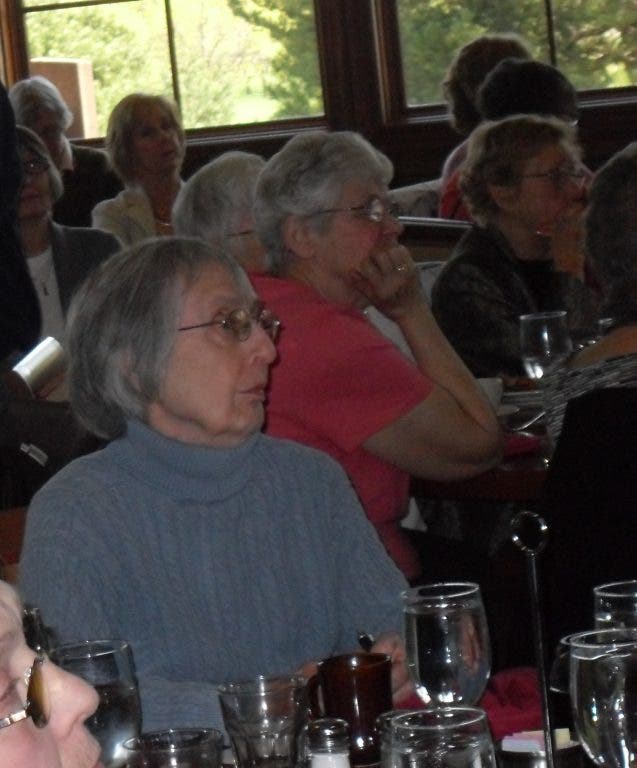

A UCLA professor gave Huntley Area Public Library District Friends Foundation insight on seniors and their buying patterns during a fundraiser breakfast Wednesday.
More than 50 guests attended “Spending Patterns & Buying Smart” by Dr. Aimee Drolet, a professor of marketing at the UCLA Anderson School of Management. Drolet offered highlights from her research, relating to buying patterns of senior consumers. The event was held at Pinecrest Restaurant and was one of the non-profit organizations fundraisers to support library programs and resources.
“The fastest growing segment of the population is people in their 80s and over,” said Drolet, a psychologist. “People are living longer, and birth rates have declined.”
Find out what's happening in Huntleyfor free with the latest updates from Patch.
The aging population brings ramifications to financial markets due to changes in savings rates, demand for investment funds and changes in the labor force, she explained. But while prior research focused on decisions made by elderly people experiencing a cognitive decline, recent research is more optimistic, according to Drolet.
“Initially in the lab research, it looked like older adults did worse in the studies, but a lot of research was with adults with dementia so it’s not surprising that they didn’t
do as well," she said.
Find out what's happening in Huntleyfor free with the latest updates from Patch.
Cognitive aging starts in a person’s late thirties and is moderated by many situational and individual-difference factors, she said.
“The fact is that most of the lab results only hold in the lab, and if you look at older people out in the workplace they do just fine,” she said. “They do just as well or better than their younger counterparts.”
That’s due in part because older adults have more life experience on which to make decisions.
“It does seem that older adults are wiser…they care more about being right, and being accurate,” she said. “Sometimes that means you have to use more complicated strategies, so that may make it seem like someone is taking a long time to make a decision, but it’s because they are thinking more about it and being more thorough.”
The decision-making process is different for older adults than for younger ones, Drolet said.
“As we get older, emotions matter more,” she said. “You go more out of your way to avoid having negative emotional experiences. You spend more time thinking about your emotional experiences and less time thinking about facts. So as you get older you get better at managing emotions, and that time you spend focusing on emotions means you are spending less time focusing on facts.”
Drolet discussed senior consumers’ preferences between two coffee ads. One consisted of more emotional appeal – including the coffee in a personal relationship moment, while the other focused on the qualities of the coffee itself, such as its flavor and aroma.
“The advertising that influences you will be different than what influences younger people,” Drolet said. “Emotional payoff will attract older consumers.” Of her 146 research participants, half of whom were the senior consumer guests at the event, and the other half were undergraduate students, the older consumers strongly preferred the emotional ad.
“As we age, our qualitative information processing changes. Elderly
are more abstract, they incorporate more feeling into how they make decisions,”
she said.
More information about the Friends Foundation is available at www.huntlelylibraryfriends.org.