Community Corner
Re-enactors Describe Life During the Civil War
From what women wore to a soldier's diet, details about life in the 1860s.
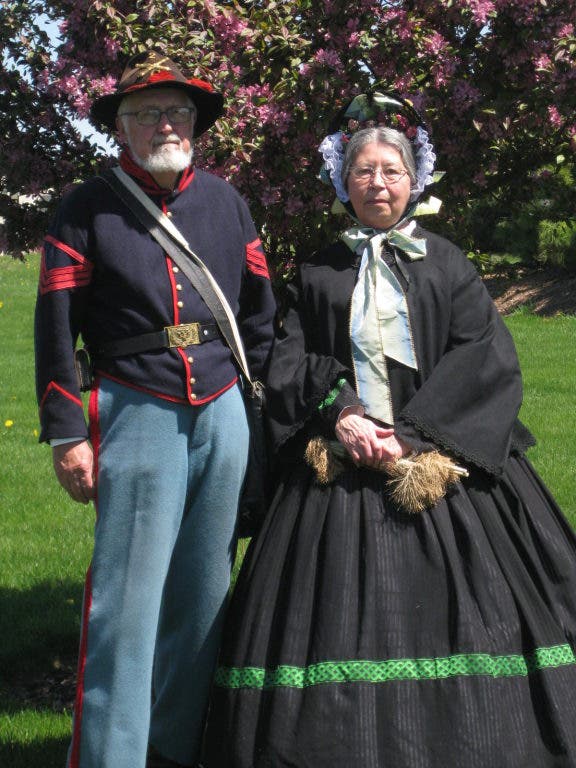

How women dressed and what soldiers ate were just some of the interesting details shared by two Civil War re-enactors at a recent program at the Huntley Area Public Library.
Dressed in authentic period clothing, Henry and Marta Vincent gave details of life for Americans, especially senior citizens, during the early 1860s.
Lifting the skirt of her long, black woolen dress, Marta described her undergarments, from chemise to under drawers to corset.
Find out what's happening in Huntleyfor free with the latest updates from Patch.
“All women wore corsets or stays to give support,” she explained. “The bra was not invented until the 1920s, when washable elastic became available.”
Over the undergarments were a petticoat, then a flexible steel hoop, then another petticoat to cover the hoop.
Find out what's happening in Huntleyfor free with the latest updates from Patch.
“The hoop was considered a “liberating” garment,” Marta said. “It kept the dresses and skirts away from the woman’s ankles and prevented her from tripping over her dress.”
Women wore a collar on their dress to keep the dress clean. The collar was removable and could be easily washed, where the heavy or delicate fabrics of the dress were not easily laundered.
The female outfit of the day included a brooch at the neck to keep the bodice closed, a belt, a bonnet and lace-up shoes. Trim on bonnets and dresses were hand stitched and could be removed to change or freshen the outfit with new details such as flowers, ribbons or lace.
The air conditioning of the day consisted of a hand-held fan or a parasol. Even men used hand fans, according to the re-enactors.
Marta said that by the 1860s, the sewing machine was in common usage. Older women of the family, often widows, moved in with a son or daughter and their family and did sewing and other chores.
Besides assisting their families, older women did much to support the soldiers.
At Sanitary Fairs they sold items such as handiwork and jellies to raise money for war relief efforts. At home, they worked the farms while then men were gone.
Henry explained that although there were some healthy volunteers up to age 65, most soldiers were younger than 45.
“Many young men saw going off to war as a time of adventure,” Henry said. “Many had never been out of their hometown and saw this as a chance to get away.”
He explained that a local businessman would usually ask the governor of the state for permission to raise a local regiment. Young men from the community would sign up together and walk to training camps in other towns. Then the local troop usually walked from their home to the battlefield, another good training exercise for the battles to come.
“You often see overweight Civil War re-enactors,” Henry said, “but this is very inaccurate. There were no overweight soldiers.”
Besides the hardships of the battles, the mens’ diets kept them lean. Hard tack was a staple of every Civil War soldier.
“It was made of flour, water and salt and was hard as a brick.” Henry told the audience, passing around a sample of the solid wafer. “It could be made edible by dipping it in water or coffee.”
Herds of cattle traveled with the troops, and each morning a cow would be slaughtered to feed the regiment for the day.
Corn was ground into cornmeal and a type of pancake was made from the meal.
But these rations were not enough to keep the men healthy.
Sanitary conditions were poor. Infections were rampant. Hygiene among regiment cooks was unheard of. The majority of soldiers who died during the war died of sickness rather than direct mortal combat.
In all, it is estimated some 640,000 soldiers from both North and South died during the Civil War.
