Politics & Government
Calling Ex-Chief 'Dumb, Unmotivated Lump' Isn't Defamation: Judge
A federal judge threw out most of former Joliet Police Chief Dawn Malec's defamation lawsuit against Joliet and City Manager Capparelli.



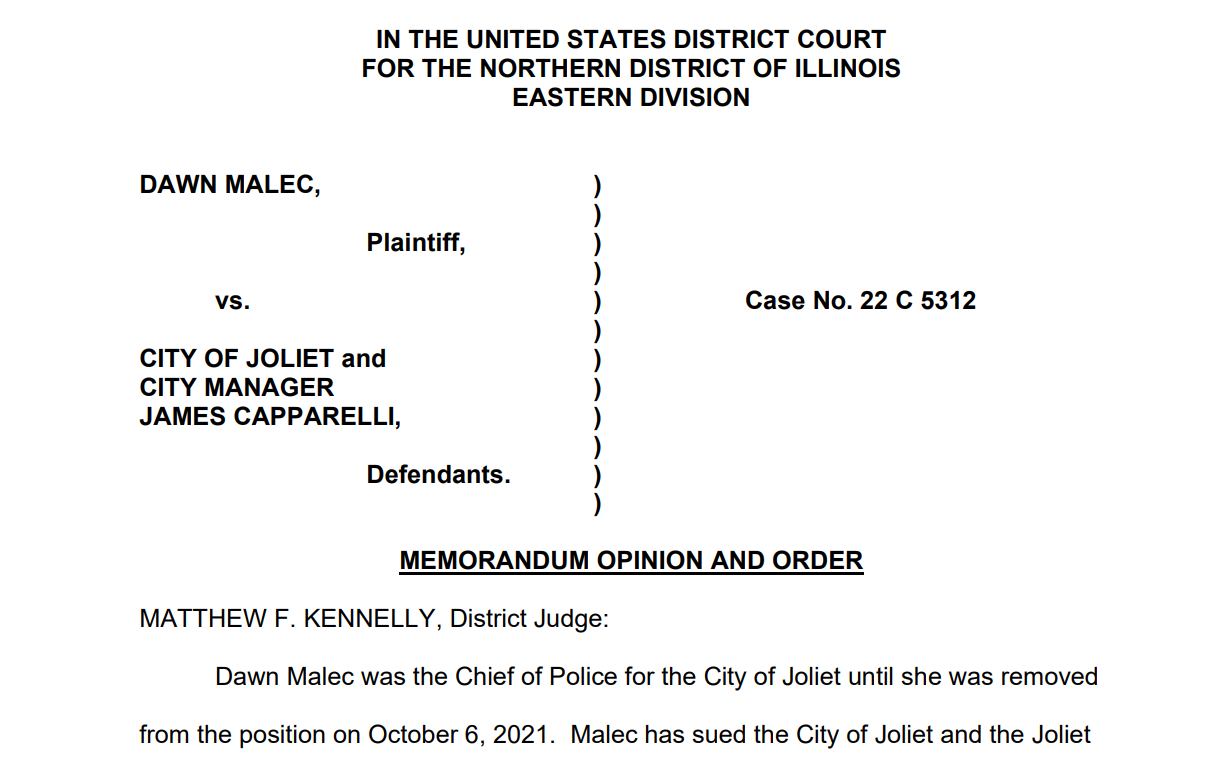
JOLIET, IL — In a major victory for Joliet City Manager Jim Capparelli and the city of Joliet, a federal judge in Chicago has dismissed much of Dawn Malec's federal defamation lawsuit. Capparelli has been removed as a lawsuit co-defendant altogether, the judge ruled.
Last summer, Malec retired from the Joliet police force after being demoted in October 2021 back to her old rank of being a patrol lieutenant. Capparelli made her chief in January 2021, within days of becoming Joliet's city manager. By fall, Capparelli realized he made a mistake promoting Malec. He removed her as chief, and replaced her with interim chief Rob Brown.
Brown served in an interim role until Bill Evans, a retired Cook County Sheriff's Office lieutenant, was named the new permanent chief of police for Joliet in March 2022.
Find out what's happening in Jolietfor free with the latest updates from Patch.
"Because Malec's pension was based on her highest earned salary in the previous year—and because her salary as lieutenant was less than her salary as chief of police—Malec alleges that she was effectively forced to retire from the police department on July 7, 2022, to avoid a reduced pension," U.S. District Judge Matthew Kennelly wrote.
"Malec further alleges that but for the defendants' misconduct, she would have continued working as chief until she reached thirty years of service and could retire with full pension benefits."
Find out what's happening in Jolietfor free with the latest updates from Patch.

Here are some of the key rulings issued by Judge Kennelly in regard to Malec's federal lawsuit that she filed last fall against the city of Joliet:
- "As a threshold matter, the City and Capparelli ask to dismiss Capparelli from the counts in which Malec names him in his official capacity alongside the City, counts 1 and 3-7. Because the City is already named as a defendant on those claims, naming Capparelli in his official capacity is superfluous. The Court therefore grants the defendants' request to dismiss Capparelli in his official capacity from counts 1, 3, 4, 5, 6, and 7."
- "In count 1, Malec asserts a claim under section 1983 alleging that the City violated her constitutional rights by removing her as Chief of Police without due process ... In short, Malec's position as police chief was governed by Joliet city ordinance, which allowed her removal at the city manager's discretion, and not by the Illinois Municipal Code's good cause requirement ... Malec cites no authority supporting this contention, nor is the Court aware of any. That aside, Malec's contention makes no sense. She cannot possibly have any property interest via a state enactment under a scheme of governance under which a municipality like Joliet is legally entitled—by virtue of home role—to displace the state enactment via its own ordinance."
- In count 2, Malec asserts a claim of defamation per se against Capparelli in both his official and individual capacities. Malec alleges that "Capparelli told at least one member of the Joliet Board of Fire and Police Commissioners that [she] was a 'dumb, unmotivated lump.'" She further alleges that "Capparelli told citizens of Joliet who were present at City Council meetings that Plaintiff was insubordinate and that she could not follow department rules." Count 2 is the only official capacity claim against Capparelli that he did not ask the Court to dismiss on that basis. But as previously discussed, suing Capparelli in his official capacity is tantamount to suing the City. And the City is absolutely immune from defamation claims ... Malec alleges that Capparelli's statements and actions imputed that she was unable to perform, or lacked integrity or ability in performing, her duties as Chief and that they prejudiced her within the Police Department. Malec further alleges that Capparelli's statements were false and caused harm to her reputation. Capparelli contends that (1) the alleged "dumb, unmotivated lump" comment is non-actionable opinion because it involves a non-verifiable condition; and (2) the comments to the City Council about Malec being insubordinate are subject to the innocent construction rule. The Court concludes that the "dumb, unmotivated lump" comment is a nonactionable opinion. To determine whether a statement is one of fact or opinion, Illinois courts consider the totality of the circumstances and whether the statement can be objectively verified as true or false. Courts have repeatedly held that referring to a person as "dumb" or "stupid" is a nonactionable expression of opinion because such statements cannot be objectively verified and are inherently subjective ... The Court therefore concludes that Malec cannot maintain a defamation claim based on these particular comments by Capparelli."
- "Turning to Capparelli's alleged statement that Malec had been "insubordinate," Capparelli cites the so-called "innocent construction" rule in seeking dismissal ... The Court overrules Capparelli's argument that his statements are protected under the innocent construction rule. Capparelli contends that his statements "simply addressed [Malec's] performance as a City employee." But that's not the normal understanding of the term "insubordinate." The Court finds this argument unpersuasive, at least on the present record—which consists at this point only of Malec's amended complaint. A defamatory meaning—particularly when considered in the context of Malec's ongoing disputes with Capparelli and his reassignment of Malec to desk duty in a public area—is more plausible on the present record than Capparelli's proposed construction, 'The context of a statement is critical in determining its meaning,' and the context here does not suggest that Malec was merely citing substandard performance as a city employee. The Court declines to dismiss count 2 to the extent it is based on this statement."
- In count 3, Malec asserts a claim under the Illinois Whistleblower Act (IWA) against the City. Malec alleges that the City retaliated against her in violation of the IWA when it removed her as Chief of Police after she disclosed to a member of City Council the previously-referenced investigation report related to criminal conduct by a police sergeant whom Capparelli and the City Council had told her not to discipline, in an effort to convince the City Council to move forward with disciplining the sergeant ... In Sweeney, the Illinois Appellate Court held that [s]imply having a conversation with the wrongdoer about the impropriety of his or her actions is not exposing the alleged improper activity, making it known, or reporting the wrongful conduct. The fact the violator is the employee's boss does not alter the analysis, as the information is still not disclosed. We hold section 15(b) of the Whistleblower Act does not protect an employee who simply notes the impropriety of conduct with the alleged wrongdoer, as that does not constitute the disclosure of information under the Whistleblower Act ... the Court dismisses count 3 for failure to state a claim."
- In count 5, Malec asserts an invasion of privacy/false claim against the City ... After her removal as Chief, Malec consulted an attorney to investigate her claims and pursue the possibility of settlement with the City. Malec alleges that the City wrongfully released—pursuant to a request made under the Illinois Freedom of Information Act (FOIA)—a settlement demand letter marked as confidential that her attorney drafted and sent to the City. The letter was later published in the local newspaper, which Malec claims placed her in a false light. Malec also contends that the City could have withheld the letter from disclosure under the exceptions in sections 7(1)(c) and 7(1)(f) of the Illinois FOIA. See 5 ILCS 140/7
The City contends, and the Court agrees, that this claim is barred under section 2-107 of the TIA. As discussed earlier, under section 2-107, "[a] local public entity is not liable for injury caused by any action of its employees that is libelous or slanderous or for the provision of information either orally, in writing, by computer or any other electronic transmission, or in a book or other form of library material." This provision immunizes the City from liability in defamation suits, and it has likewise been applied to false light claims."
- "For the foregoing reasons, the Court dismisses Malec's claims under 42 U.S.C. § 1983, the IWA, and the UPODA, and for invasion of privacy (counts 1, 3, 4, and 5) but declines to dismiss her defamation claim (count 2). The Court also dismisses all of Malec's claims against Capparelli to the extent he is sued in his official capacity. The defendants are directed to answer by May 22, 2023 any claims that they have not. In a footnote, Malec asks the Court to convert her invasion of privacy/false light claim into an invasion of privacy/public disclosure of private facts claim. But even were the Court to do that, Malec's claim would still be barred by section 2-210 of the TIA for reasons already stated. The Court therefore overrules Malec's request. The case remains set for a status hearing on May 15, 2023.

Get more local news delivered straight to your inbox. Sign up for free Patch newsletters and alerts.