Politics & Government
Joliet Data Center Doesn't Get Yes Or No, City Council Meeting Passes Midnight, Vote Moved To Thursday
The City of Joliet is comfortable that the planned water use will not strain the local system, noted Dustin Anderson in his Council memo.


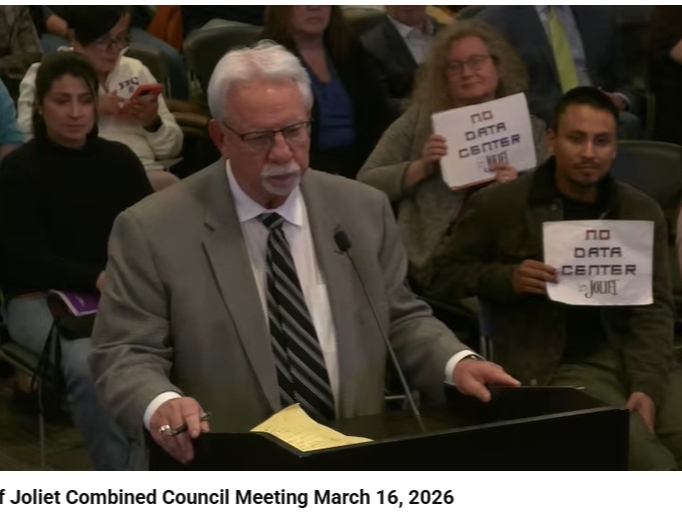
JOLIET, IL — The Joliet City Council will reconvene at 5:30 p.m. on Thursday to take a final vote on the data center project. Monday's meeting included seven-and-a-half hours of public audience comment and discussion from city staff, the developers' representatives and Council members. Once the meeting passed midnight, city staff indicated the data center vote needed to be moved to a different calendar date.
From Joliet Patch's earlier story:
Until the vote is tallied, there's no telling how the Joliet City Council will vote at this afternoon's 4:30 p.m. meeting on the proposed Joliet Technology Center. As more and more data center projects are being approved throughout Illinois, it's now Joliet's turn to consider a project. The proposed data center would be built on the city's far southeast side out near the Chicagoland Speedway NASCAR track.
Find out what's happening in Jolietfor free with the latest updates from Patch.
The land belongs to Bernhard Farms, which is the family of Joliet city planning director Jayne Bernhard. At previous meetings, audience members have suggested that Bernhard's family will make tens of millions of dollars by selling off their 795-acre farmland to build the data center on its property.
Meanwhile, in preparation for today's 5 p.m. meeting, Dustin Anderson, Joliet's director of community development, has prepared a lengthy Council memo addressing the pros and cons of the data center project.
Find out what's happening in Jolietfor free with the latest updates from Patch.
At the very end of Anderson's memo, he wrote, "Staff concurs with the recommendation of the Plan Commission and recommends the Mayor and City Council adopt the following, subject to the same conditions approved by the Plan Commission: Resolution to Approve an Annexation Agreement for the Annexation of Approximately 795 Acres Surrounding S. Rowell Road and Bernhard Road."
According to Anderson's memo, PowerHouse Hillwood Holding, LLC, intends to annex the 795 acres and develop a Data Center campus in four future phases.
"Data Center facilities are buildings that are used for the storage, management, processing, and transmission of digital data, which house computer network equipment, systems, servers, appliances, and other associated components related to digital data operations," Anderson explained.
.jpg)
Here are the highlights from Anderson's memo:
- The petitioner intends to include one six-building cluster in each future phase of development, resulting in a total of 24 principal data center buildings, with an approximate total buildout square footage of 6,936,000 gross square feet.
- Data centers are growing rapidly throughout the country, due in large part to a surge in meeting today’s digital demand as artificial intelligence (AI) technologies require an enormous amount of computing power and associated infrastructure. Several economic benefits have been associated with the development of data center campuses. The facilities result in the creation of high-paying, permanent jobs in addition to a large volume of temporary construction jobs associated with the build-out of the data center campus.
- Approximately 7,000- 10,000 union jobs would be created for the construction of this development. At full buildout, the project would create approximately 700 permanent jobs operating within the site’s 24 buildings with staff on-site 24 hours per day. The developer is committed to partnerships with local educational institutions to expand technical training programs aligned with construction and technology careers, and will work closely with these educational institutions, community groups and others to target local residents to fill these roles.
- Property tax revenues generated at the local level can also be substantial. The subject development is expected to generate approximately $310,000,000 in property taxes over 30 years, plus about $40,000,000 in utility taxes, in addition to standard industrial water and sewer rate revenues.
- The City of Joliet will not be providing economic incentives or tax abatements for this project. Furthermore, the developer has committed to a $100 million community benefit contribution to the City. An initial $20 million will be paid to the City within 30 days of closing on the property and each subsequent phase of development will be preceded by a required proportional payment.
- Noise pollution that originates from cooling equipment and backup generators has been cited as a chief negative quality of life impact for adjacent property owners. Noise from data centers is often cited as most audible within 3,000 feet of the point source, with a potential to be audible from up to two miles from the point source.
- The Illinois Pollution Control Board’s Rules and Regulations for Noise Pollution would cap a proposed Class C use between 40 and 75 decibels at property lines of adjoining residences, depending on the octave band center frequency. Model data center ordinances typically call for a maximum decibel level between 60 and 70 at the property line. The applicant has stated that it believes it can stay under a maximum decibel level of 65 decibels at the property line. The volume at this level is comparable to loud conversation or a running dishwasher. The noise generated by data centers of the kind proposed in Joliet is produced largely by the exercising of the generators.
- The quantity of luminance of lighting visible from neighboring properties shall not be of such magnitude as to cause hazards, annoyance, or interference to the users and uses of neighboring properties ... The proposed data center development would use minimal nighttime lighting. All fixtures would be focused downward and softly/minimally lit for safety purposes. Unlike a warehouse that may be busy with loading activities in the overnight hours, a data center has very little need for outdoor nighttime activity on the site.
- The proposed data center campus would utilize a closed-loop system that recycles water and significantly reduces overall water usage. The City is comfortable that the planned water use will not strain the local system. Staff recommends capping average daily consumption to 150,000 gallons per day. Staff recommends capping the average amount of daily discharge into the City’s sanitary sewer system at 50,000 gallons per day. The City will require approval of a pre-industrial treatment permit prior to discharge of any non-domestic waste into the City’s sanitary sewer system.
- For comparison, the proposed water use for the data center is significantly less than the water demands for a single-family residential subdivision, which would use approximately 1.25 million gallons per day for the same acreage. If the Project exceeds the peak daily use or average daily use limits, the property owner would be required to pay three times the applicable rate for water service charges with respect to such excess.
- As part of the interconnection process, PJM and ComEd have evaluated the impact of the development at full buildout on the reliability of the regional grid and local network and determined that extending service to the proposed data center campus site will not cause blackouts to ComEd customers. The development will have backup power generation but will rely on the local regional electrical grid for its electricity supply. The data center will secure and pay for its own electricity, independent of residential or small business service.
- The developer obtained a Traffic Impact Study from Kimley-Horn and Associates, Inc to assess the impact of the full site buildout to traffic in the surrounding area. The study found that site-generated traffic is not expected to materially impact nearby intersections.
.jpg)
Get more local news delivered straight to your inbox. Sign up for free Patch newsletters and alerts.