Politics & Government
Old Downtown Church Can Be Transformed into Senior Housing: Council
Despite strong opposition from a neighboring law firm, council members said they couldn't pass up an opportunity to restore and reuse the landmark building.


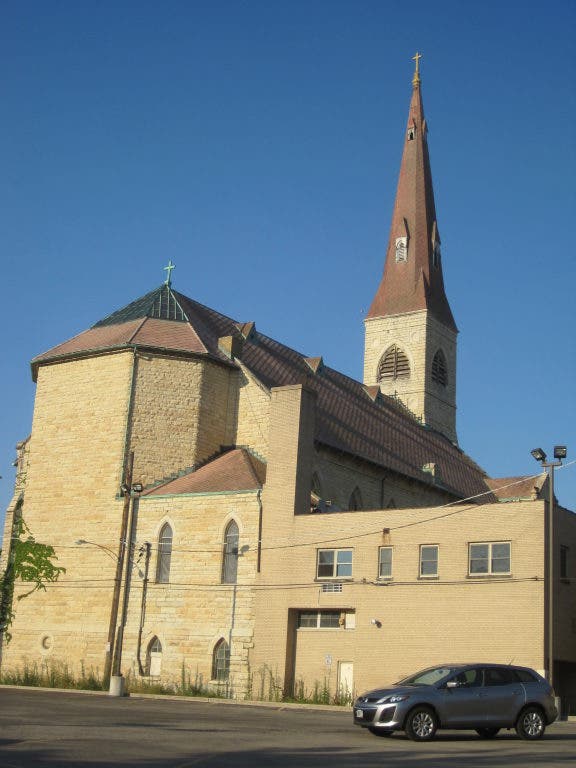


A landmark downtown church that's stood vacant since 1992 will be converted into senior apartments with the blessing of the Joliet City Council.
Despite an impassioned argument Monday from the co-owner of neighboring law firm, the council OK'd a special use permit that will allow the former St. Mary Carmelite Church at 111 N. Ottawa St. to be transformed into the Limestone Residences on the Mother Road -- a nod to the building's Route 66 location.
The 40 apartment units -- 32 of which will be one-bedroom and the rest two-bedroom -- will be spread out over four floors. An elevator will be installed, and the 52,000-square-foot building will include a private rooftop garden, an atrium common area and a fitness center, developer Scott Henry, of Celadon Holdings of Chicago, said.
Find out what's happening in Jolietfor free with the latest updates from Patch.
The company will use private equity for the $10.5 million project, which will be backed by federal and state tax credits available for several uses, including low-income senior housing and historic landmark restoration.
The property was donated to the developer by the Catholic Diocese of Joliet, which was planning to demolish it, Henry said.
Find out what's happening in Jolietfor free with the latest updates from Patch.
Henry called the senior housing concept for the building a "big, complicated project," but "(we knew) if we could pull it off, it could really be something special."
To lawyer Richard Kavanagh's way of thinking, however, using $10.5 million to build apartments ranging in size from 500 to 800 square feet is a ridiculous concept from a "fiscal sanity standpoint." For the same amount of money, double the number of apartments could be built new elsewhere, he said.
Kavanagh Grumley & Gorbold, a law firm that traces its Joliet roots back to 1800s, has owned the neighboring property at 111 N. Ottawa St. since the late 1970s, Kavanagh said. It's remained in downtown even as other large law firms have relocated to other parts of the city, in part because they remain committed to the future business development of downtown, he said.
"If the economy comes back, then (this is) a crime scene," he said. "If you want to build the business retail core, you can't fill it with housing units."
His partner, Thomas Osterberger, agreed. "We don't need residences downtown. We need businesses."
Although acknowledging the lawyers' points, council members remained unswayed.
The ability to not only save a historic and architectural landmark but to have $10.5 million invested into it is a deal that's hard to turn down, Councilman Larry Hug said. Given that the building has stood vacant for nearly 20 years, the odds of someone else stepping forward to save it are slim, he said.
"Even during the boom years, nobody wanted it," Hug said.
The "adaptive reuse" of the old church has the backing of the Will County Center for Economic Development, the Illinois Historic Preservation Agency, the Will County Veterans Assistance Commission, state Rep. Larry Walsh (D-Joliet), and members of the St. Patrick's Neighborhood Association and the Cathedral Area Preservation Association.
Construction is expected to begin by year's end or early next year, and will take a year to complete, Henry said.
Get more local news delivered straight to your inbox. Sign up for free Patch newsletters and alerts.