Politics & Government
Handicapped Street Parking Hard to Find in Downtown La Grange
The disabled can park in lots and walk, but can't park much closer to businesses.
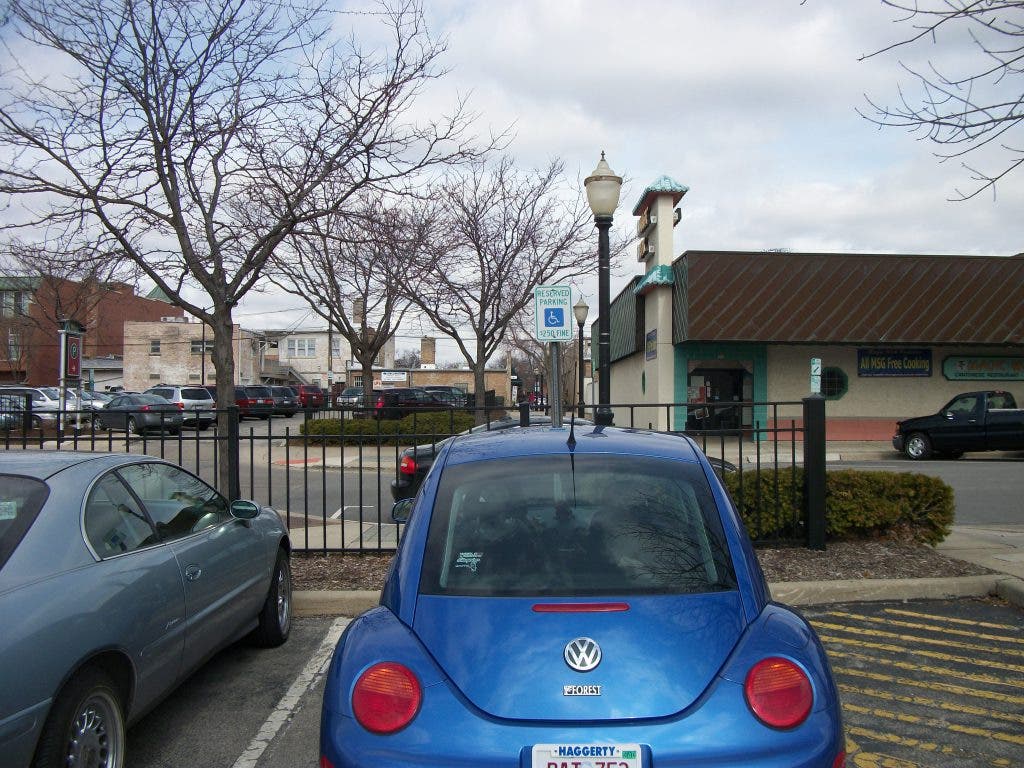


Anyone who is disabled and wants to eat in a downtown La Grange restaurant or see a movie at the La Grange Theatre, can park in marked handicapped spaces in parking lots, but not close to the businesses themselves.
On-street handicapped parking is driven by demand, location and usage, say public works and police officials of La Grange.
Police Chief Michael Holub points to medical offices that took over space in a building in the 500 block of west Burlington Avenue. The village worked with the building owner to find the best location for a handicapped space and one was put in.
Find out what's happening in La Grangefor free with the latest updates from Patch.
Officials could not come up with a count of handicapped spaces on business streets. “There’s not a lot,” Holub said. A visual check showed five on or near the avenues of Hillgrove and Burlington, and none on La Grange Road. Village parking lots have 24 spaces reserved for the handicapped.
Handicapped parking spaces were scattered around the central business district based on proximity and the best judgment at the time, said Ryan Gillingham, director of public works. When the business district was resurfaced about three years ago, those handicapped spaces were put back in the same places, he said.
Find out what's happening in La Grangefor free with the latest updates from Patch.
No one has applied to place a handicapped space in a business district in the couple years since Gillingham has been public works director, but he recommended that anyone who wanted one should write a letter to him or the assistant village manager.
About the importance of parking to downtown businesses, Robert Ware, executive director of the West Suburban Chamber of Commerce and Industry that serves La Grange and La Grange Park, says, “Parking is gold.”
Whether there is enough parking downtown depends on who you talk to –businesses, customers or commuters, he said. The parking situation can be difficult for the disabled, Ware said.
“Some businesses have customers for whom walking any distance at all is tough. They need to be 20 to 50 feet from the store,” he said. If they can’t find a parking space, they won’t get out of the car and shop, he said.
Ware said he has seen 15-minute spaces in the downtown but not that many handicapped spaces. “It’s a double-edged sword. The (handicapped) space may go empty for hours on ends, or days on end, depending on the location.”
An aging La Grange community will see more people using handicapped placards and license plates, he said. “Some may not be needed. But it’s internal with the person; they have good days and bad days when they will need the space.”
The parking structure, with its handicapped spaces, is not that far from the La Grange Theatre in number of feet, he contends.
“La Grange has done an admirable job of getting parking close to downtown. The parking garage is literally right there. There’s a lot of demand when you get down to it,” he said “It’s a popular town. Everybody wants to be there, be close.”
Illinois regulates handicapped spaces in lots
The state has rules requiring the size and number of handicapped spaces.
Any facility offering parking for employees or visitors must provide accessible parking for people with disabilities. An accessible parking space consists of a vehicle space and striped access aisle. The entire space must be kept clear of obstructions at all times, including ice, snow, shopping carts, trash cans, seasonal garden displays and bicycle racks.
Generally one handicapped parking space is required for every 25 off-street parking spaces provided: 1 for 1 to 25 spaces, 2 for 26 to 50, 3 for 51 to 75 up to 9 for 401 to 500, 2 percent of the total number for 501 to 1,000, and 20 plus 1 for each 100 over 1,000 for over 1,000 parking spaces. To comply with Illinois law, medical facilities specializing in treatment must have 20 percent of total parking spaces accessible. Outpatient medical facilities need 10 percent of the total number.
Each accessible parking space, except on-street spaces, must be 16 feet wide, with either an 8-foot-wide or 5-foot-wide diagonally striped access aisle. A high-quality yellow paint manufactured especially for pavement striping must be used. Adjacent accessible parking spaces cannot share a common access aisle.
Accessible parking spaces must be placed on level pavement on the shortest accessible route to an accessible entrance. A reserved-parking sign (listing $250 fine) must be posted on a permanent post no lower than 4 feet from the pavement and in the center of the 16-foot-wide accessible parking space. Municipalities may impose a larger fine (up to $350) by adopting a local ordinance.
Use of placards, plates is increasing
The number of drivers requesting and using disability placards has increased, according to two observers.
The Americans with Disabilities Act has made buildings, “more accessible and inviting to people,” says La Grange Police Chief Michael Holub. He agrees that more disabled drivers are out there and filling parking spaces dedicated to them, through license plates or placards that hang from their rear-view mirror. The increase took a while since the 1980s with the ADA and did not change overnight, he said.
People are living longer, which often means more may need disability placards or license plates, according to Bill Bogdan, disability coordinator for the Illinois Secretary of State’s office. “We’ll see an increase of parking placards.” He agrees that more disabled parking spaces seem to be filled.
The number of handicapped license plates in circulation in Illinois is about 93,000, compared to 90,000 in 2006, he said. Plates are renewed every five years.
The number varies for the total parking placards, which are issued on a four-year cycle, he said. The department just sent out placards for 2010-14, a total of 502,311, as of Feb. 4, 2011. “We issue about 6,000 per month from now on.”
Because some drivers have both plates, assigned to cars, and placards, assigned to people, Bogdan says you cannot add the two to come up with a total of disabled parking permissions. Placards can be used by disabled people, when riding in other cars, to use handicapped parking spaces.
On Dec. 31, 2010, at the end of the 2006-2010 cycle, some 489,398 placards were issued, he said. For the 2002-06 cycle, a little more than 670,000 placards were issued. He did not have figures for 1998-2002, “but the numbers would be outrageous.”
At that time, the state did not limit the number of placards issued to a household, Bogdan said. In 2002, the state put in controls of only one per household. If more than one person in a household is disabled, each person has to apply.
The state also changes the color of the placards every four years as a control to prevent misuse and tries to purge placards from the system for those who die or move out of Illinois.
Holub said an increase in use of handicapped parking spaces also brings, “more people taking advantage of it.”
He estimates less than six tickets a month are written for handicapped parking violations. “We get a lot at the (Adventist La Grange Memorial) hospital.”
Violations are found by parking enforcement personnel and two-part-time police officers, who also write tickets for traffic and pedestrian violations.
Besides those parking in a handicapped space without a special license plate or placard, for which the fine is $250, police personnel often find expired placards or drivers using a placard that belongs to another, or even deceased, family member. Improper use of a placard is a Class 4 felony, he said.
Where is handicapped parking?
According to La Grange’s Web site, the total spaces and number of handicapped spaces in village parking lots are:
Lot 2, north side of Harris between 6th and 7th avenues: no handicapped parking.
Lot 3, Madison Avenue and the north side of Harris Avenue: 33 three-hour spaces; six handicapped.
Lot 4, Ashland and Harris avenue: central business district decal parking only.
Lot 5, Burlington Avenue, Calendar Avenue, east side of Ashland Avenue: 181 three-hour spaces, six handicapped
Lot 8, Madison Avenue and south side of Harris Avenue: 43 three-hour spaces, two handicapped.
Parking deck, Sixth Avenue and Harris: 365 three-hour spaces, three 10-minute spaces; eight handicapped.
Lot 11, Sixth Avenue, a quarter-block south of Burlington, 17 three-hour spaces, nine decal spaces, two handicapped spaces.
Lot 12, Burlington and Bluff, 38 decal-only spaces (commuter parking, 6 a.m. to 6 p.m., no handicapped).
On the street, there are handicapped spaces near the police station, 304 W. Burlington Avenue; on Hillgrove near the front door to Borders, 1 N. LaGrange Road; one on Ashland at Hillgrove at the 7-Eleven; the Des Plaines Valley Council, Boy Scouts of America headquarters, 811 W. Hillgrove Ave.; and medical offices at 512 W. Burlington Ave.
For some of the private parking lots:
Adventist La Grange Memorial Hospital, 5101 Willow Springs Road: A 32-acre hospital campus with a medical office building and cancer treatment pavilion in addition to the hospital buildings, 560 regular and 55 handicap spaces are routinely available for patients and visitors, said Lisa Parro, senior public relations specialist. Security officers monitor parking availability throughout the day, and have the ability to open additional parking areas should space be required. In addition, the hospital operates an on-campus courtesy car that roams all parking lots and is available to pick up visitors as they exit their vehicles and drive them to the entrance closest to the area they need to visit. Return trips to their cars are provided at the end of their visit.
La Grange Public Library, 10 W. Cossitt Ave. : The La Grange Public Library restricts use of its parking lot to patrons during working hours, but the board has no policy on whose can use the after hours, said Nicole Zimmermann, marketing and public relations coordinator. The library is open from 9 a.m. to 9 p.m. Mondays through Fridays, 9 a.m. to 5 p.m. Saturdays and 1 to 5 p.m. Sundays. The lot has two handicapped parking spaces.
Triangle development, Borders, Trader Joe’s etc.: Two east of Borders, one by Pier One, two by Corner Bakery.
Walgreen’s/Caribou Coffee lot, on LaGrange Road between Burlington and Ogden avenues: Two by Walgreens and two by Caribou.