Community Corner
Illinois Nonprofit Launches App to Support Humane Farms, Raise Awareness
Consumers can use the app to buy meat, poultry, dairy and egg products from sources that don't use inhumane factory farming practices.


Have you ever picked up a package of pork chops at the grocery store and thought, ”Where did this come from?”
There’s an app for that.
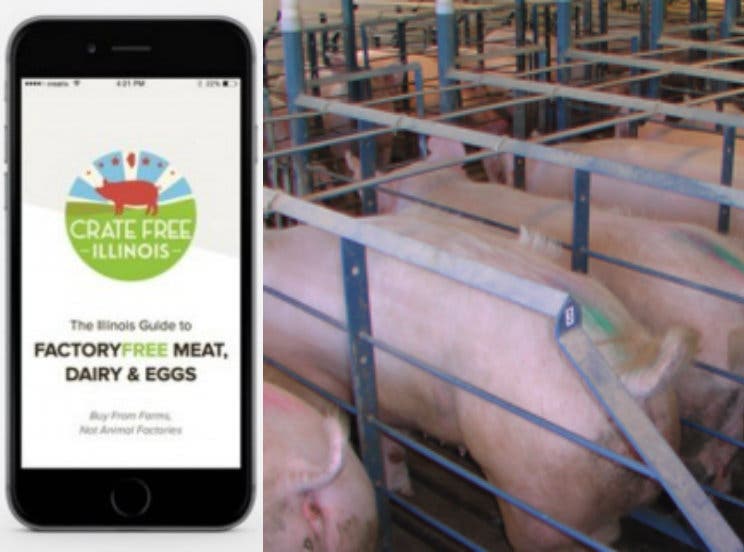
Crate Free Illinois, a nonprofit advocating against inhumane factory farming, recently released a mobile app called, “The Illinois Guide to Factory-Free Meat, Dairy & Eggs.” The app uses a consumer’s current location to find local options to purchase meat, poultry, dairy and eggs from farmers who use humane farming practices, said Jessica Chipkin, founder of Crate Free Illinois.
Find out what's happening in La Grangefor free with the latest updates from Patch.
“Our organization has nothing to do with becoming a vegetarian or a vegan,” Chipkin told Patch. “We actually really want to inform people who enjoy eating meat about what happens to the animals before in the supply chain, because many times when meat eaters become aware they go, ‘Oh I didn’t know that,’ and they start to think of alternative to get the meat products.”
The app, while useful to consumers, is ultimately a platform for Crate Free Illinois. The organization has two immediate goals, raise awareness of animal cruelty in the farming system and to lobby for legislation banning the use of gestation crates in Illinois.
Find out what's happening in La Grangefor free with the latest updates from Patch.
A gestation crate is a metal enclosure that a breeding pig will be kept in for most of its adult life, Chipkin said. A sow will be kept in the crate, nearly immobile, for the duration of a pregnancy and is repeatedly impregnated during the entirety of its life.
Chipkin compares it to a life sentence.
Crate Free Illinois is facing an uphill battle, as Illinois is one of the largest hog-producing states in the country.
Illinois is the fourth-largest hog-producing state behind Iowa, North Carolina and Minnesota, according to the 2012 Census of Agriculture complied by the U.S. Department of Agriculture. The industry also brings in a lot of revenue for the state. In 2009, the total output of the Hog industry was around $1.8 billion, according to a 2011 study titled “The Economic Impact of Illinois’s Livestock Industry.” The industry also brought in about $170 million in taxes.
That’s a lot of bacon.
And the hog industry doesn’t just represent a large cut of the economy, around 10,500 jobs in Illinois are linked to the industry, according to the The Illinois Pork Producers Association. These jobs come not just from pork production, but also from transportation, processing and suppliers of feed and equipment.
The hog industry in Illinois is also undergoing some changes, but not the kind that Crate Free Illinois advocates for. As farms in Illinois become more specialized, hog farmers are increasing the size of their operations. In the period from 2004 to 2007, the number of farms raising more than 5,000 heads of hog grew from 35 percent to 55 percent, according to “The Economic Impact of Illinois’ Livestock Industry.” Additionally, the number of farms raising fewer than 2,000 heads dropped from 31 percent to 18 percent.
Another hurdle for Chipkin and Crate Free Illinois? Pork producers firmly stand by the use of gestation crates.
“To me it goes back to who understands and really has the most experienced knowledge of what’s best for the animals and to me that answer is the farmers who are doing it 365 days a year,” Tim Maiers of the Illinois Pork Producers Association told Patch. “It’s in their best interest to care for those animals. One because it’s the right thing to do, and two because it is their livelihood.”
Maiers questioned the animal welfare and husbandry experience of groups like Crate Free Illinois, which he said often are motivated by emotions. Maiers told Patch there have been no studies that link gestation crates to poor welfare for the sows. Maiers said gestation crates even give farmers a better chance to administer aid to a sow on an individual basis, and sows often need to be contained due to their aggressive nature during pregnancy.
“It’s good for consumers to have choices and we definitely want to support that but I’m concerned that consumers are misled in thinking that if it’s not raised a certain way then it is bad and that’s simply not the case,” Maiers said.
Chipkin, convinced of the value of her cause, sees the phone app as a way to spread her organization’s message and achieve its goals.
“It’s really consumers thinking about what they want and using their purchasing power to influence change, that’s really what this is about,” Chipkin told Patch. “So that’s why the mobile app is important because you know how people are these days, there’s apps for everything. So it was just a natural fit.”
Crate Free Illinois found a likeminded partner in David Jelinek, the founder and CEO of Creatix, the company that produced the app. Chipkin said the app would not have been possible if not for Creatix, which produced the app free of charge.
“Crate Free Illinois is the perfect example of a great cause empowered by technology to advance its mission,” Jelinek, said in a press release. “While most nonprofits use social media to drive traffic to their websites or raise money, this organization is leveraging technology more strategically to expedite the speed at which it raises awareness and enables supporters to further its goal.”
Production on the app started roughly six months ago. During that time volunteers spent hours researching food sustainability websites, gathering information from nonprofits, and attending events to create a database of vendors that sold humane animal products. And no matter where you are in Illinois, the app works.
And even though the app is launched, Crate Free Illinois still relies on volunteer submissions to add to that database.
“We’ve got a few people who have seen it and have said, ‘Well I go to this great organic farm,’ so we get it into the app and we’ve already added quite a few farms,” Chipkin told Patch. “We know that we don’t have every farm but we hope to keep growing and we hope people email us and let us know.”
The Illinois Guide to Factory Free Meat, Dairy & Eggs is available for download for iPhone on the App Store and Android devices on Google Play.
Get more local news delivered straight to your inbox. Sign up for free Patch newsletters and alerts.