Neighbor News
The Stories of the Forest: Lichens, Fungi, and Mosses
by Abbey White, Montessori-trained teacher, M.S. in Plant Biology and Conservation

How to Use this Article
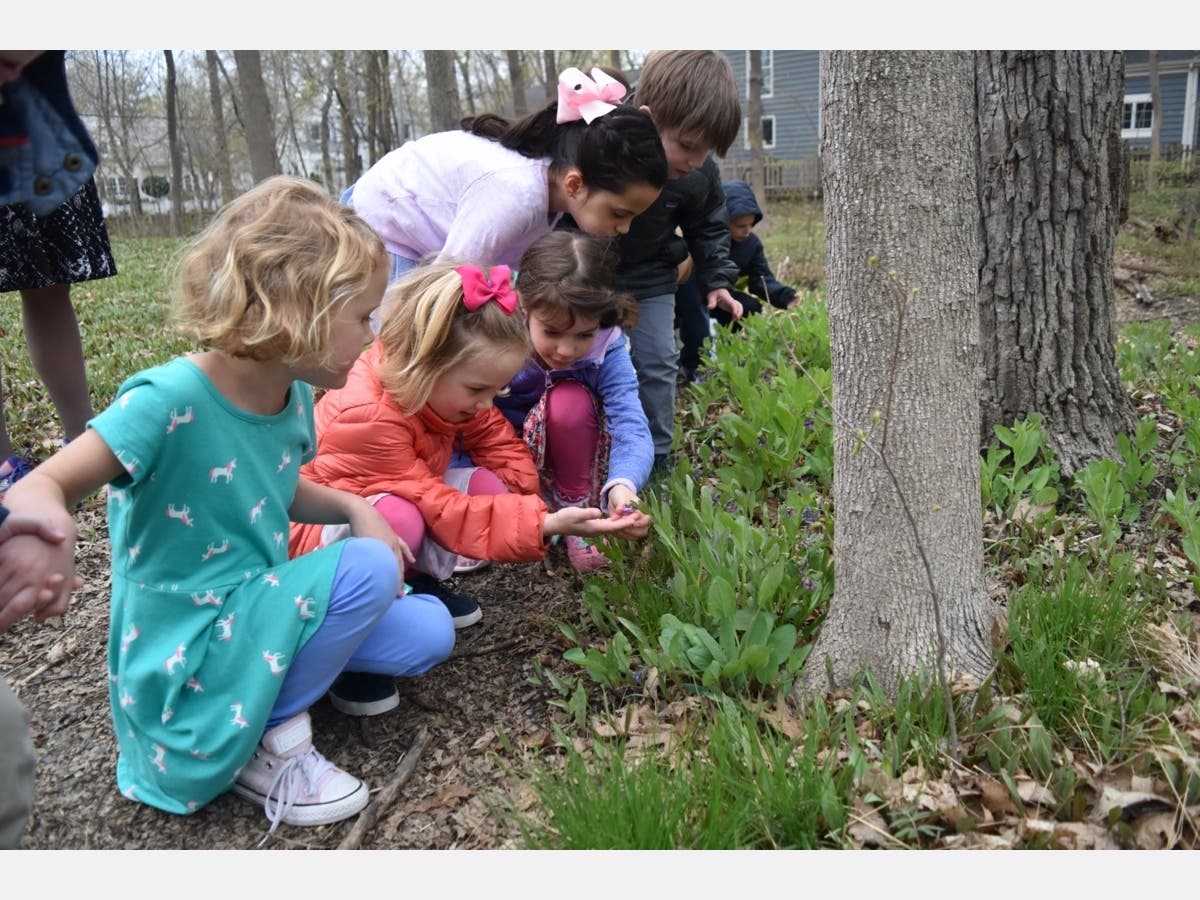
My wish for you and your family is simply to go outside and exercise your scientific minds through observation. Each and every one of us is already a scientist! Children are naturally curious observers, and the best nature walks are the ones in which I take a backseat and follow their trail.
The information provided in the following sections on lichens, fungi, and mosses is designed to be a quick reference or “mini-lesson” to generate interest. Choose just one topic each day (lichens, fungi, or mosses) and focus on that. Then, perhaps the next day, or later that week, you can choose another and go on a walk focusing on that one!
Find out what's happening in Lake Forest-Lake Blufffor free with the latest updates from Patch.
If I were to gather a group of children to talk about lichens, for example, I would weave together a short story using some of the terms and concepts included in my description. The younger the children, the shorter the story! You can always add more information in a later story if you decide to continue with the work. Then I would encourage further exploration with the suggested age-appropriate activities in the bulleted lists.
“The Stories of the Forest”
Find out what's happening in Lake Forest-Lake Blufffor free with the latest updates from Patch.
Many years ago, I read a book titled “The Forest Unseen: A Year’s Watch in Nature” by David George Haskell. The concept for this book has stayed with me because Haskell’s experimental design is powerfully simple. Every day for an entire calendar year, Haskell visited and studied a square meter plot of old growth forest in Tennessee and watched it transform. The motivation behind this project was imaginative: Haskell wanted to “tell the stories of the forest."
At the moment, we find ourselves limited to our backyards and nearby parks for exploring botany and zoology. Luckily, Haskell’s book is a beautiful and timely reminder that you do not have to venture far to enjoy, interact with, or study nature! All you need is a small plot of land.
The Power of Scientific Observation
Each chapter of Haskell’s book begins with a simple observation, one that we might not consider to carry much weight, such as “a slug meanders by.” Haskell masterfully uses those observations as a window into broader topics in biology and ecology. For example, what role do slugs play in the larger forest community? How do they facilitate decomposition and what would happen if that slug disappeared from the ecosystem? If we take a page from Haskell’s book, perhaps we, too, can open that window, and what better time to observe nature closely than when the plant and animal kingdoms are waking up with the arrival of spring?
Historic naturalists would spend hours outside with a notebook and a pencil, simply observing and writing. In fact, their published scientific papers would be pages and pages of those notes, often presented as a stream of consciousness. The scientific community has gotten away from that method in favor of a much more standardized approach (the famed scientific method), but those initial observations are the foundation of all science. Your child may be inspired to sit outside and write down everything they see in a notebook like the early naturalists!
As many scientists across space and time have noted, often the things that are inconspicuous in nature are the ones making the most impact on the ecosystem. Haskell certainly championed the less charismatic organisms on the forest floor. So today, I’d like to explore organisms that are very often overlooked: lichens, fungi, and mosses.
Lichens
Lichens are models of true partnership in nature. Although they present as one, unified entity, lichens are actually composed of two different organisms living in the same house, so to speak. And here is the most fascinating part: they are technically neither plant nor animal as a result. One part algae, one part fungus, lichens are systems of cooperating organisms and therefore excellent examples of symbiosis in nature.
Each part of the lichen depends on the other for survival. The fungal component, or mycobiont, cannot make its own food. Instead, its purpose is to determine the form or structure of the lichen. The algal component, or photobiont, captures energy from the sun and turns it into food for both itself and the fungus in a process called photosynthesis.
Depending on the type of fungus in the partnership, lichens take on many different forms. For ease of classification, they have been grouped into three general categories: crustose, foliose, and fruticose. Crustose lichens look exactly as they sound, like a crust on a surface. Foliose lichens resemble leaves and are often lobed. Finally, fruticose lichens have a branching and shrubby appearance.
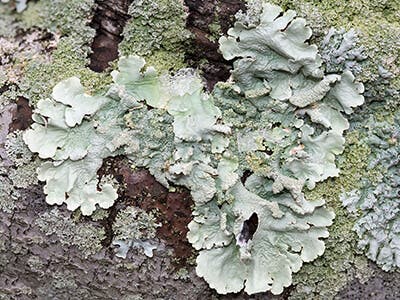
Lichen can survive in almost every region of our planet, no matter how harsh the environment. In fact, there are approximately 400 species of lichen growing in Antarctica (compared to only two species of flowering plants!). They respond most strongly to moisture availability and their presence is an indication of ecosystem health.
Exploring Lichens with Children :
- On every nature walk with young children, my objective is to reinforce language and fix specific terms. The youngest children can learn the word “lichen” if you encounter one, while older children may be capable of learning to identify it as either crustose, foliose, or fruticose.
- Perhaps you might collect one specimen and create a “nature table” in your home. A nature table is a tray or basket of items collected from nature that rotate with the seasons. Having one displayed in your home is a beautiful way to connect your family to the outdoors and it also serves as a visual reminder that it’s time to get outside and switch out the specimens! As with any collection, it is important to only take one of each type of organism so that we protect them.
- Go on a lichen hunt. Can you find all three types of lichen? Bring a photo of each type if that helps. See the Lichen Field Guide.
- Look for patterns in lichen growth. Do they grow on rocks? On wood? Where exactly on those surfaces do you notice lichen most often? On the underside? Near the top? Can you speculate about how much light they receive in those locations?
- Interestingly, lichens have a long history of use as natural dyes. Many crustose lichens are brilliant oranges, reds, and purples. What other materials in nature could be used to dye fabric? If possible, could you make a natural dye?
- Explore and diagram the life cycle of these ancient organisms
Fungus
Fungi take on many forms, but mushrooms are likely the most familiar to us. As nature’s most effective recyclers and decomposers, we would be lost without them, buried under miles of dead leaves and logs. Over the years, scientists have struggled to classify fungi because their characteristics are somewhat intermediate between plants and animals. Today, fungus is considered to be more closely related to animals.
If you were to go on a mushroom hunt, you might encounter a variety of types. For example, some have a distinct cap, others look like oysters and are aptly named “oyster mushrooms.” My caution to everyone searching for mushrooms is to look and not touch. While most mushrooms you encounter in nature will be perfectly harmless, some are poisonous, and it is best to err on the side of caution.
.jpg "Cap mushroom")
Exploring Fungi with Children
- Incorporate mushrooms from the grocery store into an upcoming meal and have your child prepare them. As they do, name the parts together (cap, gills, and stalk; see the Illinois Mushroom guide).
- Go on a mushroom hunt! Do you see the cap, gills, and stalk?
- Where do different kinds of mushrooms come from? Can you map the economic geography of mushrooms? Where do we get Portobello mushrooms, for example?
- Truffle hunting is an activity involving dogs, and more famously, pigs! In fact, the ancient Babylonians and Sumerians searched for truffles. Throughout the course of history, truffles were a delicacy often reserved for royalty and the aristocracy. Consider exploring the history of truffle hunting.
- Yeast, another category of fungus, is a crucial component of bread. Try baking bread from scratch using yeast. What effect did the yeast have on the dough?
- How does decomposition work?
Mosses
Early mosses were some of the first colonizers to survive on land when life transitioned out of the water. Therefore, mosses are incredibly primitive plants and have been living on Earth for millions of years. They lack flowers, fruits, seeds and roots, which means they have a unique life cycle.
In the same way that butterflies and toads have two phases of their life cycle, mosses also have two distinct phases. The first is the gametophyte, more simply the green, leafy structure you often see first, and the second is the sporophyte, which are tiny structures that emerge from the gametophyte. At the end of the sporophyte is a capsule, which will burst open to release a cloud of microscopic spores. The spores are the equivalent to seeds and will go on to create new moss.

Exploring Mosses with Children:
- There are many opportunities for sensory exploration with moss. Moss is often described as “carpeting the forest floor.” Encourage your children to feel moss with their hands and look closely. If you have a handheld magnifying glass, this is the perfect opportunity!
- Can you see the sporophyte?
- One of my favorite activities is making a terrarium and mosses are very often included!
- Create a tree of classification for the mosses (i.e., Phylum Bryophyta). Not far removed from mosses are the hornworts and liverworts. What makes them unique?
- See Common Mosses and Liverworts of the Chicago Region
Glossary
Crustose: lichen growth form; flat with a “crusty” appearance; often red, yellow, or orange
Foliose: lichen growth form; resembling leaves; often lobed
Fruticose: lichen growth form; upright, branched, and “shrubby”
Mycobiont: fungal component of lichen (Greek, mykēs, “fungus,” and bios, “life”)
Photobiont: photosynthetic component of lichen (e.g., algae) (Greek, photo-, “light,” and bios, “life”)
Photosynthesis: the process by which plants convert the sun’s energy into food.
Symbiosis: long term association between organisms of different species. These relationships can be mutualistic (both benefit), commensal (one benefits and the other is unphased), or parasitic (one benefits, the other suffers)
Cap: the top of the mushroom; resembles an umbrella
Gills: papery slits on the underside of the mushroom cap
Stalk: stem of the mushroom
Gametophyte: leafy stage of moss
Spores: the equivalent of seeds in moss
Sporophyte: thin shoot that emerges from the gametophyte and releases spores.
Terrarium: a glass container filled with moss, air plants, succulents, pebbles, etc. (essentially a mini ecosystem)