Neighbor News
Mother always knows best...even after she's dead
Get a glimpse at Mitera, a new play examining the idea that sometimes the people we've known our entire lives are those we know the least.
Strangeloop is in the middle of a capital campaign to raise funds for our 8th Season. Your donations will help support new and exciting works like Mitera — Strangeloop’s mainstage production, which will go up in the spring of 2016. We recently sat down with playwright Maria Burnham to chat about her inspiration for the play.
Q: What is Mitera about?
A: Mitera is the story of three, single adult sisters who live at home and have their lives turned upside down when they find out their mother is still micromanaging their lives from beyond the grave. As the play begins, they discover their mother has left their entire inheritance contingent on the youngest sister marrying within a year of her death, otherwise everything goes to their oldest male relative in Greece. But the youngest sister is an unattached romantic who believes in marrying for love.
Find out what's happening in Lakeviewfor free with the latest updates from Patch.
Q: What does Mitera mean?
A:Mitera, or (ἡ) Mητέρα, means mother in Greek.
Find out what's happening in Lakeviewfor free with the latest updates from Patch.
Q: Where did you get the idea for this story?
A: There were several different things going on when I decided to write this piece. One was simply that I wanted to write roles for Greek-American actresses because that’s not something that exists. We play a lot of other ethnic groups that are more prevalent in theater – Italian, French, various Middle Eastern nationalities. I have no idea if Greek-American actresses will be cast in these roles, but I wanted to create that opportunity. Then when I started thinking about the actual story that I wanted to write, I kept coming back to my own mother and her desperate desire that my brother or I get married and produce some grandchildren. I wanted to explore how far a mother might go to force that desire onto her children.

Q: Is this a story that will be relatable to people who aren’t Greek?
A: Ultimately it is a story about love. Love between family members, the things people do for love, the bad choices people make in the name of love, the ridiculous lengths we go to out of love. That’s what makes all stories relatable regardless of setting. Audiences relate to Les Miserables despite having no firsthand experience with the French Revolution. It’s not the trappings of a play that make a story compelling or interesting to an audience, it’s the heart of the story being told.
Q: So is this play influenced by your own life?
A: In some ways, yes. I’d say the larger world I’ve set this in is most influence by my own life. The sisters in this play grew up in an insular community, like we have in my hometown, where everyone knows everyone else’s business – where people can be friendly to you, even as they are gossiping about you behind your backs. They are half Greek, like me, which makes you an outsider to two difference communities. Character-wise, Sharon, the youngest sister’s godmother, is definitely modeled on my own godmother, and the Greek cousin has shades of my oldest male cousin back in Greece – though Adonis is not quite as nefarious as Demitrios. The sisters, though, are not based on anyone. They just sort of sprung to life on their own.
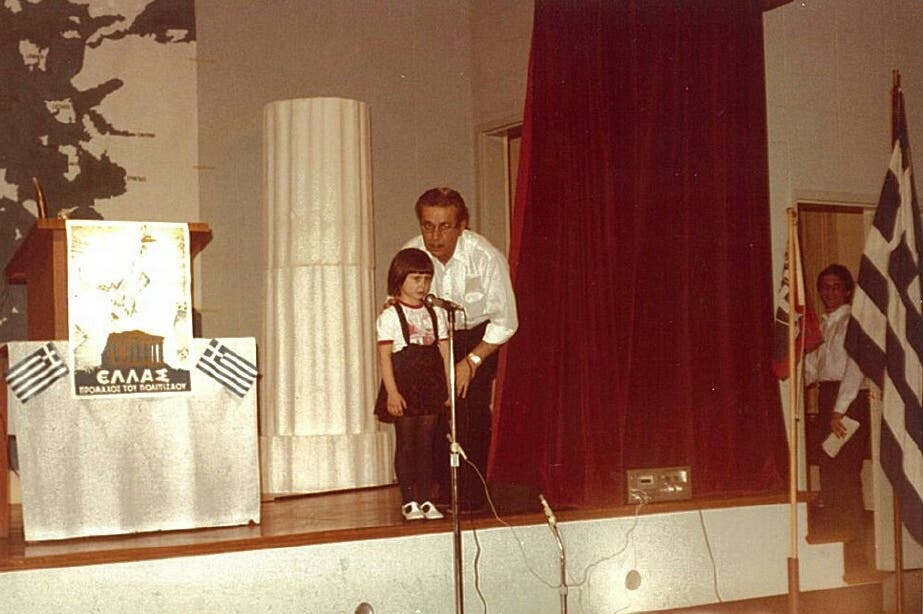
Q: Do you want to explain the photograph that is accompanying this interview?
A: That is the playwright at the tender young age of 4 being forced to recite something at a Greek Independence Day celebration at my church. It’s probably the least humiliating of the things Maria was made to do as a child to celebrate her Greek heritage. Most of the others involved funny hats.
Q: What can people do to support this production?
A: We can always use help raising awareness of the productions we mount. More immediately we have a fundraising campaign going on that will help pay for rehearsal and performance space rentals and costuming, set and prop needs. It’s not a play with a lot of spectacle, but it still costs money to produce. We have a karaoke fundraising party coming up on Saturday, October 17, at Matilda’s in Lakeview. It’ll be a lot of fun and I’ll be there reading futures in coffee grounds if you want a glimpse into one of the more bizarre Greek customs. Plus, of course, karaoke. But if people can’t make that, we also have a Kickstarter campaign going on through October. You can help us out from the comfort of your own home.