Neighbor News
Why the sports physical is the most important play of the season
A local clinician on what pre-participation physicals catch in young athletes — and why grades 8-12 families shouldn't wait until August

By Rod Levin, FNP-C, Vitality Urgent Care
Every summer, families work through the same back-to-school checklist — registration, supplies, schedules. For student athletes in grades eight through 12 hoping to make a fall roster, one item carries far more weight than most parents realize: the pre-participation physical, which the Illinois High School Association requires to be on file before the first practice or tryout.
It is easy to treat this as paperwork — a form to be signed so a season can start. It is not paperwork. It is the one scheduled moment each year when a healthy-looking teenager sits in front of a medical provider whose only job, for those twenty minutes, is to make sure it is safe for that young body to be pushed to its limit.
Find out what's happening in Lake Zurichfor free with the latest updates from Patch.
What it means for the athlete
Most serious conditions in young athletes do not announce themselves. A teenager can feel strong, practice hard and compete at a high level while carrying an undetected heart abnormality. Conditions such as hypertrophic cardiomyopathy — a thickening of the heart muscle — are among the leading causes of sudden cardiac arrest in young athletes, and they frequently cause no symptoms at all until a moment of maximal exertion. The physical exists to find these problems before the sport does.
Find out what's happening in Lake Zurichfor free with the latest updates from Patch.
What it means for the parent
Parents are asked to complete a health history before the exam, and this is where they do their most important work. Questions about fainting or chest pain during exercise, unexplained shortness of breath, or a family history of sudden death or heart disease before age 50 are not formalities. Honest, thorough answers to those questions guide the entire examination. A parent who mentions that an uncle died suddenly in his 40s has just given the examiner the single most valuable piece of information in the room.
What it means for the school
Schools and athletic departments depend on these exams as the foundation of athlete safety. Whether an athlete is trying out at Lake Zurich High School, Buffalo Grove High School, Stevenson or a local middle school, coaches and trainers can respond to an emergency — but they cannot see inside a chest. When every athlete on the field has been properly screened, the school's emergency planning becomes the second layer of protection rather than the only one.
From the exam room
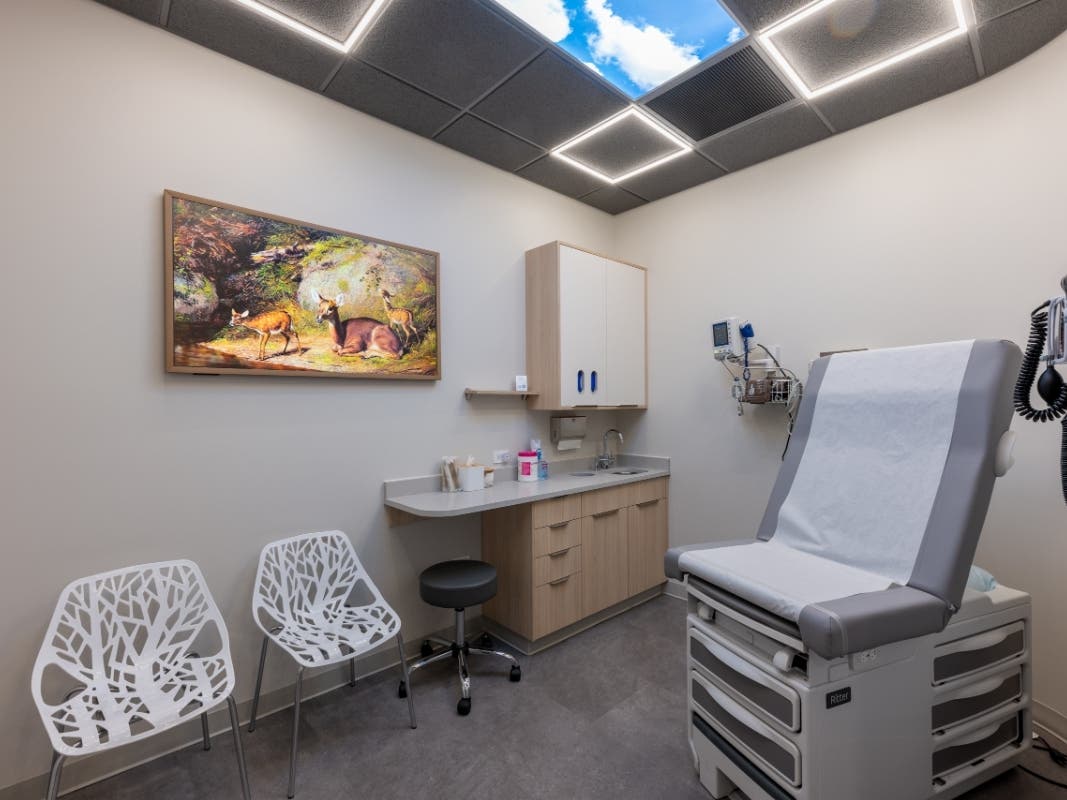
In the exam room, the physical is anything but routine, and it follows a deliberate order. It begins with the health history — the questions about fainting, chest pain, dizziness during conditioning and family heart disease that guide everything that follows. Next come vital signs, and every season we find teenagers with blood pressure readings high enough to need follow-up. Then the vision check, where we regularly find athletes who see poorly out of one eye and never knew it. Sometimes that needs further evaluation; sometimes it simply means protective eyewear for certain sports. Either way, it is discussed with the parent and athlete before they are released to the activity of their choice.
Then we listen to the heart — in more than one position, because some murmurs appear or change only when an athlete stands or strains. When we hear something, I tell families the same thing every time: there is a heart murmur — a heart sound that should not be there. It may be entirely innocent, and many are, but it may warrant additional investigation. Often an EKG can be done the same day, and depending on those findings, the athlete may or may not need further testing.
The exam finishes with the lungs, the joints and the rest of the body — screening for asthma that flares only with exertion, asking about that ankle injury from last spring that "healed on its own," and making sure everything is in alignment and works the way it should before a season of running, cutting and contact.
Most exams end with a clean bill of health and a signed form. But when something is found — a murmur that needs an echocardiogram, blood pressure that needs rechecking, a heart rhythm that deserves a cardiologist's opinion — early recognition changes everything. Detected late, these conditions can lead to permanent heart damage or tragedy on a field or court. Detected early, most are treatable or manageable, and the great majority of athletes, after proper evaluation and treatment, are cleared to return safely to the sport they love. That is the entire purpose of the exam: not to keep kids out of sports, but to make sure they can stay in them for years to come.
A checklist for families
- Schedule the physical in June or July — August appointments fill quickly, and follow-up testing takes time.
- Complete the health history before the visit, and answer the heart questions carefully: fainting or chest pain during exercise, and any family history of sudden death or heart disease before age 50.
- Bring the pre-participation physical form from your school or athletic program — and if you forget it, don't worry; most clinics keep them on-site.
- Bring a list of medications, allergies and any injuries from last season — including ones that "healed on their own."
- If a finding needs follow-up, complete it promptly. Most athletes are cleared to return safely once evaluated and treated.
Those twenty minutes in the exam room are what they truly are — the most important play of the season, made before the season even starts.
Rod Levin, FNP-C, is a board-certified family nurse practitioner and medical director with more than 20 years of clinical experience, practicing in Buffalo Grove and Lake Zurich. Vitality Urgent Care is a community partner of Township High School District 214.