Obituaries
Argonne Scientist and Nobel Laureate Dies at 88
Alexei Abrikosov, a prominent scientist and Nobel Laureate, passed away March 29.


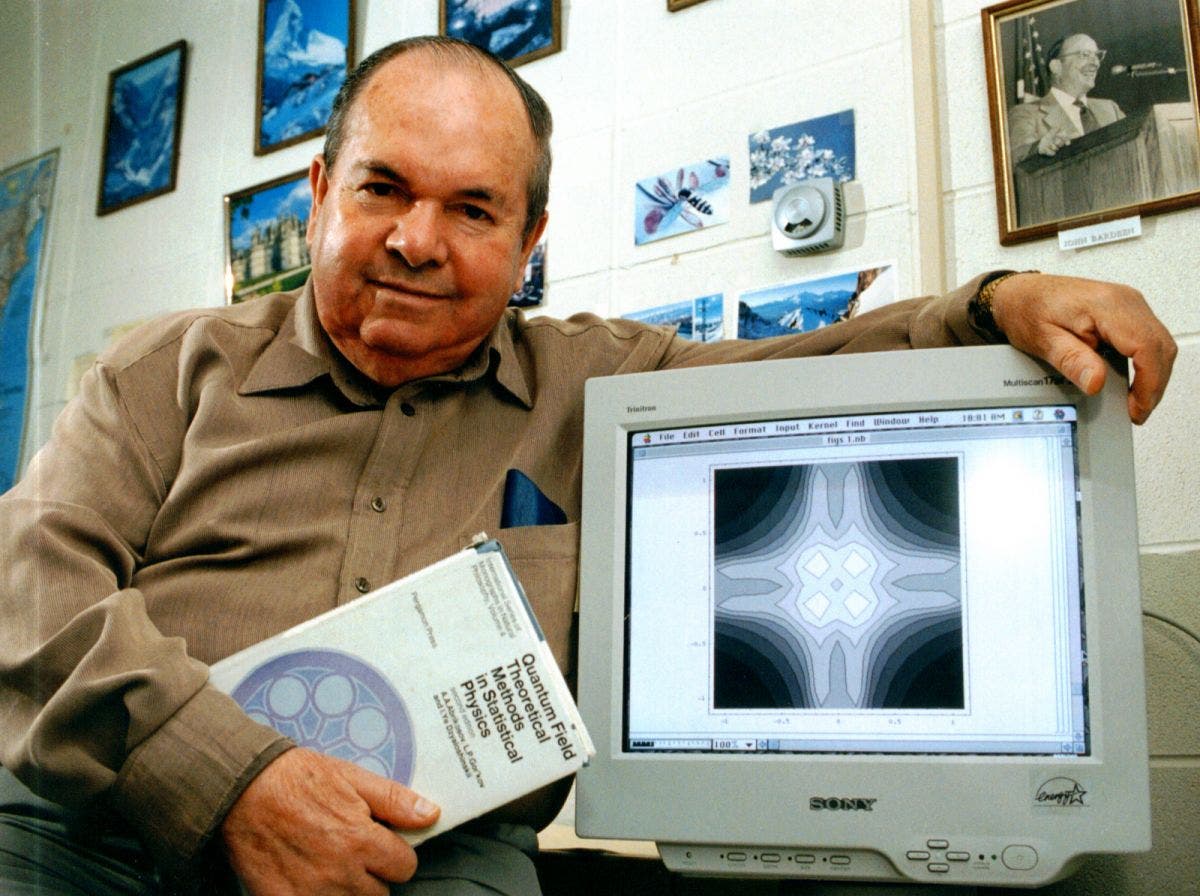
LEMONT, IL - Alexei Abrikosov, an acclaimed physicist at the U.S. Department of Energy’s Argonne National Laboratory who received the 2003 Nobel Prize in Physics for his work on superconducting materials, died Wednesday, March 29. He was 88.
According to a release from Argonne, Abrikosov proposed the theory that underlies the understanding of “type-II” superconductors,which are instrumental to technology that affects many areas of our lives and areas of science, including MRI machines, particle accelerators and cell phone towers.
Until 1952, scientists only understood one type of superconductors, whose properties vanished under a sufficiently strong external magnetic field. That year, Abrikosov developed a theory that showed that magnetic fields could penetrate a superconducting material to create a network of vortices, while the material itself remained superconducting.
Find out what's happening in Lemontfor free with the latest updates from Patch.
“You can think of it like punching holes in a sheet of paper,” said Argonne Materials Science Division director Michael Norman in a release. “As long as the holes stay in a fixed position, the paper keeps its form.”
“Dr. Abrikosov’s achievements laid a foundation for years of scientific research and discovery to come,” said Paul K. Kearns, Interim Laboratory Director. “Work we do every day at the lab relies on what he was able to explain, and is instrumental to technology that affects our personal and professional lives."
Find out what's happening in Lemontfor free with the latest updates from Patch.
Kearns said that Abrikosov was more than a colleague, he was an inspiration.
“All of us at Argonne aspire to his intellect, to the perseverance he showed in the face of criticism during his early days as a scientist, and to the longevity of his accomplished career. He will be missed and his memory honored," Kearns said in a release.
Abrikosov’s wide-ranging scientific research also included work in quantum electrodynamics – the theory of elemental particle interactions – as well as astrophysics, magnetoresistance, plasma physics and the theory of quantum liquids.
Argonne said his foundational book with Lev Gorkov and Igor Dzyaloshinskii, “Methods of Quantum Field Theory in Statistical Physics,” has become such a classic in condensed matter physics that it is known to scientists in the field simply by the acronym of its three authors – “AGD.”
According to Norman, Abrikosov’s discovery formed the foundation for future breakthroughs in “topological matter,” which involves, in part, essentially two-dimensional superconductors. Work in this field by researchers who followed Abrikosov formed the basis of the 2016 Nobel Prize in Physics.
Abrikosov was born in Moscow in 1928, and received his Ph.D. in 1951 from the Institute for Physical Problems. He worked at several institutes in Moscow, including as director of the Institute for High-Pressure Physics of the Academy of Sciences, before joining Argonne’s Materials Science Division as a Distinguished Scientist in 1991. He became leader of Argonne’s condensed matter theory group in 1992 and held the position until 2000, and he continued to work with the division until last year.
“He grew up in the age of Stalin, came to the United States as the Soviet Union was breaking up and loved to climb mountains,” Norman said in a release. “You needed to be prepared to spend an hour with him if you went to his office because he always had stories to tell.”
Abrikosov was also an adjunct professor with the University of Illinois at Chicago and the University of Utah. He is honored at the laboratory with a postdoctoral fellowship named for him that sponsors up- and-coming materials scientists.
Abrikosov was a member of the U.S. National Academy of Sciences, a foreign member of the Royal Society of London, a member of the Russian Academy of Sciences and a fellow of the American Physical Society, among other honors. He also received the Lenin prize in 1966, the London prize in 1972, the Landau Prize in 1989 and the John Bardeen Award in 1991.
Photo provided by Argonne National Laboratory.
Get more local news delivered straight to your inbox. Sign up for free Patch newsletters and alerts.