Community Corner
Host Thanksgiving Dinner in Traditional Style
A Log Cabin Treasure for Many Thanksgiving Dinners 10/15/14 By Laura Knapp
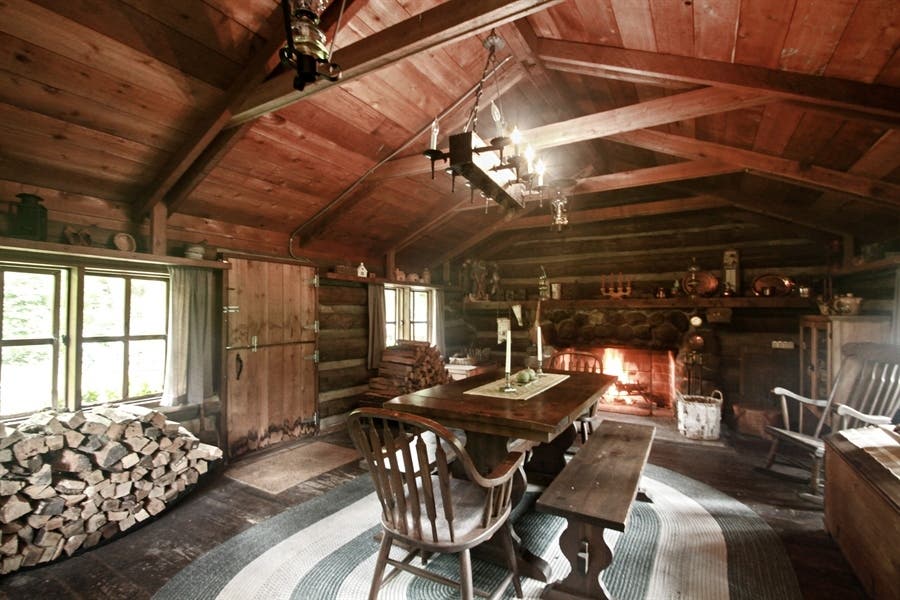
Libertyville has a grand log cabin history. The earliest log cabins are no longer around, but one rustic and simple log cabin has survived and is located adjacent to the Bull Creek tributary in the Brookside Park Subdivision, just west of the Des Plaines River. The cabin was restored in 1972 and has been enjoyed by owners Leonard and Gill Peterson as a rustic retreat. They believe it was built over 90 years ago.
Libertyville’s early pioneers built and lived in log cabins. These homes were quickly assembled and were built from grove trees. The building type was a natural fit for those arriving in Lake County following the Treaty of Chicago in 1933. One of the first noted log cabins in Libertyville was for George Vardin and his daughter. The Vardins were the first permanent settlers of “Vardin’s Grove.” The name was later changed to Independence Grove, Libertyville, Burlington, and in 1841, back to Libertyville. The Vardin’s left the area by 1837 and their log cabin became Libertyville’s first post office. Other noted pioneers Richard and Ransom Steele, brothers who had moved to the area in 1834, built a log cabin south of town. Richard’s son, Albert B. Steele, was born in the cabin and is said to be the first white child born in Lake County.
Find out what's happening in Libertyvillefor free with the latest updates from Patch.
Interestingly, the Peterson’s log cabin sits upon what was once part of a well-known and recorded land disagreement. Tobias Wynkoop built his log cabin in 1835 along the banks of Bull Creek, mentioned earlier. Tobias Wynkoop came to Libertyville from New York State along with his nephew, Archimedes Wynkoop. Wynkoop gained a reputation and was described as “…a person of rare eccentricity, whose peculiarities are remembered by the early settlers, and at whose expense many a ludicrous anecdote is related.” His biggest scheme began when he settled on 1,520 acres of U. S. Government land in Libertyville Township in Sections 3, 4, 5, 7, 8, and 9. He lived on the land for 14 years and raised cattle. His family never owned the land and even convinced others to buy it for him and purchase cattle for him to manage. After Wynkoop disregarded countless attempts for repayment, the land was finally auctioned in 1849 to Julius Bull, a wealthy New Yorker. A justice of the peace had to forcibly remove him from the log cabin. Later, the land continued to be used for cattle by the Cater Family and then was sold in 1922 to Quinlan & Tyson to be developed as the Brookhill Park Subdivision with sites ranging in size from three to eight acres. When Wynkoop lived on the land he named the creek after himself, Wynkoop Creek, and it wasn’t until the property was officially sold to Bull that it was renamed Bull Creek.
The Peterson’s log cabin was built well after the 1830s. It was part of a log cabin revival that hit America in the late 19th Century. Popular publications about log cabins added to the revival of the building type. Specifically, the 1889 book, “Log Cabins: How to Build and Furnish them” by William S. Wicks, was popular for forty years and went into a 10th printing by 1929.
Find out what's happening in Libertyvillefor free with the latest updates from Patch.
The Peterson cabin is constructed with a single pen plan and has a rustic fieldstone fireplace at the south end. A single door and simple window openings provide access and light to the one room space. Leonard Peterson, an accomplished architect, built the home adjacent to the cabin and reported he “carefully sited the new house around the existing log cabin so most rooms have a view of the cabin and the creek.” Full logs, believed to be of recycled pine utility poles, make up all walls and were assembled and connected with saddle corner notches, a typical log cabin connection that provides structural integrity by locking the log ends in place. The Peterson log cabin, similar to pioneer cabins, is chinked and daubed between the logs where joints occur. This finishing technique would have created a waterproof seal against driving wind and typically was a three-part system having the final coat consisting of a mixture of clay and lime.
The Peterson’s Brookhill Park house and log cabin is on private property, but currently is for sale. The property is 1.5 acres on a wooded lot that includes a 300-year-old oak tree, the 1920’s log cabin, and spectacular views of Bull Creek. You’ll feel a million miles away yet still close to town, shopping, dining and transportation. The Prairie style main house has a hexagonal floor plan with custom built-ins, millwork and intricate ceiling design and is constructed using Clear Heart California Redwood inside and out - decking, paneling and millwork. There are decks off every room and floor to ceiling windows offer spectacular views of Bull Creek. There is an indoor pool suite with full bath, hot tub, sauna, wet bar. Extensive outdoor lighting highlights the heritage trees. Other amenities include a den with Murphy bed, master bedroom with sitting room, kitchen with double oven, garden window and a pop-up sky light. It isn’t every day you can own a log cabin to host your Thanksgiving dinners and that is full of Libertyville history!
The home, located at 115 Brookside Court, Libertyville is currently listed for sale for $759,000. For more information, please contact the listing agent, Julie Pawl, @properties at 847.845.9348. www.115Brookside.info
Laura Knapp is a preservation consultant who regularly consults on local historic properties. Records from the Cook Library, Libertyville-Mundelein Historical Society, and the Lake County Discovery Museum were used to research this topic