Community Corner
Naper Settlement program highlights little-known Chicago history
Naper Settlement's History Speaks Lecture Series presents John and Mary Jones and the Illinois Black Codes Feb. 8.

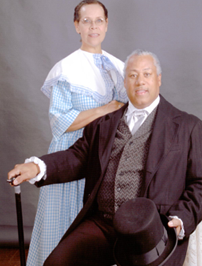
D. Kucha Brownlee grew up in Chicago and had never heard of John Jones until she saw an exhibit at the Chicago History Museum about Abraham Lincoln.
“When I went through the exhibit, I saw this beautiful portrait of John and Mary Jones. We started doing the research and we realized how important he is to our history,” Brownlee said.
That research grew into a fully costumed performance about the life, times and accomplishments of John Jones, vice-president of the Freedmen’s Association, who was most influential in removing the Black Codes from Illinois Law, and his wife, Mary Richardson Jones, his constant support.
Find out what's happening in Napervillefor free with the latest updates from Patch.
Storytellers D. Kucha Brownlee and Baba Tony Brown are bringing this courageous couple to life during Naper Settlement’s History Speaks Lecture Series: John and Mary Jones and the Illinois Black Codes that will be held from 4 to 5 p.m. Sunday, Feb. 8 in the Meeting House, located at the corner of Webster Street and Porter Avenue near downtown Naperville. Tickets are $10 per person. This year marks the 150thh anniversary of the repeal of the Illinois Black Codes.
John and Mary Jones moved to Chicago in 1845 and he started a tailor shop at 119 Dearborn Street. His business soon flourished; he invested in real estate; and by 1860, he was one of the nation’s wealthiest African Americans.
Find out what's happening in Napervillefor free with the latest updates from Patch.
Brownlee described Chicago at that time as a hotbed of abolition. When the Fugitive Slave Act was passed in 1850, the Jones’ home and tailor shop became stops on the Underground Railroad. They became friends with ardent abolitionists, including Frederick Douglass and John Brown.
The Illinois Black Laws, also known as the Black Codes, had been in effect since 1819. These laws prohibited blacks from voting; they could not testify or bring suit against whites; they could not gather in groups of three or more; and they could not serve in the militia. They also were required to obtain and carry a Certificate of Freedom; otherwise, they were presumed to be slaves. Jones wrote a 16-page pamphlet titled, “The Black Laws of Illinois and Why They Should Be Repealed.”
“John Jones was talking to everyone about the Illinois Black Laws and he had a strategy to get them repealed in the state legislature,” Brownlee said.
Thanks to his hard work, determination and persistence, the Black Codes were repealed in 1865 and, in 1871, Jones became the first African American Cook County Commissioner.
“To educate is very important to us, to give people knowledge they don’t know,” Baba Tony Brown said. “Our program stresses the importance of relationships. The opposite of violence is conversation.”
For more information, about the program, visit <a rel="nofollow" href="http://www.napersettlement.org">www.napersettlement.org</a>.
About Naper Settlement
History comes to life at Naper Settlement, an outdoor history museum, located in downtown Naperville at 523 S. Webster St. Nationally accredited by the American Alliance of Museums, Naper Settlement has 30 historic structures ranging from a rustic log cabin to an elegant Victorian mansion, listed on the National Register of Historic Places. It’s where history comes to play.
For more information, visit <a rel="nofollow" href="http://www.napersettlement.org">www.napersettlement.org</a> or call (630) 420-6010.