Health & Fitness
Find Relief from Gallbladder Disease
Silver Cross offers a free program about gallbladder problems on Oct. 6.

By Tracy Simons | Silver Cross Hospital
Over 20 million Americans live with gallbladder disease, which is one of the most common and expensive of all digestive diseases since treatment often times requires surgery and hospitalization. The two major conditions that comprise gallbladder disease are gallstones and cholecystitis, which is an inflammation of the gallbladder wall and nearby abdominal lining.
Silver Cross Hospital is offering a lecture on why it’s important to find relief from gallstones and cholecystitis, which are risk factors for gallbladder cancer and bile duct cancer.
Find out what's happening in New Lenoxfor free with the latest updates from Patch.
[ A Sponsored Feature by Silver Cross Hospital ]
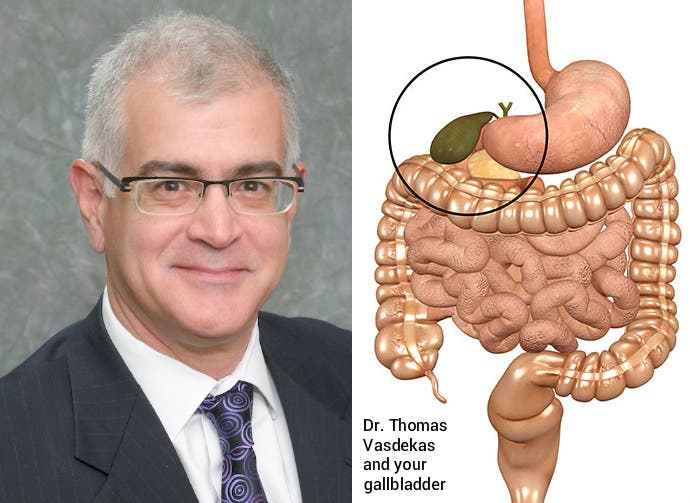
Dr. Thomas Vasdekas, board certified general surgeon, will present a free program on Gallbladder Disease: Reasons, Remedies and the Robotic Approach, on Tuesday, October 6 from 6:30 to 7:30 p.m. at Silver Cross Hospital, Pavilion A, Conference Center, 1890 Silver Cross Blvd., New Lenox. Dr. Vasdekas will discuss the symptoms, diagnosis, and the latest treatment options including robotic surgery. Register to attend at www.silvercross.org or call 1-888-660-HEAL (4325).
Find out what's happening in New Lenoxfor free with the latest updates from Patch.
Causes of Gallbladder Disease
The gallbladder is a small sac under the liver which stores bile, which is produced in the liver. The gallbladder releases bile, which helps digest fat, into the upper small intestine after eating.
Gallstones form when bile, stored in the gallbladder, hardens, becoming stone-like. A slowing of gallbladder emptying and an excessive amount of cholesterol, bilirubin (bile pigment) in the bloodstream may result in gallstones.
Cholecystitis or gallbladder inflammation is typically caused by a gallstone located in the duct that connects the gallbladder to the liver duct. It may come on quickly or develop over a long period of time.
There is no guaranteed way to prevent gallstones, but there are many things you can do to lower your risk. “By maintaining a healthy weight by exercising and consuming low-fat foods, you may be able to prevent gallstones and other gallbladder problems from occurring,” said Thomas Vasdekas, M.D.
Symptoms and Treatment of Gallbladder Disease
Gallstones and gallbladder inflammation can trigger a variety of symptoms, such as abdominal pain, bloating, nausea, and vomiting. Depending on the cause of the pain, age, and overall health of the patient, the disease can be treated in a variety of ways that include: medications to dissolve the stones, a shockwave procedure to break up stones into smaller pieces so they can pass through the bile ducts, or surgery using the da Vinci® robot surgical system to perform a single-incision gallbladder surgery.
Dr. Vasdekas is one of a small group of surgeons in the country who has received training to perform the surgery, and one of several on staff at Silver Cross Hospital. He has performed nearly 400 surgeries using the da Vinci® robot surgical system.
“Single-Site instruments used with the da Vinci system are the most highly advanced tools of surgical equipment,” said Dr. Vasdekas. “We are excited to offer this type of cutting-edge technology to our patients.”
Potential benefits of single-site gallbladder surgery may include virtually scarless results, minimal pain, low blood loss, fast recovery, a short hospital stay and high patient satisfaction. The surgery can be performed in about one hour with a typical hospital stay of less than 24 hours.
How it Works
During the procedure, the surgeon sits comfortably at a console, viewing a 3D, high-definition image of the patient’s anatomy. The surgeon uses controls below the viewer to move the instrument arms and camera. In real-time, the system translates the surgeon’s hand, wrist and finger movements into more precise movements of the miniaturized instruments inside the patient. Unlike traditional robotic surgeries requiring three to five small incisions, this new technology allows for a single incision in the belly button where instruments are placed and the diseased gallbladder is removed.
Most people who require gallbladder removal are candidates for the robotic, single-incision surgery. According to the American College of Surgeons, surgery is the recommended treatment for gallbladder pain from gallstones and non-functioning gallbladders. More than 1 million people in the U.S. have their gallbladder removed each year. Most are performed with traditional laparoscopy using several incisions.
Interestingly, misconceptions still exist that the robot is actually performing the surgery all by itself. “The important aspect to understand is that the robotic system cannot make decisions by itself,” said Dr. Vasdekas. “The da Vinci System requires that every surgical movement be performed with direct input from the surgeon.”
Silver Cross Hospital has performed over 2,000 robotic procedures since the acquisition of the da Vinci Si Surgical System three years ago. Surgeons at Silver Cross use the robot to perform prostate, gynecologic, single-site gallbladder and complex oncologic (cancer) procedures for colorectal, stomach and esophageal disease. Uniquely the hospital has two robotic surgical devices and currently 27 physicians on the Silver Cross Medical Staff are credentialed to perform surgery using the da Vinci Si™ Surgical System.
For a referral to a surgeon who performs robotic surgery, call 1-888-660-HEAL or visit http://www.silvercross.org/our-services/other-services/davinci-robotic-surgery.
About Thomas Vasdekas, M.D., FACS
Thomas Vasdekas, M.D., is a board certified general surgeon. Dr. Vasdekas completed a general surgery residency at Mount Sinai Medical Center of Chicago. He has Board Certification with the American Board of Surgery, Fellow American College of Surgeons, Member of the Clinical Robotic Surgery Association, and Member of Society of Laparoendoscopic Surgeons. His office is located at 15300 West Ave., Ste. 202, Orland Park. To schedule an appointment, call (708) 364-0441.