Schools
Montessori education offers individual attention that public schools are forced to sacrifice
The first in a series explaining the Montessori method: Meeting Common Core standards—without the inflexible Common Core curriculum
As first-time parents to a kindergartner, my wife and I recalled images from our own early experiences. Letters, numbers, colors, shapes, and lots of play. We lived in a good school district and had high expectations that our son would find his first school experience enriching, encouraging and nurturing—just as we remembered it.
We could not have been more wrong. What we found were great teachers, shiny new facilities and good-hearted administration—yet they were all hamstrung by the prescribed implementation of the Common Core State Standards (CCSS).
Find out what's happening in New Lenoxfor free with the latest updates from Patch.
My wife and I volunteered time to help in the classroom and we saw the true situation ourselves: five-year-olds spending most of their day rooted in their seats, drilled to memorize CCSS-mandated buzzwords that would appear in their CCSS-mandated testing, three years in the future.
Find out what's happening in New Lenoxfor free with the latest updates from Patch.
Very little interaction was allowed. Recess was held perhaps twice a week, for 15 minutes at a time. Silent submission to the projected lessons and teacher’s rapid, droning script of rote memorization—for five-year olds!—shocked us. We would not have believed that modern kindergarten was this way, if we had not seen it with our own eyes on multiple occasions.
It was heartbreaking to see what public education had become, but we could not ignore what we’d seen with our own eyes and heard in our son’s persistent complaint that “things just go too fast and they don’t make sense.”
Public schools are caught in the middle
Students are not the only ones having a hard time coping with real-world realities of CCSS.
We saw good teachers who were not allowed to use their talents to individually engage with their students. Instead, kids were handed off to social workers at the slightest indication of boredom or discomfort, as if a five-year-old getting squirmy after half an hour of a PowerPoint presentation represented a behavior problem—social workers who did not have a teacher’s accumulation of day-to-day experience with those kids.
We met with kind and involved administrators who were powerless to change the way CCSS was implemented in their classrooms. There were privacy issues related to the way they collected personal data and used technology to administer standardized tests, and a shocking inability to work with concerned parents who may take issue with such things. There was no flexibility allowed to treat children as individuals with the uneven levels of development that are normal and expected in young children. This is a frequent criticism of CCSS, particularly in primary and early elementary education.
We came to feel that, with CCSS driving the daily routine the way it does in public schools, there is no such thing as a “good” public school anymore. CCSS curriculums enforce uniformity above all—not elevating struggling schools, but diminishing those that are blessed with excellent staff and supportive families. It’s no wonder good public school teachers are discouraged and quitting the profession.
Separating the standards from the methods
It’s important to understand that CCSS is not just one issue, but two. There are the CCSS standards; and then there is the curriculum developed by politically-embedded education companies that are supposed to help students achieve those standards. No one could argue against ambitious standards for education, and I don’t mean to do so here. It is the curriculum—the suffocating script forced on teachers and districts—that is failing kids.
After Kindergarten, we sought an alternative to public schools after learning that first grade would only offer more of the same environment. We investigated private schools, parochial schools and eventually arrived at Joliet Montessori School in Crest Hill. We were unfamiliar with Montessori education, but what we learned during our initial conversations and visits proved to be a priceless lifeline.
Montessori offers a different route to proficiency
The Montessori method is named for Maria Montessori, the physician and educator who spent decades observing how children naturally learn. She incorporated those tendencies into a structure that empowers kids to take ownership of their education—to become their own best teachers, and teachers of each other.
My first, skeptical reaction to this idea was that it could only be a recipe for chaos, but investigation and classroom observation proved that there was indeed a clever method to this supposed madness. I discovered a nurturing, individualized environment full of calm, polite, and above all, BUSY children.
So, what is a Montessori classroom like?
Montessori education differs from public education in several important ways. I invite you to learn more about it here, but these are the factors most relevant to curriculum and the classroom experience:
Children are able to move about the room. This is what young bodies are made to do, so they don’t get fidgety with no way to burn energy. The classroom is broken out into a dozen or so subject study areas, so kids always have a choice of enriching destinations.
It promotes uninterrupted, three-hour work cycles. Two of these daily allow a child to immerse at his or her own speed, pursue subjects more deeply and discover links between different subjects—such as reading about tornadoes leading a student to study the geography of the United States to see where tornadoes are most common.
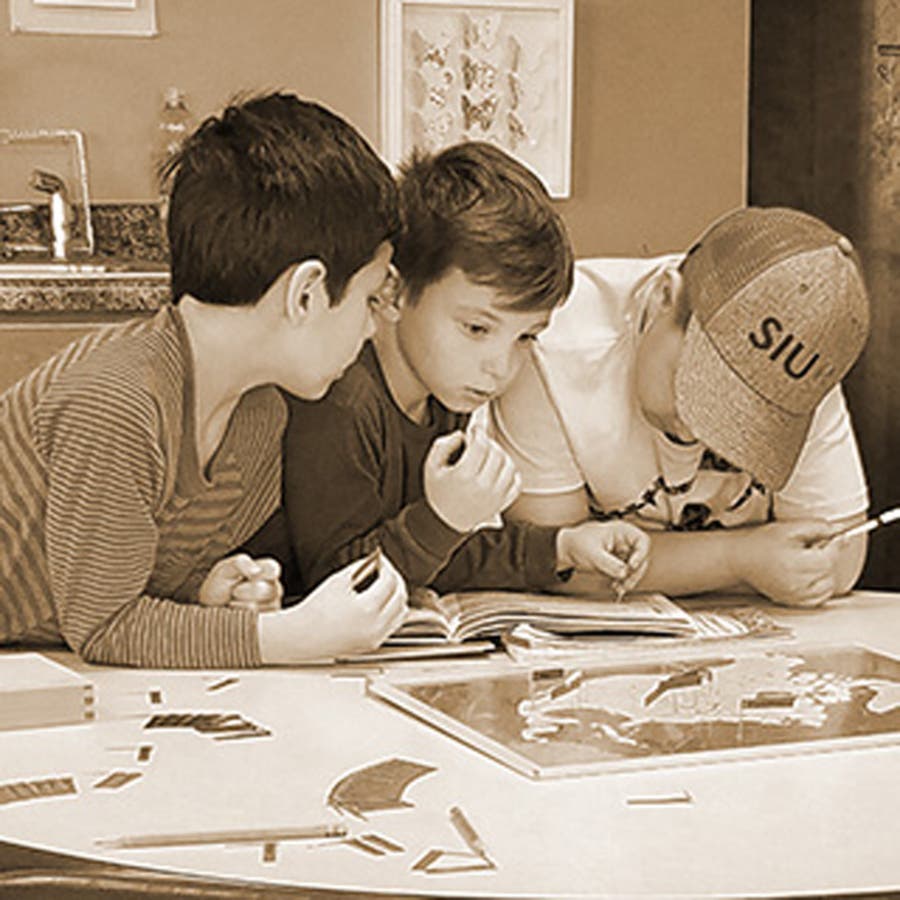
It uses unique and intuitive hands-on learning tools. These proven methods engage both a child’s imagination and intellect. Technology plays a very limited role—finger swiping on a tablet can’t replace hands-on manipulation of the physical learning tools used in a Montessori classroom.
It promotes mentor relationships. By grouping children of multiple years—such as first through third grade—the Montessori classroom opens new avenues of learning. Since development is so uneven in the early years, it helps ensure everyone has peers regardless of age.
It teaches manners, respect, self-discipline and self-reliance. In academics and personal routine, learning to be a good adult is fundamental. For example, students prepare their own snacks and can nibble when they are hungry, not when the schedule tells them to eat.
Teachers don’t drill—they guide and encourage. This ensures that no child is left without something enriching to do, and that everyone learns the fundamentals that matter.
Each child receives individual attention. This means celebrating accomplishments and filling gaps—based on the teacher’s insight, not a CCSS test preparation checklist.
Because Montessori education embraces a child’s natural curiosity about the world and their innate desire to learn, it’s particularly effective in helping students achieve superior levels of competency in subjects across the board—not only in CCSS-measured categories like language and math, but also in science, reasoning, history, social studies and other subjects.
As in all Illinois schools, Measures of Academic Progress (MAP) testing is administered in the higher grades to demonstrate proficiency in accordance with CCSS standards. However, for Montessori children, it is more a formality than the high-pressure, high-stress experience described by many students (and teachers) in public schools.
In this way, Montessori education observes and meets CCSS standards without the crippling limitations of the standardized, impersonal CCSS curriculum currently imposed on public schools. Simply put, it’s a much more flexible and rewarding way to reach the same destination, and for many students (my son included), to go far beyond it.
Our Montessori journey continues
Successfully completing his first year at Joliet Montessori School, my son is already on a lifelong path of constant learning, enrichment and wonder. His confidence has never been higher, and he speaks expertly on subjects that occasionally even baffle his mother and me. I will be sharing some examples of the extraordinary depth of his Montessori education in a future column.
I am absolutely certain, however, that our discovery of Montessori education and Joliet Montessori School has already provided our son with skills and competencies that are more than capable of meeting and surpassing CCSS standards—without crushing his natural love of learning beneath the weight of the CCSS curriculum. More to the point, they meet and surpass the standards of real life—and to us, that is the most important test of all.