Schools
Vietnam Veterans Bring Book to Life for American Lit. Students
Vietnam Veterans Visit Oak Forest High School Students Reading "The Things They Carried"



Oak Forest High School students in Mrs. Jennifer Schanz's American Literature class are currently reading Tim O'Brien's, The Things They Carried. Without giving too much away, the book is about the Vietnam War and the emotions soldiers felt after returning home.
The book is wrote loosely based on O'Brien's own experiences in the 23rd Infantry Division. While the book is a work of fiction, it is written in a memoir style making it especially gripping for its readers.
In an effort to bring the historical nature of the book to the reality of Oak Forest High School students, Schanz decided she would have her students talk to men who actually fought in the war. This way, students could compare the experiences of real-life Veterans to the ones they were reading about in O’Brien’s novel.
Find out what's happening in Oak Forestfor free with the latest updates from Patch.
After reaching out to Vietnam Veterans of America, Chapter 311, a group of four Veterans were sent to speak with students in late November.
Students would soon learn of some of the many similarities between O'Brien's characters, including the very-real effects of Post Traumatic Stress Disorder (PTST).
Find out what's happening in Oak Forestfor free with the latest updates from Patch.
Veteran Gary Sieroslawski told students, “We are talking to you [OFHS students] because it is good therapy for us.”
Sieroslawski was drafted in 1968 and sent to Louisiana for basic Army training, which he thought was good because the weather was very similar to that in Vietnam - hot. His main job was to fire a huge artillery gun that could fire at things 20 miles away, though, he said, it wasn’t always too accurate.
Veteran Tom Newton went to Vietnam to fight for the Army in 1967-68. Although Newton was in the Army, he spent most of his time up in a Chinook helicopter as a radio operator for his comrades on the ground.
Veteran Jerry VanBladel was the only speaker who didn't get drafted into the war, but actually enlisted in the Navy as his three brothers had. VanBladel worked as what's called a "Navy Beach Jumper." This was a unit similar to Navy SEALS and he said, “It was an amazing duty. We felt that we were doing pretty great.”
Veteran Mark O’Brien served in the Air Force while he was in Vietnam. While most expect him to have done maintenance or missions on the fighter planes, his duty was primarily to guard the air force base. He said this involved a lot of crouching in creepy bunkers with many bugs and rodents. He would also stand in towers and look down over the base. In these situations, he had to be careful not to get electrocuted in the case of lightning strikes since everything in the tower was made of metal. One of his most important duties was to protect the runways. If there was any foreign material on the runway, it would get sucked into the air force engines and cause a crash.
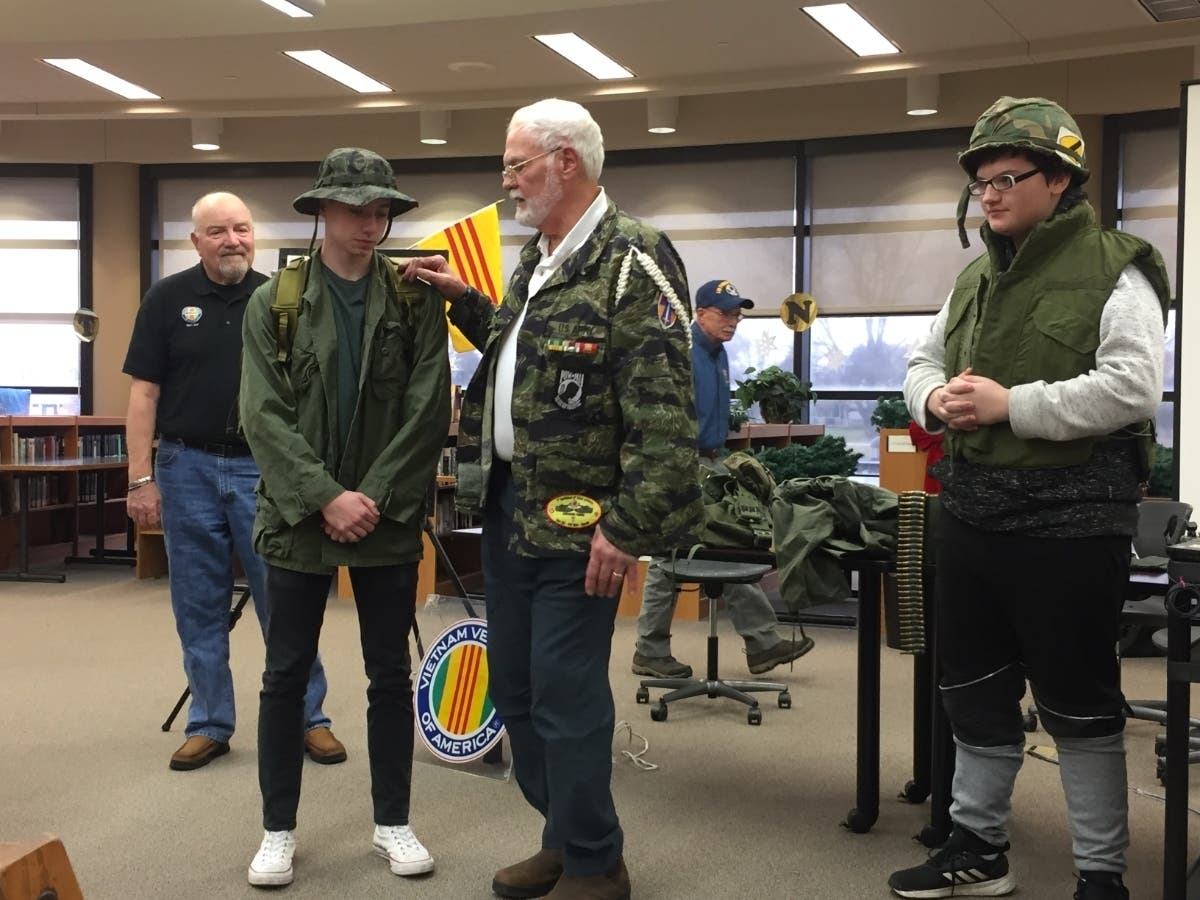
After talking about their experiences, the four Veterans showed students the differences between military gear that was issued at the beginning of the Vietnam War to the end of the Vietnam War.
The gear issued at the beginning of the Vietnam War was left over from WWII. It was heavy and not suited to be used in a very wet environment; the clothing would not dry out, and the leather shoes would fall apart off of soldiers’ feet. The gear that was given at the end of the war was more suited to a wet environment; the clothing dried well and was very ventilated. The boots even had gripping soles for walking in mud and were not made of leather so they held up much better when soldiers were walking in wet mucky weather and fields. They had students model the two different types of gear so that everyone could see the differences and how it was improved over the course of the war.
Sieroslawski said that talking to the students was good therapy for the Vietnam Veterans, but also informative for students. He asked, "Do you know about the draft? Do you know that when you are 18 you still have to register for the draft? Do you think it is fair that only boys have to register for the draft and not girls?”
As you can probably assume, students were divided over the final question.
Nevertheless, by sharing their experiences, these four men brought the Vietnam War to life for students and helped them connect to the context of the Vietnam War as described in The Things They Carried.