Crime & Safety
New Details Emerge In 2003 Newborn Twins' Deaths, Mom Charged
How Cook County Sheriff's Police used genetic genealogy to crack a 17-year-old cold case.


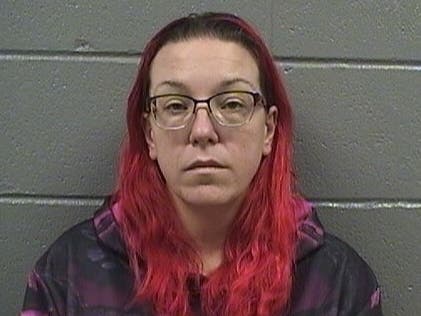


COOK COUNTY, IL — Investigative work conducted 17 years ago using the DNA technology of 2020 led Cook County Sheriff’s Police to a Michigan woman now charged in the deaths of her newborn twin sons. The infants were found discarded in the trash in unincorporated Stickney in 2003, police said.
Antoinette Briley, 41, of Holland, Mich., appeared Saturday afternoon at the Leighton Criminal Courts Building before Judge Susanna Ortiz and two felony counts of first degree murder. Briley, who has ties to the Cook County area, was arrested during a traffic stop Thursday in Oak Lawn.
On June 6, 2003, a Waste Management employee was emptying trash bins in an alley behind the 4800 block of South Latrobe Avenue in unincorporated Stickney. The employee saw a baby’s arm sticking out of the front bucket of the garbage truck.
Find out what's happening in Oak Lawnfor free with the latest updates from Patch.
Cook County Chief of Public Safety Leo Schmitz explained how detectives used genetic genealogy to solve the 17-year-old cold case. In 2003, DNA samples taken from the babies’ placenta were submitted to the FBI’s national DNA database, but there was no match.
“Things [sheriff’s police] did back then helped us today. We didn’t know back then who these kids were tied to,” Schmitz said during a news conference at the Cook County Sheriff’s Police headquarters in Maybrook. “These detectives took it upon themselves to use today’s technology to get it done.”
Find out what's happening in Oak Lawnfor free with the latest updates from Patch.
In 2018, detectives took DNA from the 2003 investigation and used the latest developments in genetic genealogy. Samples were uploaded to GEDMatch, a free online database where anyone can share their data from consumer DNA testing companies, such as 23andMe and Ancestry.com, to search for relatives who may have submitted their DNA. Sheriff’s detectives were able to develop a family profile which enabled them to identify Briley as a possible suspect. The first case to be cracked using genetic genealogy led to the arrest of convicted Golden State killer Joseph DeAngelo, who in June pleaded guilty to a string of murders in the 1970s and 1980s.
“[Detectives] didn’t know they were on a suspect from Michigan,” Schmitz said. “It was all genealogy.”
Detectives traveled to Holland, Mich., to retrieve Briley’s DNA, Schmitz said. They watched Briley smoking a cigarette outside. When she tossed the butt on to the ground, detectives moved in and retrieved it. Briley’s DNA matched the infants, according to the charges.
“Once we developed probable cause, we were keeping an eye where she was at and when she was coming back to Cook County,” Schmitz said.
Knowing that she would be in the area last week, police took Briley into custody during a traffic stop in Oak Lawn, where Schmitz described her as “distraught and emotional.”
Such breakthroughs in a 17-year-old case don't happen all the time, Schmitz said.
“We felt a void because we couldn’t find out who did it,” he said. “We never gave up.”
During a bond hearing Saturday at the Leighton Criminal Courts Building, prosecutors said Briley, then 24, was home alone at her grandparents’ home in unincorporated Stickney.
“She noticed she was bleeding from her vagina and experienced cramps and got into the shower,” the prosecutor said. “She began giving birth to the first baby. The defendant began to feel more pressure, when she continued to feel pressure, she realized she was giving birth to a second baby.”
Briley pulled the placenta of the second baby to get the infant out. There was no water in the tub, according to investigators.
“She saw that both infants were male,” the prosecutor said. “Both babies were crying after they were born, but not enough that other neighbors could hear. She described the sound as "whimpering.”
Briley cleaned herself off and went into the bedroom, where she retrieved a duffle bag. The prosecutor said she placed both babies into the bag "without wiping them off" and decided to drive to the hospital to get the babies checked out, the prosecutor said.
Somewhere between her grandparents’ house and the hospital, the prosecutor said Briley stopped the car.
“Because nobody knew or would never know, she put the babies into the garbage and chose a garbage can at random,” the prosecutor said.
The prosecutor said one of the babies was still connected to the placenta by the umbilical cord; the second baby was detached and the placenta was found in a black shoe box.
Briley threw away the duffle bag. When she got back to her grandparents’ house, the prosecutor said Briley took a shower and went back to bed, where she watched TV and eventually went to sleep.
“She wishes she could take the whole thing back,” the prosecutor told the judge. “She wishes should have gone to hospital to make sure [the babies] were okay and cared for or helped. They might have had a chance.”
The assistant public defender told the judge that Briley was born and raised in the Chicago area. She’s lived in Holland, Mich., with her young daughter and works at a factory. Briley has no criminal background and has been a productive member of society.
“She has no violent activity,” the assistant public defender said. “We don’t know if she made statements post Miranda. There doesn’t appear there were any witnesses.”
The judge did think Briley was a danger to the community or flight risk, and set bail at $150,000, with 10 percent to apply. Briley’s attorney asked if the bond could be carried over to Michigan so that Briley could return home. Ortiz said she would leave that up to the next judge “if and when she is able to post $15,000.”
Briley can attend hearings by phone during the pandemic. The Michigan woman’s next court date is Dec. 8 in Bridgeview.
Get more local news delivered straight to your inbox. Sign up for free Patch newsletters and alerts.