Arts & Entertainment
Voices from the Past: Lettie-Kennedy Harnew
One of Oak Lawn's earliest residents recalls a lifetime of change.

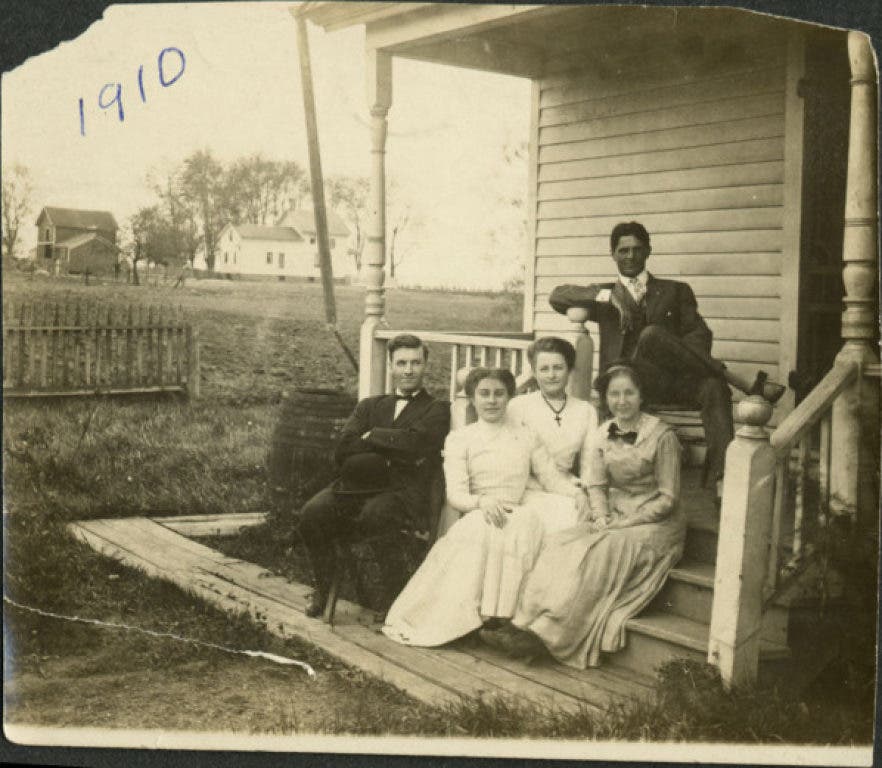


Finally settling into her desk in a frigid one-room schoolhouse, Lettie Kennedy let out a giant sigh as she removed her filthy boots and dropped them to the floor besides a stack of textbooks. Although she drew looks of scorn from her classmates and teacher, Lettie paid no attention to them. After a two-mile journey that took her across the boggy marshes of the Cal-Sag Canal, she felt that a break was well-deserved.
Across town, in a diminutive building that served as the office for officials, a weathered farmer pleaded with the council members gathered before him. Why, he asked, should his daughter be forced to travel nearly five miles each day to attend school? The Kennedys lived on the edge of the Palos-Worth boundary line, and it seemed illogical to make his child walk twice as far when she could earn her education just down the block. While it seems unimaginable to us in 2011 that a school district would force a student to walk several miles each day, it was a different era.
In October 1975, just a few years before her death, Lettie sat down with members of the and reminisced about these simpler times.
Find out what's happening in Oak Lawnfor free with the latest updates from Patch.
Originally from the now non-existent town of Pekin, Nebraska, Lettie’s family had a rich past that was almost as fascinating as her future in Oak Lawn. When her grandfather was killed fighting in the Civil War, his wife quickly remarried and uprooted the entire family and moved to the bustling metropolis of Chicago. Although Lettie traced her ancestry back to the East Coast, several distant relatives made a living as farmers just outside the town of Worth, Illinois. During the 1870’s and 1880’s, land values in the Midwest hit rock-bottom prices, causing a surge of German and Irish immigrants to flow to the fertile prairies of Illinois and Iowa.
After briefly moving to Missouri in 1894 to work an unsuccessful gold mine, the Kennedys relocated to Worth in 1896.
Find out what's happening in Oak Lawnfor free with the latest updates from Patch.
Lettie recalled a simpler time, when you could spend hours looking up at the night sky, or lose track of time fishing at the nearby Oak Lawn Lake. When she graduated from grammar school in 1902, Lettie traveled by train to Englewood, the closest high school, located on the outskirts of Chicago. Although her first experience on the iron horse was a nerve-wracking one for the small-town girl, her feet must have been relieved after years of slogging across mud-encrusted country roads.
Education was a luxury that many could not afford back during the early 1900’s, and Lettie felt grateful that her father and brother were able to pool their money long enough for her to graduate. Both would eventually take jobs in nearby Chicago Ridge, toiling away for a company that assembled slot machines. After both received a raise (unheard of for mere factory workers), they saved again, and Lettie was able to attend the Chicago Business School, located in the heart of the Loop.
Taking inspiration from her family’s work ethic, she immediately took a position at a local steel mill while working at the Union Stock Yards as a secretary on the weekends. It was during one of her many trips between Worth and Chicago Ridge that she met her future husband, William Harnew.
The two quickly fell in love and were married in 1911. William, who lived in the quiet farming town of Oak Lawn, served as the tax collector for Worth Township. Traveling the back roads of local communities, his distinctive black horse and buggy would frequently break down mid-journey. Luckily for him, those passing by always recognized his smiling face and assisted him by dragging their hapless tax collector’s wagon out of numerous ditches.
Now addressed by her friends as “Mrs. Harnew," Lettie moved into Bill’s spacious home located at 9624 South Mason Avenue. Even with his government salary, which would more than enough to live on, Bill’s family had a proud past of farming in the area. Even in his last years of life, Bill held dear two land titles purchased by his grandfather, dating back to the 1840’s and 1850’s. Lettie’s husband was only too eager to point out to visitors that they were signed by Presidents Martin Van Buren and Franklin Pierce. Prior to his death, Bill’s grandfather would sell the properties for nearly $55,000.
As the wife of a tax collector, Lettie gained a wealth of knowledge related not only to finance, but also local property values. When Oak Lawn’s coal company was bought out by Beatty’s Lumber Yard, Mrs. Harnew saw the immediate need for clarification of the town’s zoning codes. The deal between the two companies had been extremely controversial, and arguments over property rights near the coal factory were endlessly debated.
In the wake of these disagreements, Lettie and Bill converted their parlor into a tax office, employing a staff of almost ten full-time employees. In addition to helping residents with their finances, the Harnews maintained a ledger of property values in Oak Lawn and Worth, just in case another business transaction went sour.
Even with his busy work schedule, Bill found time to give back to the community. He served on the District 122 School Board for more than three decades, using his knowledge of local governments and zoning issues to help see the district’s schools remodeled to accommodate an ever-increasing student body.
In 1958, Bill retired after serving 35 consecutive years as the Worth Township tax collector. Even with her husband’s death in 1961, Lettie continued to share her unique stories about early Oak Lawn history. After her death in 1979 at the age of 90, the renamed its elementary school after the , who had done so much for the Oak Lawn and its neighbors.
It was a well-deserved honor.
For more on the stories of Lettie Harnew and other early residents, visit the Local History Room of the Oak Lawn Public Library