Neighbor News
The Architecture of Barry Byrne
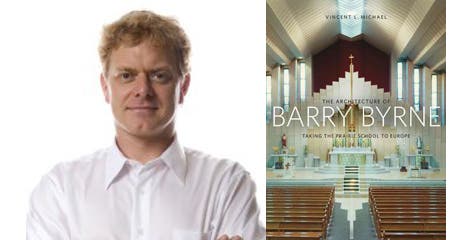
Join speaker Vincent L. Michael, author of "The Architecture of Barry Byrne: Taking the Prairie School to Europe," for a lecture on 5/21/16.
This is now a free event, with admission provided as a part of your Wright Plus ticket. Join us for "Wright and More in Hyde Park."
Francis Barry Byrne entered Wright’s practice as an inexperienced novice in 1902. Over the course of his long career in architecture, Byrne would remain one of Wright’s strongest supporters from the Oak Park studio years.
Inspired by the progressive buildings he witnessed in Chicago, Byrne developed an early fascination with architecture. In 1902, at the age of 19, he encountered an exhibition of Frank Lloyd Wright’s work at the annual Chicago Architectural Club exhibition. Despite his lack of training, Byrne was inspired to approach Wright for a position in his studio. Over time Byrne accepted increasing responsibility, executing plans for Unity Temple, and the Beachy, Hills, Tomek and Coonley houses. He remained with Wright until 1908. Looking back on his life in the studio, Byrne wrote fondly, “Life at the studio savored not of a dream but of a higher order of things.”
Find out what's happening in Oak Park-River Forestfor free with the latest updates from Patch.
In his independent career, Byrne forged an individual style defined by taut planar skins enveloping modern space plans. In 1922 he designed the first modern Catholic church building, St. Thomas the Apostle in Chicago, and in 1924 he traveled to Europe where he met Mies, Mendelsohn, Oud, and other modernist architects. He was the only Prairie School architect to build in Europe, designing the concrete Church of Christ the King, built in 1928–31 in Cork, Ireland.
Event includes reception, light refreshments, and book signing.
Find out what's happening in Oak Park-River Forestfor free with the latest updates from Patch.
Speaker Vincent L. Michael is the author of The Architecture of Barry Byrne: Taking the Prairie School to Europe. A distinguished leader in the preservation field, he is a Trustee of the Global Heritage Fund in Palo Alto, California, and a Trustee of the National Trust for Historic Preservation. He was the John H. Bryan Chair of Historic Preservation at the School of the Art Institute of Chicago. He has served globally as a prominent keynote speaker and panelist on historic preservation issues; international preservation education; heritage conservation practices; and community planning. Vince received his B.A. and M.A. from the University of Chicago and his doctorate in architectural history at the University of Illinois at Chicago.