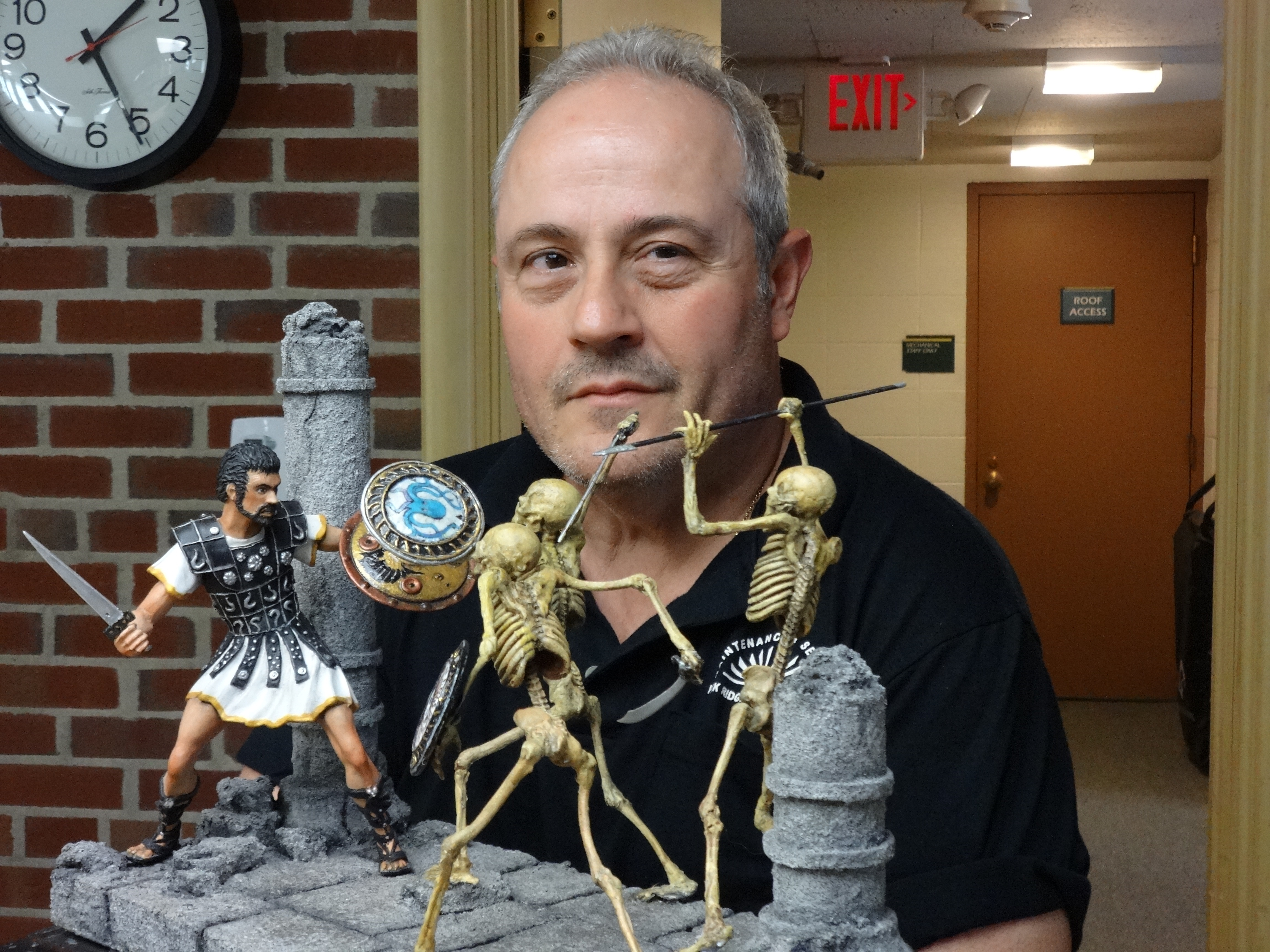
Raging beasts. Screaming crowds. Rows of cars lit up by the flickering light of a projector. Once upon a time, a date movie meant paying a visit to the local drive-in, to watch the latest cinema monster terrorizing the big screen.
Starting October 1, the Park Ridge Public Library will host “Cinema Terrors: Men, Makeup, and Monsters,” a special display that offers a brief glimpse into that lost era, and the people whose imagination, creativity, and talent fueled the special effects behind the stories.
Special effects in modern films have come amazingly far thanks to computers, but for Paul Pandocchi, who organized the display and created all the model replicas, computer-generated imagery (CGI) can’t compare to the work of special effects pioneers such as Ray Harryhausen, Willis O’Brien, and Millicent Patrick. As Pandocchi points out, creations such as the original King Kong and the Creature From the Black Lagoon have gone on to become cultural icons, while modern effects tend to be largely forgettable.
Find out what's happening in Park Ridgefor free with the latest updates from Patch.
“Today’s CGI seems soulless to me,” Pandocchi says. “And when audiences are overwhelmed by constant special effects, they tend to focus on them too much, and not on the story being told.”
Such was not the case in earlier films, when special-effects were used economically to advance the narrative. This was partly due to the fact that, up until the 1980s, special effects were created painstakingly by hand, using models made of clay, metal, glue, wood, rubber, and other materials. Footage was shot using stop-motion animation, which involved changing the model’s position in minute increments and capturing the image. This could produce hundreds, if not thousands, of frames for a single scene.
Find out what's happening in Park Ridgefor free with the latest updates from Patch.
One of the most famous early examples of this technique can be seen in 1933’s King Kong.
“This was a groundbreaking film not just for the special effects, but because this is the first time you have an animated model interacting with a human actor,” Pandocchi says. “There was an emotional and psychological component that was unique for that time – and the amazing thing is that it was done with an 18” puppet.”
Kong’s creator, Willis O’Brien, left a colorful past as a cowboy, bartender, and amateur paleontologist to pursue an interest in art, especially sculpture. In 1913, at the World’s Fair in San Francisco, he displayed an experimental film involving animated dinosaurs, which caught the attention of Thomas Edison’s company. After producing several short films for Edison, O’Brien ended up in Hollywood, working on Harry O. Hoyt’s epic, The Lost World (1925).
The film is memorable today largely due to O’Brien’s prehistoric creatures, the likes of which had never previously been seen by audiences. According to one critic, the effects were “marvels of ingenuity . . . so supple and natural that it would be easy to believe them to be huge living creatures.”
One protégé of O’Brien, Ray Harryhausen, would go on to become the genius behind such landmark films as The Beast From 20,000 Fathoms (1953). Harryhausen passed away earlier this year at age 81, and Pandocchi has dedicated a central part of the display to his work, with replicas of characters such as Talos, the giant bronze warrior who rampages through a key scene in Jason and the Argonauts (1963).
Pandocchi considers Harryhausen a major influence on his own work as an artist. “I’m a kid of T.V., and one of my earliest memories is The Beast from 20,000 Fathoms rising his head above the waters. I immediately wanted to draw it.”
While Harryhausen is well-known even outside of the film industry, Pandocchi has made a point of highlighting some lesser known creators, including Millicent Patrick, one of the few women who worked in the early years of special effects. The consequences of being the exception were telling for Patrick, who today is credited as the true designer for the iconic “Gill Man” in Creature From the Black Lagoon (1954). In the film’s credits, Bud Westmore is listed as the chief makeup artist.
“Fortunately, the truth is starting to come out about that,” Pandocchi says, “but there still isn’t a lot about her online.”
Pandocchi’s work frequently wins awards at shows and film festivals; many of the models in the library display are from private collections.
“Cinema Terrors” will be on display through the month of October. For more information, please call (847)720-3209 or email mdalton@prpl.org.