Neighbor News
Washington, IL Tornado - 8 years later Survivors Prospective
Washington, IL Tornado - 8 years later Survivors Prospective
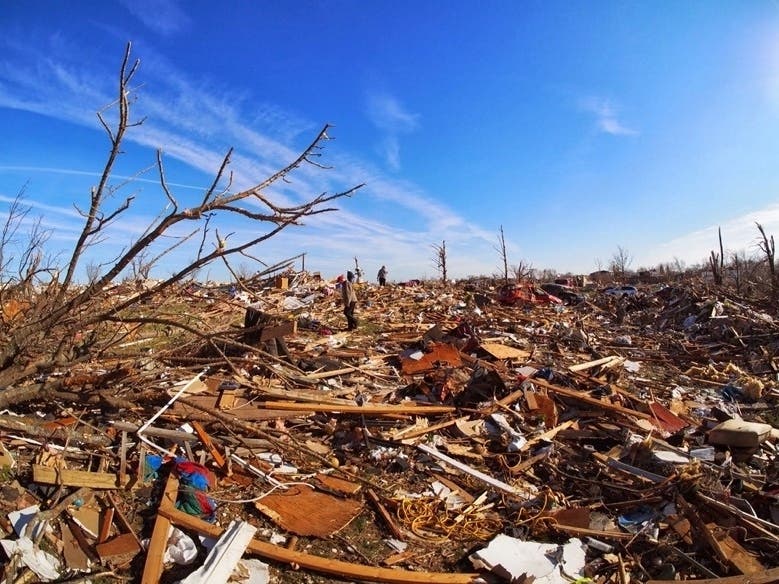

Although it’s been eight years since a historic tornado ripped through Washington, Illinois, the experience is still fresh in the minds of survivors, who share their memories as well as what they’re doing now to prepare for future disasters.
One of those survivors is Darlyn Short. Sunday, November 17, 2013, is a day permanently etched in her memory.
At that time, Short lived on the first floor of an apartment building in Washington, Illinois, with her two dogs. Her husband was working in Texas, so she and her dogs were alone that morning.
“I didn’t have access to the news,” Short recalled. “I didn’t know there was a tornado warning.”
Realization struck as she picked up her phone. “It said in red, ’Take shelter immediately.’ I was just kind of stunned … I grabbed the dogs and I grabbed a quilt and I just dove under the kitchen table.”
The next few moments were terrifying. “It was really loud … I could hear things hitting the patio door. People say it sounds like a train, but no — it sounded like a jet engine,” she said.
The tornado touched down at 10:59 a.m. as an EF4 (on a scale of 0 to 5) with peak winds of 190 mph, according to weather.gov. Unusually powerful and large for the month of November, it ripped through the area, causing 125 injuries, 3 deaths, and damaging or destroying hundreds of structures.
After the tornado swept through, Short and her dogs slowly emerged from under the kitchen table.
The scene was catastrophic.
“I opened my door to the hallway and there was glass all over the floor,” she described. “I looked up, and there was sky. There was no second floor to my building. It was just gone completely.”
John Lee, a longtime resident of Washington, worked for Caterpillar Tractor Co. in Peoria, Illinois, for 48 years before retiring in 1998. Lee was in Romeoville on that memorable day in 2013, returning home to find the entire second floor ripped away. Utter devastation surrounded his entire property. Miraculously, his Ford Model A was unscathed, although covered in debris and dirt.
Find out what's happening in Peoriafor free with the latest updates from Patch.
“I remember pulling up to the house and taking my camera out and feeling my heart sink,” said Dan Reynolds, a photographer from Peoria, Illinois, and a friend of Lee’s.
Washington resident John Lee's property immediately after the tornado.
Jeffrey Earp, a Morton, Illinois, resident involved in organizing volunteers to help with cleanup after the tornado, described his initial reaction upon seeing the tornado’s path: “The areas that were hardest hit, there was just nothing left. … It was just completely leveled,” he said. “It literally looked like someone took a rag or a broom and swept it completely clean.”
Short, Lee, Reynolds, and Earp all have something in common — they’re Jehovah’s Witnesses.
Congregations throughout the area mobilized immediately to care for victims spiritually and emotionally, as well as in practical ways.
“When one congregation suffers, we all suffer. So, the friends were above and beyond concerned about the level of damage and even the emotional toll that it took,” said Reynolds.
Volunteers of all ages from surrounding communities came together to clean up Lee’s property.
“We showed up with 20 volunteers, flatbed trucks, trailers … without a doubt, John was the first person in all of Washington, Illinois, who could see grass in his front lawn,” recalled Reynolds.
Lee later passed away in 2015. Looking back, Reynolds marvels at the speed with which his property was cleaned. Local construction and cleanup crews were unavailable due to the scope of the damage throughout the area. Yet, Lee’s property was cleared in just three days.
Debris was cleared from his Ford Model A. “When he got it fired up and he was able to drive away … that was kind of like his little victory lap,” described Reynolds.
Volunteers also came together to help gather belongings from Short’s apartment, which would
later be demolished. Friends provided a home for her to stay in, a vehicle, meals, and other practical assistance. Short was overwhelmed with gratitude. “You need people. You need physical help. If I hadn’t had that I would have just been lost,” she said. “And thankfully, they were there to help in an emotional way, in a spiritual way, and in a physical way.”
Find out what's happening in Peoriafor free with the latest updates from Patch.
On this eighth anniversary of the Washington tornado, survivors are still impacted by the
devastating effects. Yet, they’ve taken away valuable lessons from their shared experience.
“Have your go bag ready. Don’t skip that step,” Short said. Immediately after the tornado, she was
instructed to flee on foot with whatever she could carry to the nearest standing structure. “I was in my pajamas. It was getting cold; I was soaked because it was raining … I didn’t even get my purse or anything; I just got my dogs.”
“Having a personal preparedness plan increases your chances of staying safe,” according to a training program from the Columbia University’s National Center for Disaster Preparedness. Having supplies ready to go, it says, is one of the steps that provides “resilience to all types of emergencies.”
Lee outside of his home during cleanup efforts. Volunteers of all ages cleared his property within mere days after the tornado. The Federal Emergency Management Agency (FEMA) recommends collecting what everyone in the household needs to survive for several days along with important documents into an easy-to-carry kit, often called a go bag.
Short has since put together a go bag using disaster preparedness resources on jw.org, the official website of Jehovah’s Witnesses. She advised,
“Don’t put it off because you never know… I learned my lesson from the tornado because you never think it’s going to hit you.” She also reviews and replenishes it regularly. “It’s an absolutely necessary thing.”
“It hit so quickly. … It shows how quickly things can change, even with warnings. It’s very humbling. It’s fear-inspiring when you see something like that,” said Earp. “Seeing the damage that it caused firsthand, seeing all the power that was involved and how lives were lost, it really
teaches you to obey the initial warnings.
Even though maybe we don’t see anything happening outside, still obey the warnings.
“A go bag is very, very essential. When these things happen, it’s too late to pack it. When they say ‘go bag,’ they mean it. You’ve got to take it and go,” said Earp.
Despite the tragic effects of this historic disaster, the close-knit community of Washington pulled
together. “Washington Strong” bumper stickers are still spotted throughout the area and reflect the community’s resilience.
“The effects of that tornado are always going to be a part of our lives,” said Reynolds. “And the beautiful thing though, is that the memories that stand out from this natural disaster are not those of the damage, but it’s the memories of the love and concern that was shown for one another, how we came together as friends and as family and as a congregation.”
Disaster-preparedness suggestions and tips for putting together a go bag are available from FEMA at ready.gov and from Jehovah’s Witnesses at
https://www.jw.org/en/library/magazines/awake-no5-2017-october/disaster-....