Community Corner
Putting the Dan Patch Legend Out to Pasture
It makes for a good story, but Plainfield's ties to the record-setting horse are tangential at best.


The Inquiry
Recently, two village employees asked me whether it was true that famed racehorse Dan Patch had once been pastured at Plainfield.
The Facts
Find out what's happening in Plainfieldfor free with the latest updates from Patch.
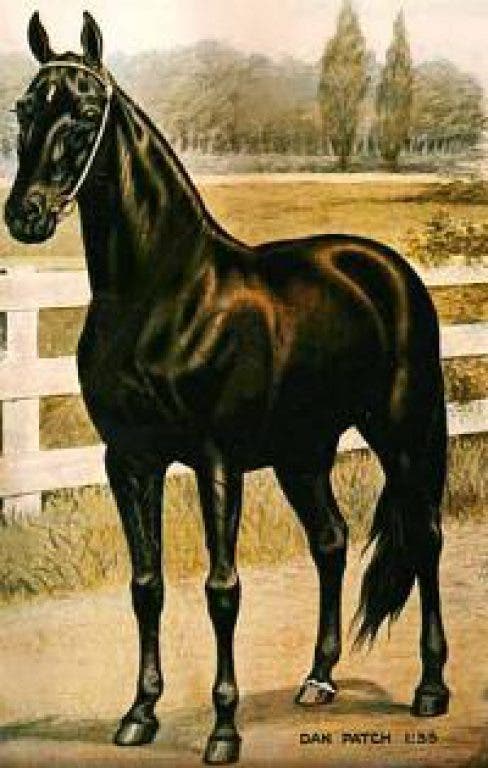
In his day, Dan Patch was one of the nation’s greatest sports icons of all time. Billed as “kindhearted, generous, and a staunch Methodist who never performed on a Sunday,” the legendary racehorse inspired songs (including the 1901 Dan Patch Two Step) and lengthy newspaper accounts of his many accomplishments.
The horse was such a celebrity, in fact, that he endorsed everything from children’s toys and watches to washing machines, gasoline engines, livestock feeds and cigars — even a new-fangled contraption known as an automobile.
Find out what's happening in Plainfieldfor free with the latest updates from Patch.
Described as the “Epitome of Excellence in American Sports,” Dan Patch entertained the American public as he toured thousands of miles each year in his private railway car, greeting crowds that often numbered in excess of 40,000.
Years later, the record-breaking pacer inspired a movie, The Great Dan Patch (1949).
Dan Patch was born in Oxford, Ind., in April 1886, and took his name from his owner, Oxford merchant Daniel Messner Jr., and his sire, Joe Patchen, who was stabled at Chebanse, Ill.
Joe Patchen was a record-breaking standardbred, a harness pacer who earned the nickname "The Iron Horse" after setting a new half-mile track record of 2 minutes and 5¼ seconds in August 1886 and and then trimmed it by another second two months later.
In May 1897, Joe Patchen was purchased by C.W. Marks of Chicago for $15,000 (the equivalent of about $400,000 in 2011).
Marks was a millionaire who amassed a fortune by revolutionizing the distribution of wholesale shoes and boots. A contemporary of A. Montgomery Ward and Marshall Field, Marks became one of the best amateur harness racers and by the early 1880s was a sought-after name in horse-racing clubs around the country.
Marks came to Illinois after the Civil War, settling first with distant relatives in Plainfield. In 1871, he moved to Chicago, where he established his wholesale shoe business.
For many years, Marks kept a small home on Lockport Street in Plainfield and often pastured racehorses either in his small paddock at Lockport and Bartlett Avenue or in his larger pasture on Eastern Avenue.
In May 1898, Marks — ever grateful for the hospitality exhibited to him as a young man new to town — erected the Opera House Block for the “citizens of Plainfield” after the first building burned to the ground on Feb. 4, 1898. Marks sold Joe Patchen in 1899, shortly after the building was completed.
Over the course of his 10-year racing career, Joe Patchen took first place in 53 of 100 races. His half-mile track world record stood for seven years until his offspring, Dan Patch, broke it.
Dan Patch was a remarkable racing specimen. By age 4, he stood 16 hands tall (64 inches) at the withers (the base of the neck) and weighed in at a hefty 1,165 pounds.
Dan Patch ran his first harness race in August 1900, and within two years had tied the world record for the one-mile distance for pacing horses set by Star Pointer in 1897. He made headlines the same year when he was sold for a record $60,000!
In 1903, Dan Patch cemented his reputation as the “World’s Fastest Pacing Horse,” breaking every possible harness racing record. Between 1904 and 1909, he continually bettered his times and in a racing career spanning nearly a decade, Dan Patch lost only two heats and never lost a race.
Lameness forced him to retire to his Minnesota stable in 1909, and he died there two years later.
So, with apologies to those Plainfield residents who live on Dan Patch Drive, the great Dan Patch was never owned by any resident of our village and was never pastured here at Plainfield.
However, Joe Patchen was likely stabled and paced here, off-season, between May 1897 and September 1899 … along with several other less-famous racehorses owned by C.W. Marks.
Do you have a question or a column idea for Michael Lambert? Send it to karen@patch.com.