Neighbor News
‘Engineering the Future’ at Rock Valley College: Curiosity, Grit and Building Connections Matter Most
In collaboration with NIU's College of Engineering and Engineering Technology, Feb. 24th session highlights pathways to stay and work local



Forget the myth of the straight-A math prodigy. To become an engineer, you don't need the best grades or have industry connections, either.
Instead, nurture your curiosity, commit to continual learning and hone your communication skills. That will not only get you started but will help you adapt to rapid and relentless technological change.
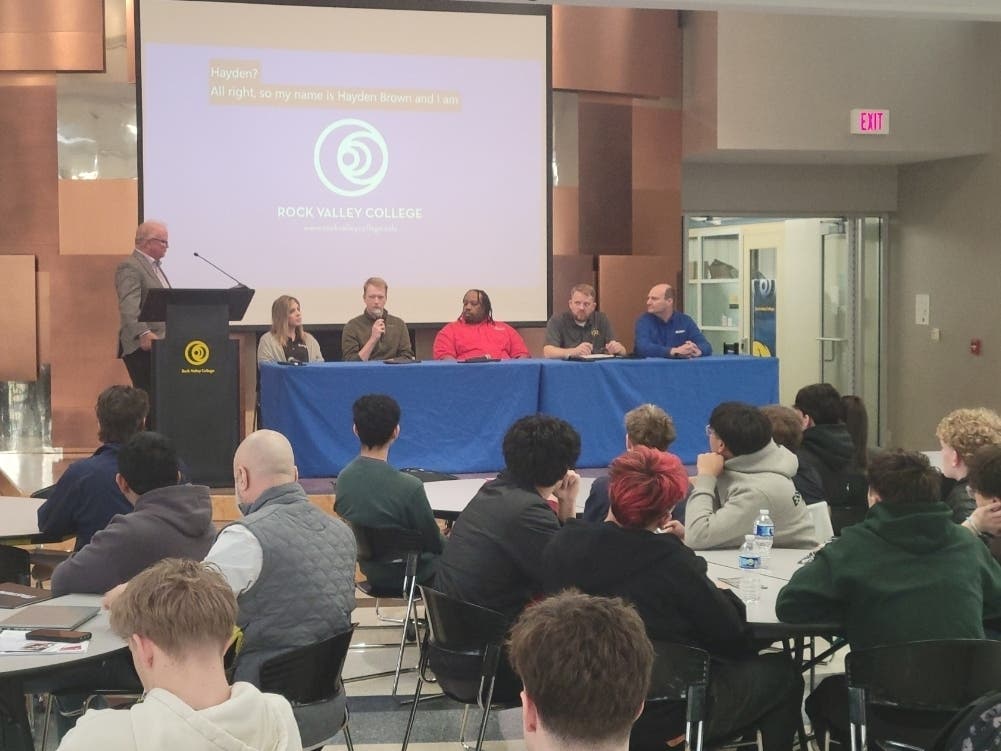
At "Engineering the Future" on February 24th, professional engineers shared that message with about 100 students from Rockford-area high schools. Hosted by Rock Valley College in collaboration with NIU's College of Engineering and Engineering Technology (CEET), the gathering at RVC’s Stenstrom Student Center came during National Engineers Week.
Find out what's happening in Rockfordfor free with the latest updates from Patch.
As panel moderator, CEET Dean Dave Grewell emphasized "there's no industry out there that doesn't need engineers.”
“For every engineering job created, there's seven auxiliary jobs created around that person," he added. "So, it's a job multiplier, an economic multiplier. You have an opportunity to make a big impact.”
Find out what's happening in Rockfordfor free with the latest updates from Patch.
Teachability is Crucial
Collaboration between NIU and RVC has strong historical roots. In 2016, the NIU Engineering at Rock Valley College program began as a partnership between NIU, Rock Valley College and regional industry to build and nurture local engineering talent.
Among the panelists was Hayden Brown, a senior in the NIU at RVC program who is set to graduate in May with a bachelor's degree in mechanical engineering.
Addressing students who might doubt whether they’re “good enough” at math, Brown offered reassurance. Yes, engineering requires rigorous problem-solving, he said, but success hinges on persistence, not perfection.
"Schools teach you how to learn...Having the passion for wanting to take things apart, putting them back together, figuring out how they work and wanting to know how things work is really all you need in engineering," Brown said.
Engineering jobs traditionally pay well—the average income for a 2026 graduate with a bachelor’s degree is projected to be over $80,000, according to the National Association of Colleges and Employers.
That reality prompted one student to ask the panel whether they recommended high schoolers have a mindset of enjoying the work, rather than "for the money."
Joel Thompson, manufacturing production manager at Fastenal, replied that while enjoyment is important, “no job is going to pay me just to have a fun time.”
“Really it boils down to attitude….do you want to enjoy your job? Do you want to enjoy your life?” Thompson said. “Carry that into the workplace with you."
Lucas Beveroth, manufacturing systems engineer at Gleason Cutting Tools Corp., urged students to think of setbacks in the engineering process not as failures but as a “design iteration.”
A 2006 NIU engineering graduate, Beveroth added, “This is what we look for when we hire: We look for people who know already coming in that they're not going to be perfect. In fact, when we design something, we try to make it fail. We want to find those failures long before they get out to the customer."
Company representatives emphasized the importance of internships, which provide invaluable on-the-job training that builds on classroom learning.
James Howell, a 2024 electrical engineering graduate of CEET, noted that his company, Crandall Stats & Sensors, regularly brings aboard interns. Crandall is also sponsoring a CEET student team for a senior design project. Their focus is the creation of a humidity chamber to help the company develop new products.
The Value of `Face-to-Face’ Communication and Networking
In response to a high school teacher’s question about what “soft skills” students should work on to distinguish themselves, Jamie Knowler, executive assistant at Electroform, emphasized the ability to communicate beyond texting by phone and “from behind a screen.”
“Being able to work on that face-to-face interaction and being able to walk into an interview or to hold a conversation with someone and having those skills sets is very important,” Knowler said. “It really does differentiate between yourself and someone who lacks in that area.”
Building a network of supporters, both personally and professionally, is also vital, panelists agreed. Howell credited Bernie Luecke, NIU’s Rockford Outreach and Partnerships Manager, for playing an instrumental role in landing his first full-time job after graduating.
"That's one of the reasons I'm here. I want to give back,” Howell said. “I want to pay it forward, because if it wasn't for that networking opportunity, I wouldn't be here today."
Further along the career path, Beveroth has been at Gleason for 16 years—a destination that he traces to his NIU roots.
"I have worked at a few places and every single one of those places was directly because of a professor at NIU who put me in touch with a person at the company where I got my job,” Beveroth said. “I never had to try to find one on my own."
Career Expo Connections
Students from across the region — including Rockford East, Guilford, Harlem, Belvidere, North Boone and Hononegah high schools — filled the atrium. A career expo before the panel discussion enabled them to speak one-on-one with representatives from event sponsor Fastenal, Crandall Stats & Sensors, Gleason, Electroform, PBC Linear, and the Institute of Language, Mathematics & Sciences.
“Engineering the Future” was a snapshot of the NIU at RVC program, in which students can earn a bachelor’s degree in mechanical engineering on the RVC campus, complete internships with area employers, and gain hands-on experience while benefiting from ABET-accredited curriculum and affordability.
The program emphasizes industry connections, practical learning and strong career outcomes for graduates. To learn more, visit go.niu.edu/NIUAtRVC.
See WTVO television coverage of "Engineering the Future."