Politics & Government
Signatures of Heroism: Veterans Leave Their Mark on a Historic Iwo Jima Flag
Flossmoor man has spent 22 years collecting signatures of those Marines who fought on the Pacific island.


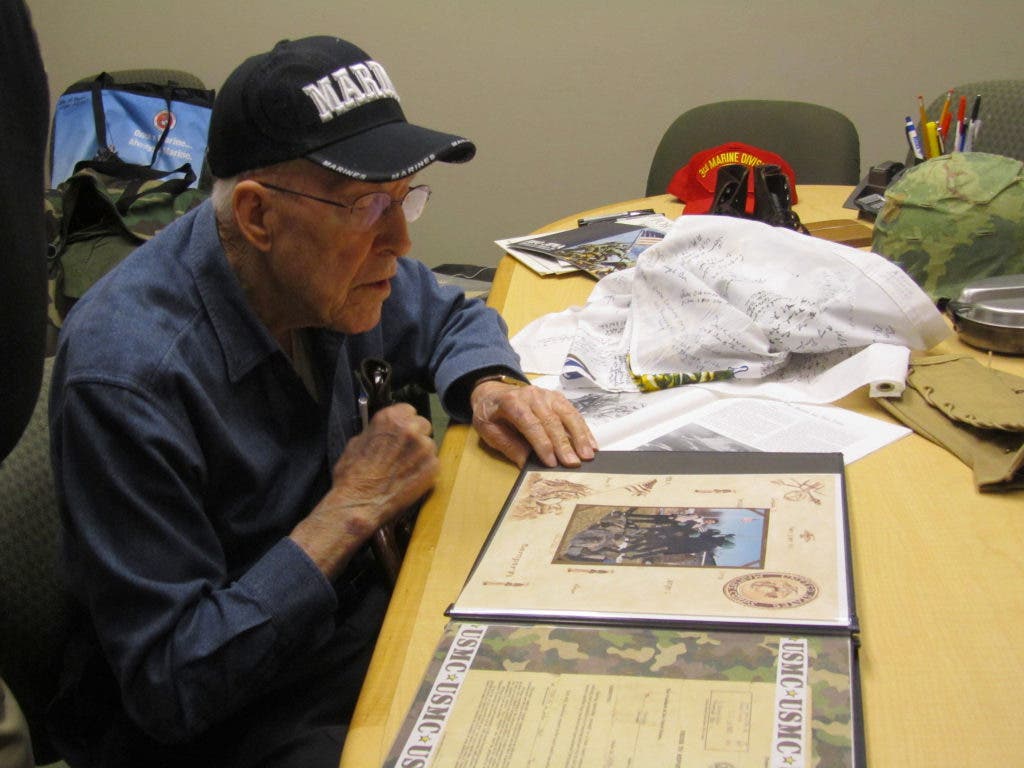


John Lauzon and Charles Kovel missed each other by a couple weeks on the Pacific island of Iwo Jima.
Lauzon, from Orland Park, served as flight crew chief on a C47 plane that picked up wounded soldiers from the battlefields, and Kovel, a Shorewood man was among the first Marines to set foot on the island toward the end of World War II. The two met for the first time in August at an Orland Park to add their names to a legacy.
“This is absolutely beautiful,” Lauzon said, while looking at hundreds of names signed on a white flag. A full-color rendering of the famous American flag raising during the Iwo Jima battle takes up the flag’s center space.
Find out what's happening in Shorewoodfor free with the latest updates from Patch.
“People should know what it meant to see that flag go up,” Kovel said. “It was quite a sight.”
For 22 years, Flossmoor resident and former Marine John Beele has been filling the flag with signatures of soldiers who survived one of America’s most iconic – and perilous – battles. The flag was given to him by Sam Nuzzo, another Iwo Jima veteran and one of the first to sign. As years passed, the signatures kept adding up.
Find out what's happening in Shorewoodfor free with the latest updates from Patch.
While he doesn’t have an official count, Beele said the signatures number in the hundreds.
“It’s always a very emotional experience,” Beele said about the signings. “Many guys are reluctant at first to sign the flag. They feel they’re not heroes. They say all the heroes are still on the island.”
But once they see the flag, Beele said the veterans start looking for fellow servicemen they knew and are glad to participate.
AP photographer Joe Rosenthal, who shot the famous picture of six armed forces men trying to raise the flag, also has signed the white flag. Next to his signature he added, “With respect and admiration for the Marines of Iwo Jima.”
Foxhole Surprise
Charles Kovel served as a plank man when D Company, 2nd Battalion 28th Regiment 3rd Division, first marched onto the island as part of the first wave on Feb. 19, 1944. He carried a Browning Automatic Rifle, but when he first arrived on the island, Kovel said he didn’t do a lot of shooting. At least at first.
“People didn’t realize they dug from the top of the hill, all the way under Iwo Jima,” Kovel said about the Japanese soldiers he eventually encountered. “All they did was work, work, work. While we were bombing, they’d run in a hole. They never charged except one time.”
Iwo Jima is considered one of the most heavily bombed Pacific islands during the war. When U.S. Marines arrived, they found desolate, bombed out beaches of volcanic ash. Beneath the ash lied a network of tunnels and spider holes where Japanese soldiers waited.
To accomplish the goal of securing the 500-plus foot Mount Suribachi at the southern tip of the island, the Marines had to fight a hidden enemy keen on surprise attacks. One such attacker jumped into Kovel’s foxhole the first night.
“He was very weak, living like that,” Kovel said. “They lived underground all the time, digging, digging, digging.”
Eleven days after arriving on the island, Kovel was shot in the hip and taken out of combat.
Injured Airlift
John Lauzon may not have been behind the wheel, but he was certainly in charge of the flight.
As crew chief of a C47 flight team, Lauzon and company had to fly into the battlefields to take wounded away for treatment.
Some of the flights took as long as five-and-a-half hours from the battlefields, including one flight to Iwo Jima.
“We had about a thousand guys in our outfit and only about five guys made it to Iwo,” Lauzon said. “We flew there one time. The men had to help secure the area around the strip so we could fly in and pick (the wounded) up.”
Connecting the Past
When Beele connects with a veteran for a flag signing, the meeting goes beyond the flag.
Souvenirs, pictures, old military equipment and scrapbooks from the war are shared. The Marines’ hymn is sung. Stories are swapped back and forth about what part of the conflict they faced.
Solemn moments do arise, especially when thinking of battles the U.S. wasn’t fully prepared for such as Tarawa and the low tides. The Higgins boats used to transport Marines from the oceans to the shores got stuck due to the low water level around Tarawa.
“They shouldn’t have gone in with those tides,” Lauzon said. “They slaughtered those guys.”
But the August meet in Orland Park ended with smiles and gratitude. Both Lauzon and Kovel thanked Beele for his efforts, and Beele thanked them accordingly.
Beele eventually plans to donate the flag to the National Museum of the Marine Corps. But not before he finds more Marines.
“People keep reading articles, or seeing a segment about it on TV and they keep calling me up,” Beele said. “As long as they are still out there, there’s no reason to stop now.”
Contact John Beele at his Coldwell Banker office to ask about signing the flag at 708-922-4107.
Get more local news delivered straight to your inbox. Sign up for free Patch newsletters and alerts.