Politics & Government
Skokie Abandons Plan That Would Reduce Minimum Wage Until 2024
The village board considered opting out of Cook County labor rules in response to the recent passage of a new statewide minimum wage law.


SKOKIE, IL — The Skokie Village Board has permanently shelved a proposal that would have temporarily reduced minimum wage in the village by aligning it with state law rather than a Cook County ordinance that offers a higher wage floor for the next several years, according to a joint statement from the mayor and village trustees.
Under the state law signed into law by Gov. JB Pritzker in February, the minimum wage would rise to $9.25 on Jan. 1, 2020, and increase gradually on the first day of each year until reaching $15 in 2025.
But under the Cook County ordinance, hourly wages in the suburbs rise to $12 per hour on July 1, 2019, and to $13 an hour a year later. After that, the wage floor rises annually by up to 2.5 percent. With the state minimum set to surpass the county regulations in 2024, a $15 an hour minimum would apply to every county in the state on Jan. 1, 2025.
Find out what's happening in Skokiefor free with the latest updates from Patch.
Last week, the Village Board voted unanimously to table a proposal recommended by Corporation Counsel Michael Lorge for a resolution to reiterate that the state has sole authority when it comes to overseeing employee welfare and rights, "including minimum wage and the eventuality of earned sick leave."
In a memo to village officials, the village attorney told trustees he had been asked by elected officials and various residents and business owners to analyze the legal status of the Cook County wage. Lorge said he believed minimum wage and earned sick leave were matters only the state could address and that the county and the village would be prohibited from enacting their own ordinances. He said there was still a legal question over whether the Cook County Board ever had the authority to pass the minimum wage legislation in the first place, citing a 2017 opinion authored by the Cook County State's Attorney's Office relying on an Illinois Supreme Court case limiting local legislative authority to address local labor conditions.
Find out what's happening in Skokiefor free with the latest updates from Patch.
"The issue before the board is whether — now that the state of Illinois has taken action on minimum wage — it should follow the state legislation or remain under the Cook County ordinance," Lorge said at the board's May 20 meeting.
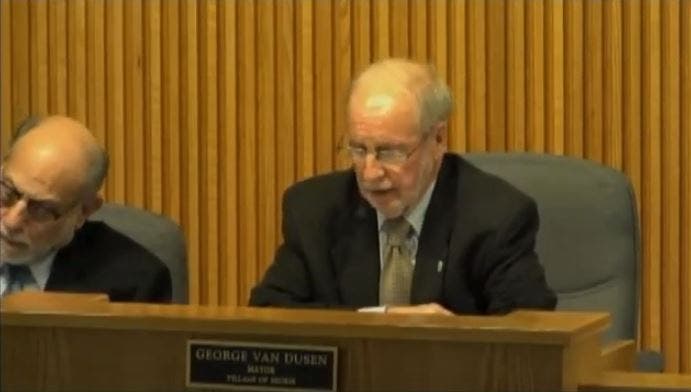
Mayor George Van Dusen addressed the matter following more than hour of public comment, where nearly two dozen speakers spoke in opposition to the proposal and a representative of local business spoke in support.
Van Dusen said major corporations had no problems working around the minimum wage requirements, but his concern was for small businesses competing against them. The mayor said employers have told him directly that they have relocated or cut employee hours because the village had not opted out of Cook County labor standards.
"I've been told by a few of them that they are on the verge of going out of business. This is what I hear, and I don't hear it just once in a while. I hear it from the small businesses," Van Dusen said. "When a business goes out, people lose their jobs. That's a fact of life." He said the village had to find a way to level the playing field for its businesses.
"We've lost some businesses. We don't know how many business would have come here and instead located elsewhere. We do know a few because they've told us so," Van Dusen said.
"I think we have to do something, and it's not regressive to conform to what is the state standard," the mayor added.
During earlier public comment, Howard Meyer, executive director of the Skokie Chamber of Commerce, attributed the closures of several business that have shuttered over the past two years in Skokie to the increased minimum wage, including M Burger, Wing Zone and Baha Fresh. Other businesses, such as Culvers, Chic-Fil-A, Moretti's and Coopers Hawk decided to open up in Glenview, Morton Grove or Niles as a result of higher wages and paid sick leave in Skokie. He said the present statewide minimum wage of $8.25 is "an embarrassment" — but so was the Cook County legislation.
"The county ordinance is not just about the dollars. By virtue of the fact that it allows municipalities to opt in and opt out, there's uneven representation between the communities," Meyer said. He noted 126 of the county's 132 municipalities with home rule authority chose not to abide by the Cook County labor laws. "Their trustees saw that this was not going to be good for economic development," Meyer said.
Skokie is at "an overall economic disadvantage to a wide variety of business sectors that are offering entry-level wages," Meyer said. As a result, employers are cutting back hours, eliminating full-time positions and reducing services, he said.
"I think we deserve a united vote from each of you supporting the new statewide law so Skokie stays a leader in economic development and that economic development will benefit all of our workers and all of our residents," Meyer told trustees.
Skokie resident and Metropolitan Water Reclamation District Commissioner Debra Shore read a joint letter from local elected officials to the village board. It noted that more than 85 percent of local voters had agreed in last fall's election that the village should abide with the Cook County minimum wage and sick leave ordinances.
"By reverting back to the state minimum wage, not only will the village of Skokie be blatantly disregarding the will of the voters, they will also allow a path for employers to cut the wages for more than 6,000 people," Shore said, asking for any board action to be postponed until a more substantive conversation could take place. "The state legislature has passed and the governor did sign a law to increase the minimum wage. From a legal standpoint, the state has not preempted the county, the state law is a floor, not a ceiling and the Cook County ordinance is above that state law."
The letter was signed by U.S. Rep. Jan Schakowsky, State Senators Ram Villivalam and Laura Fine, State Representatives Jennifer Gong-Gershowitz and Yeheil Kalish, MWRD Commissioners Shore and Josina Morita, Cook County Commissioner Larry Suffredin and Cook County Board of Review Commissioner Mike Cabonargi. It also included a legal opinion from Illinois Senate President John Cullerton's top attorney explaining how the village is not in contradiction with state law.
"In my 21 years here, I feel that this measure, this resolution is not consonant with Skokie's values and I would urge you to, at a minimum, defer action until some of the legal questions can get resolved," Shore said.
In their joint statement Tuesday, Van Dusen and village trustees said there had been an "outpouring of comment in support of maintaining the current system of minimum wage."
Village officials found several provisions of the state law "important," according to the statement. It noted that the state law will eventually arrive at $15 an hour compared to $13 in Cook County. The statement also referenced higher annual increases once the state minimum catches up to the county minimum and said the whole state had agreed upon the new wage.
"Residents have raised important questions about limitations in the state’s minimum wage and, after consulting with our state legislators and county representative, along with community leaders, the Mayor and Village Trustees have decided to permanently table its resolution on minimum wage," it said, announcing the village will stick with the status quo of the county ordinance.
"We leave reconciling the two conflicting laws to the Illinois General Assembly and the Cook County Board," it said, without specifying any conflicts. In case of differing wage standards, employers are bound to pay by the highest minimum wage in the applicable jurisdictions. As such, the state minimum will override the county ordinance and make the debate moot in less than five years.
State Sen. Ram Villivalam, a co-sponsor of the Lifting Up Illinois Working Families Act, which will raise the statewide minimum wage to $9.25 next year, and to $15 eventually, celebrated the move and acknowledged the mayor and trustees for their thoughtful consideration of all viewpoints.
"I strongly believe that the Village of Skokie made the right decision by opting into the Cook County Minimum Wage and that they made the right decision again by continuing to opt in. I want to thank all of the Skokie residents, community leaders, and elected officials who made their voices heard on this issue," Villivalam said in a statement. "Everyone who works deserves to earn a living wage. Period.
"Let me also say this: I am committed to helping our small businesses in Skokie. They are the engine of our local economy. I look forward to working with everyone to ensure their success."
Earlier:
Get more local news delivered straight to your inbox. Sign up for free Patch newsletters and alerts.