Politics & Government
Skokie Sues Evanston Saying New Water Rate Violates Civil Rights
Evanston violated its neighbor's constitutional rights by passing a "punitive" law raising the price of water, according to a federal suit.


CHICAGO — The litigious water fight over the wholesale price Evanston has offered its neighbor Skokie entered federal court this week. Already facing a lawsuit in Cook County court accusing it of unjustly enriching itself by insisting on paying an artificially low subsidized rate for Evanston water, Skokie filed its own suit Wednesday, asking a judge to find that Evanston violated the village's civil rights.
The contract between the two towns expired last year, prompting the ongoing legal battle. After negotiations failed to produce a new agreement before the expiration, the Evanston City Council passed an ordinance increasing the water price unilaterally. Skokie refused to pay a higher price, and its neighbor went to court asking for a declaratory judgement declaring Evanston set a reasonable rate.
“For 74 years, Skokie and Evanston have been partners in water delivery to residents of both communities,” said Skokie Mayor George Van Dusen.
Find out what's happening in Skokiefor free with the latest updates from Patch.
“Inexplicably and abruptly, Evanston decided to charge a contrived water rate to gouge Skokie residents and businesses that are dependent on Lake Michigan water from Evanston, while charging significantly lower rates to attract new municipal customers," he said Thursday, in a release announcing the federal suit. "This contentious action, born of financial desperation in Evanston City Hall, disregards the basic right of all Illinois communities to have access to water at the same fair rate as in other municipalities.”
In its federal complaint, Skokie claims Evanston effectively has a monopoly on its water "as one of the few municipalities near Skokie that has both access to Lake Michigan water and the infrastructure to deliver water to Skokie."
Find out what's happening in Skokiefor free with the latest updates from Patch.
Skokie officials said they tried to negotiate a fair rate with Evanston for more than a year.
“After months of negotiation, there is no credible explanation for Evanston’s demand for a water rate to Skokie residents and businesses that is between 264 and 307 percent higher than the water rate it charges other municipalities,” said Village Manager John Lockerby.
“It is most disappointing that all of Skokie’s good faith efforts to resolve the water rate issues were rejected, including Skokie’s suggestion to use a third party mediator," he said. "Evanston leaders stated that they would prefer to leave it to the lawyers.”
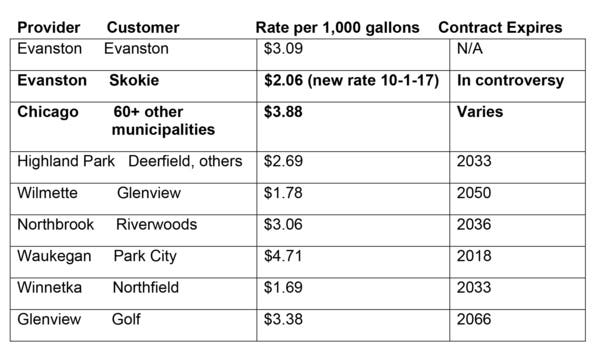
The suit makes no mention of Chicago, which charges all its suburban customers $3.88 per 1,000 gallons. Meanwhile, according to data provided by Evanston, Winnetka and Wilmette sell water to neighboring towns for $1.69 and $1.78 per 1,000 gallons, respectively. Skokie is fighting a rate hike from $1.08 per 1,000 gallon to $2.06.
Evanston argued it properly calculates the rates it charges for water using established industry standards. It said Skokie wanted to pay something in the vicinity of $0.70 per 1,000 gallons, describing that as far below a reasonable rate. Morton Grove and Niles, who Evanston will begin selling water around the end of the year, negotiated a joint price of $0.78 per 1,000 gallons. However, the new customers are spending more than $80 million to build new infrastructure to connect to Evanston – through Skokie, in fact – and will handle their own water pressure, which Skokie currently does not.
But while it was cutting a deal with Niles and Morton Grove, Skokie's suit alleged, Evanston "refused to negotiate" with Skokie and made "extensive efforts to maintain secrecy as to the wholesale water rate negotiated with Niles and Morton Grove." Skokie also alleges Evanston rejected its offer to construct identical delivery systems to the one Niles-Morton Grove will use.
Further, Evanston politicians announced their intentions to force Skokie to pay significantly more for water because of the previous deal was perfected as favorable.
"Alderman Ann Rainey threatened to hire attorneys to break the previous wholesale water contract with Skokie and impose, through oppression (by its control of Lake Michigan water), new, arbitrary wholesale water rates," the suit alleges. The way Evanston set the higher rates, it argued, involved "discriminatory purposes unrelated to and outside the scope of their governmental duties and authority."
Skokie asked the court to declare that Evanston violated the village's constitutional rights under the Fifth and Fourteenth amendments, find that Skokie has been damaged by Evanston's ordinance setting the price of water and void the ordinance, give Skokie compensatory damages attorney fees and mandate that Evanston must provide water to all its municipal customers at identical wholesale water rates.
Before the legal kerfuffle kicked off, Skokie boasted of how it had the second-lowest water rate among comparable communities in the area as it raised its price for consumers by about 8.5 percent last July. But it said Evanston was improperly inflating water rates to price gouge the village and plug a multi-million-dollar hole in its budget.
According to the village's federal complaint, senior Evanston officials, including City Manager Wally Bobkiewicz, then-treasurer Marty Lyons and members of the city council knew about the city's "looming" $5 million deficit but did not disclose it prior to the April 2017 municipal elections.
"When coupled with its use of over $4.5 million of wholesale water rate revenue for non-water related budget items in that year," Skokie's federal suit allege, "Evanston has a growing $10 million municipal deficit, which it seeks to plug with its discriminatory wholesale water rates."
The Evanston Law Department has withheld all correspondence between Bobkiewicz and the Village of Skokie sent prior to the first lawsuit, claiming – without evidence – that they were all prepared as part of pending litigation.
Cook County Circuit Judge Celia Gamrath set a hearing date of July 18 on a motion from Skokie to dismiss the case (2017-CH-12966) in state court.
Joining the Village of Skokie in the federal suit (18-CV-04289) are a trio of Skokie residents living on fixed incomes and a nut company that relies on "a predictable fair market price for water," according to the complaint before U.S. District Judge Charles Kocoras.
“This unique litigation is filed pursuant to the Fifth and Fourteenth Amendments of the United States Constitution against Evanston and the Evanston City Council for violating Skokie’s and its residents’ and business’ rights to equal protection under the law,” explained Skokie Corporation Counsel Michael Lorge, in the release.
“Guided by Federal law and its principles of fairness, due process and equitable rights, this case seeks constraints over Evanston’s monopolistic exercise of market power over basic water rights," said the village's top lawyer. "This law suit seeks to remedy similar water rate inequities that occur throughout Illinois by framing as a legal matter that it is unreasonable and unfair for municipalities selling water to impose arbitrary and disparate water rates on each of its municipal customers.”
Evanston Mayor Steve Hagerty responded with an announcement Friday evening saying Evanston would "not use divisive and dramatic language in this dispute, take other actions intended to intimidate or bully our neighbor, or litigate this dispute in the press."
Hagerty said Evanston taxpayers have paid a "huge subsidy that is neither fair nor sustainable" and "the time has come for Skokie to pay its fair share." He said Skokie had other options for water, "but one other option they no longer have is water subsidized by Evanston taxpayers."
The mayor denied Skokie's claim that the city did not negotiate in good faith, although he was not in office during much of the time period between the expiration of the water contract between the towns and the date Evanston filed its lawsuit accusing Skokie of "unjust enrichment."
Evanston's amended complaint also accuses Skokie of violating the Local Government Prompt Payment Act and asks for an additional 1 percent penalty to be assessed on all bills it deems "unpaid" at the higher rate.
"Once the courts have weighed in, I hope that Skokie will remain a valued customer of Evanston," Hagerty said. "In the meantime, we will continue to provide fresh, clean water to Skokie residents."
Read Skokie's federal complaint alleging unconstitutional discrimination on the part of Evanston and its elected officials:
Related:
- Skokie Calls Evanston Water Lawsuit 'Reckless And Hostile'
- Evanston Says Skokie Still Has No Answer To Water Lawsuit
- Evanston Sues Skokie To Enforce Water Rate Hike
Top photo via Shutterstock
Get more local news delivered straight to your inbox. Sign up for free Patch newsletters and alerts.