Politics & Government
Illinois Fireworks Legalization Effort A Dud So Far
State lawmakers have shown little inclination to generate tax revenue by joining 46 other states and rolling back restrictions on fireworks.


SPRINGFIELD, IL — With fireworks readily available in every surrounding state, Illinois lawmakers have introduced several bills in recent years to legalize and tax consumer fireworks, but they've gotten nowhere. Fire safety officials argue there is no safe way for unlicensed amateurs to use fireworks and point to permanent injuries and deaths caused by misused or defective devices. Supporters of allowing the sale of fireworks in the state point to millions of dollars in lost revenue from people picking up pyrotechnics right across the borders with Indiana, Wisconsin, Iowa and Missouri.
None of the three bills to loosen those restrictions introduced by Republicans since the election of Gov. Bruce Rauner have been granted hearings by Democratic leadership in either chamber of the Illinois General Assembly.
Fireworks have been banned in the state since 1935 under what has been dubbed the Fireworks Regulation Act. People found to be in violation of the state's law can also face penalties of up to a year in jail under the Pyrotechnic Use Act, depending on the type and amount of fireworks involved, it could be a violation of the Illinois Explosives Act – a felony that could bring up to five years in prison and a $10,000 fine – and those caught crossing state lines could also be charged with a federal offense that would carry a one-year prison sentence if prosecutors chose to pursue it.
Find out what's happening in Springfieldfor free with the latest updates from Patch.
"People are setting off fireworks left and right all over the place anyway," said Sen. Chapin Rose (R-Mahomet), describing the issue as one of personal freedom and liberty. "And all we're doing is employing people in other states and paying sales tax in other states. "
Rose tried to put together a bipartisan fireworks package in 2014, which allocated potential sales tax revenue from legalizing the fireworks industry to local conservation districts, agricultural extension offices and fire and emergency medical services. He said downstate fire service officials were unanimously in favor of his plan in 2015, but Democratic leadership blocked the bill from ever getting a committee hearing.
Find out what's happening in Springfieldfor free with the latest updates from Patch.
"The Senate president believes that people can't be trusted to watch out for themselves, so he has not allowed that to go forward," said Rose, referring to Sen. John Cullerton.
Rose's staff calculated Illinois fireworks consumer provided somewhere between $10 to $15 million in sales tax revenue to neighboring states.
"I would point out that, since I introduced it, we've lost anywhere from $30 to $45 million dollars in potential revenue," Rose said.

Cullerton's office said he is open "to discussing legislative proposals to change the law," but noted "there were no Senate proposals on the table this spring to consider." His office said proposals in the past have failed to advance out of committee "because of opposition from police, firefighters and public health and safety experts.”
After Rose's efforts were halted in the Senate, two House Republicans introduced proposals last year aiming to establish a legal and taxed trade in consumer fireworks in Illinois.
Earlier this year, Rep. Dave Severin (R-Benton) introduced House Bill 5630, which would legalize both consumer and display fireworks and impose a 3.75 percent tax on their sale. It too wound up dying in the Rules Committee, although not before being sent over to the Sales and Other Taxes Subcommittee of the Revenue and Finance Committee before it was re-referred to Rules in April.
At the same time, Rep. David Welter (R-Morris) introduced House Bill 5637, which would allow for the sale of consumer fireworks (also called D.O.T. Class C common fireworks or 1.4G Explosives) with a 12 percent tax. Half of the revenue from the tax would be developed to the Fire Prevention Fund. It was sent to the Rules Committee in upon its introduction in February and no further action was taken on it.
"Talking to law enforcement, it's very difficult for them to police it, I've talked to several agencies that don't even go on those calls," Welter said. Although police did not disapprove of his proposal, it was strongly opposed by representatives of firefighters.
"The fire services are definitely concerned about the fire hazards of legalizing consumer fireworks in Illinois, so they came out pretty strong against it," he said. Other concerns included the impact on people whose post-traumatic stress is triggered by fireworks and the potential danger of terrorism or other explosive-related violence.
Welter said he hoped to establish parity with existing laws in neighboring states and use revenue from the sale of consumer fireworks in Illinois to support fire education and prevention.
"Although I do support people's ability to get common consumer fireworks," he said, "It's best to go see professionals who are trained."
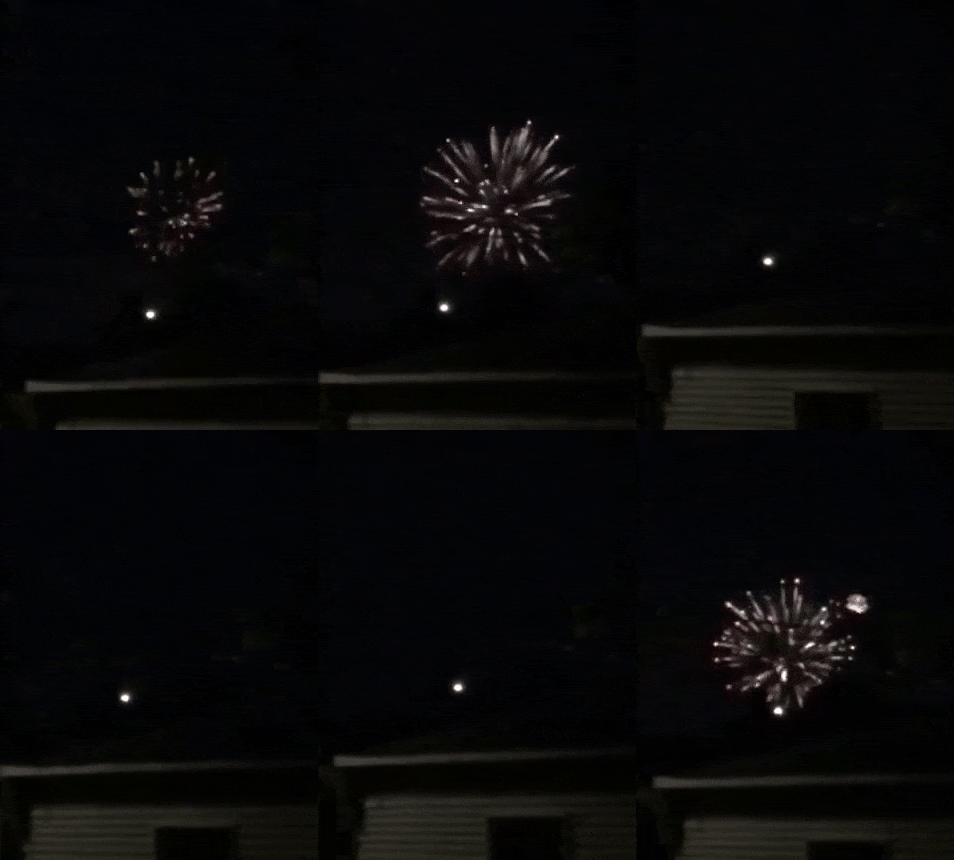
The risks of misusing fireworks are considerable. According to the Illinois State Fire Marshal, there are an average of 18,000 fires caused by the improper use of fireworks every year. The fire marshal's office conducts an annual statewide survey of hospitals for data on the number of fireworks-related injuries.
In 2017, 60 hospitals reported 204 injuries related to fireworks, which is 3.4 injuries per hospital. That was up from 1.35 per hospital in 2016, 1.6 per hospital in 2015, 2.08 per hospital in 2014 and 1.49 per reporting hospital in the 2013 calendar year, according to the office's annual reports.
According to the American Pyrotechnics Association, the number of injuries caused by fireworks declined by 43 percent between 2000 and 2016, a period of time coinciding with the relaxation of various state laws restricting fireworks.
Illinois is one of only four states, along with Massachusetts, Ohio and Vermont, that bans all consumer fireworks other than sparklers and other novelty items, according to the trade group for the fireworks industry. It attributed the decline in juries to higher-quality products and improved safety education from the industry.
Nationwide, fireworks were involved in an estimated 12,900 injuries during 2017 that wound up in U.S. hospital emergency rooms, according to statistics from the Consumer Product Safety Commission. Two thirds of those – an estimated 8,700 fireworks-related injuries – took place during the month surrounding the July 4 holiday. But between 2002 and 2017, staff at the commission found no statistically significant trends in estimated fireworks-related injuries, according to its annual fireworks report.
Men and boys suffered 70 percent of reported injuries, and children and teens 19 and under suffered half of the injuries that required emergency room visits, according to the federal report. There are an average of between seven to eight fireworks-related deaths reported in the United States.
In 2017, five deaths were related to reloadable aerial devices, one was connected to the manufacture of homemade devices, one involved a firecracker and one – a 4-year-old Wisconsin girl – involved sparklers placed in a plastic tube. One person in Illinois died last year from fireworks, a Chicago man checking on a display that had at first failed to ignite.
The CPSC report also said about 31 percent of shipments of imported fireworks were found to contain non-compliant consumer fireworks devices. The most common violations in samples tested with the help of customs agents were related to being overloaded or the burning time of the fuse.
Don't Let 4th Of July Turn Dangerous: IL Doctor's Safety Tips »
Under Illinois law, items defined as "novelty" fireworks are permitted for consumers without a pyrotechnic license. They include:
- Sparklers
- Snake/glow worm pellets
- Smoke devices
- Trick noisemakers known as "party poppers," "booby traps," "snappers," "trick matches," "cigarette loads" and "auto burglar alarms;"
- Toy pistols, toy canes, toy guns or other devices using plastic caps containing twenty-five hundredths grains or less of explosive compound (provided that are made so they do not come into contact with a person's hand)
4th Of July Fireworks In Illinois: What's Legal, What's Not »
Most everything else has been banned, including but not limited to:
- Hand held fireworks
- Bottle rockets
- Firecrackers of any size or type
- Sky rockets
- Roman candles
- Chasers
- Buzz bombs
- Ground items other than those identified as Approved Consumer Fireworks
- Helicopters
- Missiles
- Pin wheels or any other twirling device whether on the ground or mounted above the ground
- Planes
- Sky lanterns, the type of balloon which requires fire underneath
Liability insurance worth $1 million with your local municipal or county government is required in order to be granted a permit to legally set off fireworks in Illinois, according to the office of the state fire marshal. Some local government authorities have placed additional permitting restrictions in place.

In Northwest Indiana, about four of every five customers come from Illinois, according to Kris Zambo, one of a family of school teachers that own and operate a pair of Hammond-based stores.
"Fireworks have gotten a bad rap, you only hear about the nightmare stories," Zambo said. "Everything is supersized today, but government regulations have made fireworks safer. When you shot off something big in the old days it would fall over and shoot at you."
Read more: Fireworks On The Down-Low: Indiana Retailers Do Booming Business »
Patch editors Shannon Antinori, Lorraine Swanson and Tim Moran contributed
Get more local news delivered straight to your inbox. Sign up for free Patch newsletters and alerts.