Neighbor News
Gravitational Radiation And The Dawn On Non-Photonic Astronomy
The ability to detect gravitational waves, ripples in space-time. By Kristin Zavala

The ability to detect gravitational waves opens a new window to study the universe that is unique in that it doesn’t rely on any electromagnetic radiation. Gravitational waves are ‘ripples’ in space-time that are caused by some of the most violent and energetic processes in the Universe. Albert Einstein predicted the existence of gravitational waves in 1916 in his General theory of Relativity. Einsteins mathematics showed that massive accelerating objects, like neutron stars or black holes orbiting each other, would disrupt space-time in such a way that ‘waves’ of undulating space-time would propagate in all directions away from the source. These cosmic ripples would travel at the speed of light, carrying with them information about their origins, as well as clues to the nature of gravity itself.
From the Newtonian aspects that we all learned about in high school, it gave us ground aspects about objects simply pulling on each other throughout space with a force described mathematically, but whose mechanism of exerting it’s influence was not articulated. Albert Einstein observes this and in turn articulates a way that this force is communicative. What he stated was objects within bring, like some free will, as with the sun and the planets, and they actually warp their environment of space and time. The metaphor that we use is that if you think about space and time as a sort of trampoline - if you put a heavy object in the middle of it, it warps the surface and if you were to roll say a marble, the marble goes into orbit, just as a planet would. Much like the sun warps the environment which causes the planets to go into orbital trajectory.
Einstein comes along in 1915 and gives this very different view of gravity, where very quickly evidence was shown to back up his claim. The first observation backing his view had to do with the motion of the planet Mercury. According to the classical mechanics of Newton’s Laws the planet should trace out the same orbit throughout time, but observation showed the orbit was actually shifting, and at the time nobody could give a good explanation as to why. Einstein was able to spot and predict the procession of perihelion of Mercury. He observed the bending of the light by the sun giving it the ability to go in a curve trajectory as it goes to the curved environment surrounding the planet thus giving it the affect of making the sources position in the sky shift. Which means we are able to apply the use of the equation of general relativity to calculate the angle, allowing for astronomers to take the angle between those two positions taking photographic place during a solar eclipse to be compared with photographic place taken 6 months prior. This allowed us to see that Einstein’s ideas were indeed correct.
Einstein then went on to write a paper in 1916 in which he said that mathematically if space is sort of like a trampoline and it can warp and curve that if you start to tap the trampoline and disturb it, you’ll send ripples going along the trampoline. Those ripples, removing the metaphor, were the ripples in the fabric of space, and that’s what gravitational waves are.
However, in the paper Einstein wrote in 1916 he made a mistake in doing calculation of relativity. He corrected this error in 1918 staying close with this idea, writing later papers that suggests that everything is not quite right, but he had others drawn to this that helped it along avoiding his pitfalls and in full belief of the validity of his work. But what did this data gathering and research all mean? It means that if you disturb the fabric of space you should get gravitational waves - the ripples. An example is rapidly orbiting neutron stars or black holes sending out this March of gravitational waves. But what would that mean for somebody in the wake of these waves? The object would be stretched or squeezed, the amount is so slight that it takes utmost precision to measure it.
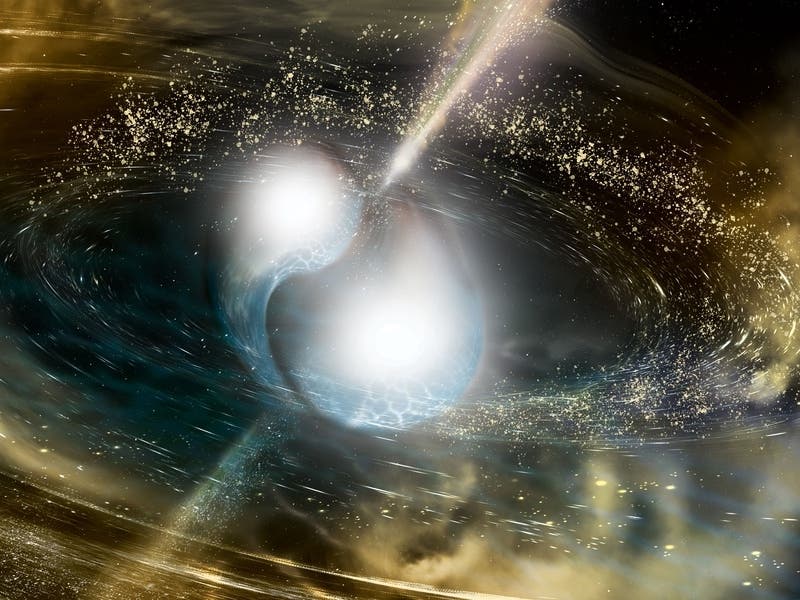
Scientists have detected the merging of two neutron stars a hundred and thirty million light years away and this is the first detection of gravitational waves from in-spiraling neutron stars. At the same time the event has been observed with telescopes in all areas of the electromagnetic spectrum. LIGO interferometers identified a clear gravitational wave signal that lasted about a hundred seconds which was longer than previous detection and its constant with theoretical predictions of the signal from two merging neutron stars. Precisely 1.7 seconds later NASA’s Fermi gamma-ray telescope identified a burst of gamma rays. Gamma rays or radiation is a form of electromagnetic radiation arising from the radioactive decay of atomic nuclei. They are ionizing radiation and hazardous to life. They were thought to come from neutron star mergers but the evidence just isn’t there so we are unsure that gravitational waves and the gamma ray burst in fact came from the same event.
Unlike a merger of black holes, neutron stars emit light when they smash together and continue emitting electromagnetic radiation afterwards. During this particular event, Virgo, which is the newest gravitational wave detector located in Italy, was online at the time and detected virtually nothing, which means the gravitational wave must have been coming from one of its blind spots. All interferometers have some blind spots where if the waves coming at that angle, it’s symmetric in respect to the two arms so it just fails to be detected. So what this did was help to narrow down the search area where it just hovers after the initial detection. Astronomers located a bright spot in the galaxy NGC 4993 where two neutron stars merged 130 million years ago.
What are neutron stars? They’re the leftover cores of very big stars that have exploded which have gone supernova. Their remaining cores are squeezed down by gravity, and if they are too big, larger than two or three solar masses they keep getting crushed until they collapse in on themselves and become a black hole. However, if they are smaller, then they get squeezed further and electrons merge with protons to form neutrons and neutrinos. The neutrinos then take off and the neutrons are left in a really really densely packed Star. They can never combine because of the Pauli exclusion principle, which is a quantum principle that basically says you can’t put two of these particles on top of each other, which is the only thing holding that neutron star up.
So if you have two of these neutron stars orbiting one another some of the energy that they emit is as gravitational waves and as that occurs they lose energy, meaning they spiral closer to one another, and when they get close by a few hundred kilometers apart, gravitational waves become so intense it allows us to detect them hundreds of millions of light years away.
Now when the neutron stars collide it creates what is known as a kilonova which spews debris out into space. This debris actually glows allowing us to observe what’s happening and what has been created. In fact, with new observations with light telescopes we can see heavy elements like gold, lead, and platinum were made during this event, and so we can understand where a lot of the heavy elements in our universe come from. This shows the new age of astronomy that we live in during amazing times where we can detect gravitational waves, and not just from black holes, but now from neutron stars and use that information to locate places in the sky where that occurred and it can be made valid with our other telescopes looking in all parts of the electromagnetic spectrum. It is a very exciting time we live in from an astronomers point of view where we have gravitational wave observatories that just keep getting better and better. It’s truly a phenomenal time to be studying the universe.