Neighbor News
MACHO’s And The Discovery Of A Seven Solar Mass Black Hole
Let's take a thorough look into Archive 2201.13296, An Isolated Stellar-Mass Black Hole Detected Through Astrometric Microlensing.

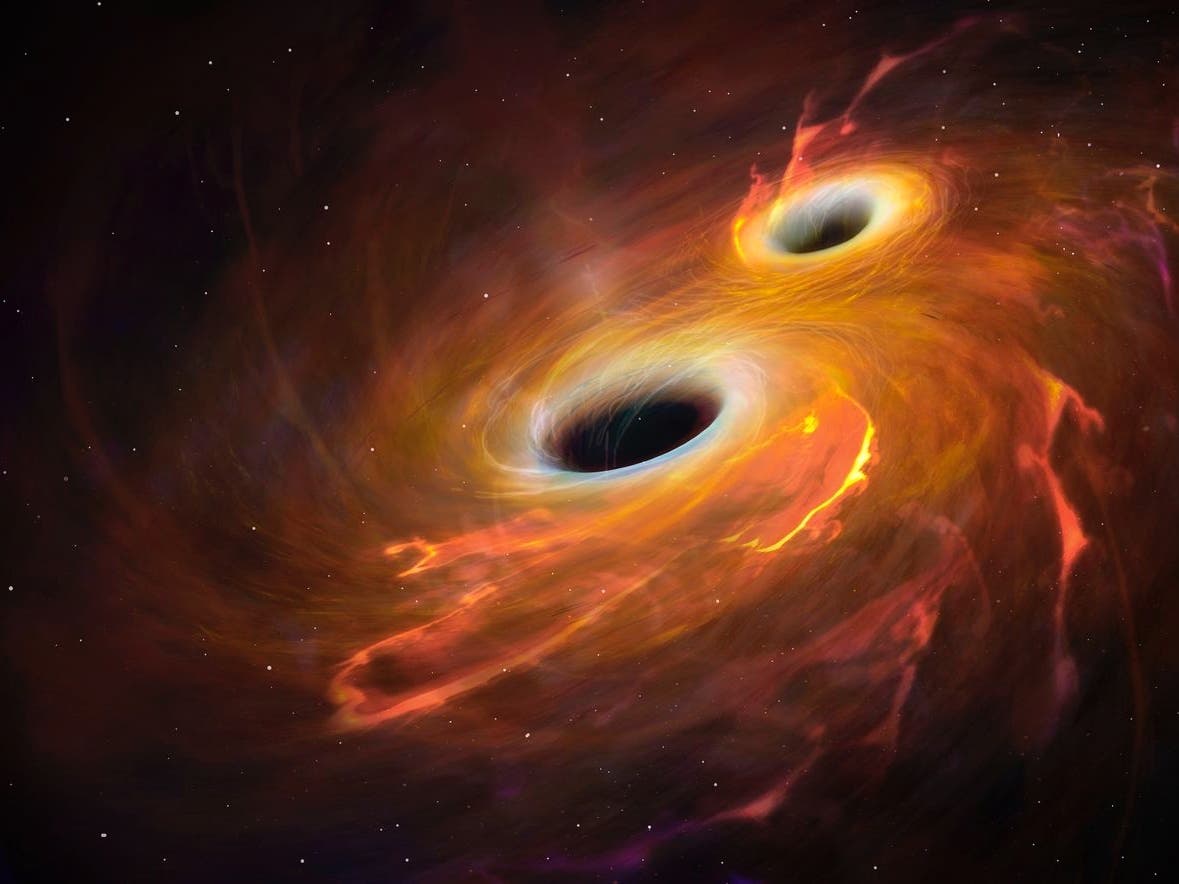


Let’s take a thorough look into Archive 2201.13296, An Isolated Stellar-Mass Black Hole Detected Through Astrometric Microlensing, and explore the data research that was gathered on this topic. All research is based on observations made with NASA/ESA Hubble Space Telescope, obtained from the Space Telescope Science Institute operated by the Association of Universities for Research in Astronomy, Inc., under NASA contract NAS 5-26555.
What I am primarily going to cover is Massive Compact Halo Objects (MACHO), dark matter, and how it was related to the rogue black hole that was discovered. Archive 2201.13296 is all based on photometry, taking images as distant objects and looking for changes in the brightness of these distant objects which compiles the majority of this data. The Ogle collaboration is the Optical Gravitational Lensing Experiment, which was applied, they also look for exoplanets because of microlensing events, observing photometric signatures of planets. There are multiple groups of people that collaborate, all looking for changes in the brightness of distant objects, and the places where they concentrate. So their telescopes are either at the galactic center because there are a lot of stars, which gives you a lot of targets, you can look for changes in brightness, or they will look towards the Large Magellanic Cloud, which also has a very large concentration of stars. In particular what is being looked for is when you have a distant star, and as an intermediate object passes along the line of sight, when the two line up within very small precision, what will happen is the gravitational influence of the lensing object - you get light focused from the distant target around the lens. So instead of just getting light that only comes along the line of sight, you also get some light that is away from the line of sight that gets lensed back towards you, so as a consequence, this will brighten. This is the kind of signature researchers are looking for. If the lens has a little planet going around it then you will often see a little bump, as the planet often produces a lensing signal. So you don’t actually observe the lens, you observe the target star, and you infer the properties of the lens based upon the nature of this change in brightness. Not only can the lens make the target appear brighter, but it can also shift the position of the lens. So when looking along the line of sight, and you are locked on the target, when the lens comes by you, you can actually get the light predominantly coming towards the line of sight from one side verses the other side, so it will displace, and it will look as though the distant target actually shifts slightly to one side. This is what is displayed in the data research of Archive 2201.13296. It’s the shift in milliarcseconds of the position of the star that they’ve been monitoring. When the lens is directly aligned, then the shift goes away. The shift then turns predominantly to the other side as the lens continues to go by, and then you see the amplification that’s the brightness. So as the light gets brighter and passes along the line of sight, and then gets back to its normal value, this will continue to happen over a large period of time.
Through the data in Archive 2201.13296 you can see a shift in the position of the object because it gets distorted by the intervening lens, and then you see the change in brightness. The change in brightness is the most when the lens is perfectly aligned along the line of sight. They observed this with HST over the course of almost a decade.
So when they did this they saw this change in brightness, they used physics, equations, that basically tell you what are the properties of the lensing object given the change in brightness that you observe. What they came up with was, with the big lensing event with the peak of the lens, that from this they can determine the mass of the object, and what they ended up with was a seven solar mass black hole. This was the first unambiguous detection and mass measurement of an isolated stellar mass black hole.
We use the Hubble Space Telescope to carry out precise astrometry of the source of the long duration 270 day high magnification micro lensing event. So the lensing event was high magnification and then they went back and looked at several different images from HST to get the displacement of the source. But this is the most important thing - it’s the first unambiguous detection of a mass measurement of an isolated stellar mass black hole that took place.
We have several different reasons why we believe that black holes exist. For example, one of the main reasons that we understand black holes exist came from observations of the orbits of stars in the center of the galaxy going around some point in the middle, and these stars have huge orbits, you can map out the orbits and they are all different sizes. So mapping them out over time you just look at the center of the galaxy, and you trace the positions of these stars, and then you just fit an elliptical orbit to them, and from the orbits of all these stars you can determine the mass of the object that’s at the center, and based upon where those orbits are, or how close the orbit gets to the middle - you can put a constraint on the size of the object that they’re orbiting. So these things combined we can say that there’s some very high mass object in the center of the Milky Way Galaxy, and that it’s about 3 million solar masses fitting in something roughly the size of the orbit of Pluto. The only object that we know of that can be that massive and that small is a black hole.
We can see the image of the black hole from the very long baseline interferometry, so the black hole accretion disk can be seen from several telescopes spread out across the globe (as an interferometer). So they basically treat the whole earth as one big telescope and combine information from a variety of telescopes that are all spread out. They did get an image that indicates the information that we currently have, but also, even then, there’s the possibility that it could be something else, where it could be more exotic. So it isn’t definitive proof that’s a black hole that came from the stars orbits. The explanation we have - it would require coming up with a new theory for creating an object right there when we have a perfectly good theory that predicts what it is.
What’s apparent in the photo is the material that’s orbiting around the black hole and how it gets warped. So we have some massive compact object in the center of the galaxy and we can see that the disk of material that’s going around it is bright because of friction, and we can also see from that disk of material that some of it gets lensed and that’s why it’s brighter, some of it’s going behind and that’s why it’s getting distorted a little bit. At this time we can’t really get much higher resolution so what you see with the M87 black hole is what we got, it is not the galactic center black hole, but it is the black hole at the center of a different galaxy that’s got it where we can observe this, and it’s a bigger black hole than the one in the center of our galaxy, which is why they look there. This is all consistent with the existence of black holes and consistent with the predictions of Einstein, which is where those predictions came from and where the idea of a black hole is derived from.
Why are black holes so heavy? Black holes are dense more than heavy, so you can have black holes of a variety of masses but the density of the black holes is what’s the real kicker. So they’re super dense but they can be the mass of say a penny if you get it small enough, you can have a black hole that’s the mass of (and in this case) a million solar masses. It’s a much larger region of space but the physical properties mass is just one parameter and there’s nothing that prevents you from having a black hole of masses that are arbitrarily small. Except for the fact that eventually quantum mechanics takes over and you have to worry about the quantum wave function of the particle fit within the radius of the black hole that you form from that particle.
If you also want to have quantum mechanics function at the same time then what you end up with is called the Planck Mass, which is a small unit of mass used in physics derived using an equation involving Planck’s Constant, the speed of light in a vacuum and the gravitational constant. So the Planck Mass is the mass of the black hole. The idea is if you form a black hole with something that is the Planck Mass then the Compton wavelength (the wavelength associated with a photon scattered by an individual particle), the quantum wavelength of this object will be the same size as the event horizon of the black hole. So the event horizon of the black hole where the escape speed from the black hole is faster than the speed of light. The boundary, where the escape speed is equal to the speed of light is called the event horizon. Every event in space that occurs inside the event horizon, its future light cone points towards the singularity. A singularity is a place where matter is compressed down to an infinitely tiny point, and all conceptions of time and space completely break down.
The black hole at the very center is the singularity, but everything outside the event horizon can escape to infinity. So any event of that happens outside means that the light cone (meaning the information from it) can propagate outwards and make it to infinity. At the event horizon, that’s where the transition happens between objects that can communicate with the rest of the universe, and objects where their universe is the interior of the black hole. The black hole what most people consider the ‘surface’ of the black hole, is actually an imaginary line called the event horizon that separates those two things. So any quantum particle is going to have some corresponding wavelength and like quantum wavelength, which is the distance between two adjacent maxima or minima in the electric or magnetic field, which basically is how we describe how subatomic particles move and interact. The Planck Mass is the mass where if you form a black hole out of it then the quantum wavelength is equal to the size of the event horizon of the black hole. If you make the black hole with a smaller mass then the quantum wavelength of that particle is bigger than the event horizon of the black hole, then you really have to worry about quantum mechanical effects. For instance, what does it mean when you can’t localize the position of something inside the event horizon that formed around it? And this is why we don’t have a quantum theory of gravity yet because we don’t have a theory that can simultaneously deal with the event horizon size and the quantum mechanical effects.
The Planck Mass is not incredibly tiny it’s around 10 to the minus 5 grams (in grams two times ten to the minus five grams) so that’s a microgram, it’s 21 micrograms, which is not a trivial thing. A proton on the other hand is 10 to the minus 27 kilograms (10 to minus 30 grams) so this is 25 orders of magnitude larger than a proton. A proton mass in grams, the Planck Mass is about that, it’s a 0.00001 and the mass of the proton is 0.0000000000000000000000001. So that’s the difference between the proton mass and the Planck Mass.
We know that black holes exist from the galactic center at least that is strong evidence for it, we see it from the very large baseline interferometry looking at the accretion disk and the fact that it behaves the way that we expect it to behave. Another piece of evidence for the existence of black holes is the LIGO (Laser Interferometer Gravitational Wave Observatory) black hole detection. So it’s the in spiral of black holes that creates the gravitational radiation that produces the signal that we see in LIGO.
The data research shows this is the in spiral of a pair of black holes, in this case it’s two solar mass black holes (so two black holes 30 times the mass of the sun) that are spiraling around each other and eventually merge, and this is showing the distortion of space-time, which means the distortion of the light rays that are coming or would be propagating through the space between us and this object. That distortion shows up as basically a stretching and compressing of space-time by a tiny amount. So by 10 to the minus 24 times 4 kilometers - that is smaller than the size of a proton, it’s around one-one thousandth of the diameter of a proton. It’s a small amount but we do have the instruments capable of measuring that stretch. Which makes the research kind of definitive proof these are black holes because that’s the only way to get these objects that are that close together. We already know that the theory applies that these objects are compact enough that it would form a black hole even if it wasn’t a black hole.
Since we don’t have a quantum theory of gravity we can’t simultaneously deal with space-time curvature, we do have a rough theory but it’s a little overblown as it doesn’t make any predictions we can actually test and as a consequence it’s not really falsifiable. String Theory is proposed as a quantum theory of gravity but it’s got a ways to go before it will be widely accepted as such. So a quantum theory of gravity is something that can simultaneously deal with the curvature of space-time, meaning the region around a black hole properly mathematically describing the properties of space-time around a black hole and simultaneously describing the quantum nature of the particle itself - like what’s its quantum wavelength, can you have interference like black hole interference? Patterns and things such as that from quantum measurement devices and so simultaneously addressing the quantum nature and the space-time curvature nature of an object - that theory doesn’t exist. These two theories are currently incompatible with each other.
This is some evidence of black holes and this one which is an isolated stellar mass black hole is the very first time it has ever been detected. Stellar mass is the important thing or one of the most important things here. So we have seen supermassive black holes at the centers of galaxies that are millions of solar masses, this is something that is much closer to the mass of the sun - it’s seven solar masses plus or minus 1.3 solar masses.
In regards to the dark matter, we believe the dark matter exists because we can see the effects of the rotation curves of galaxies that stars orbit more rapidly than they otherwise should. If it’s only the stars that are present the galaxy should be flying apart because the stars are moving too fast for the gravity of the stars alone to keep it bound. That and the same thing with clusters of galaxies and you’d have the same problem describing the growth of clusters of galaxies like the growth of large-scale structure in the universe - all of these things point to the existence of dark matter or something really unusual. Dark matter is a kind of standard cosmological model and includes a major component of dark matter. Saying it’s a major component is that roughly thirty percent of the universe total is matter divided into about five percent regular matter and twenty-five percent dark matter. So one-sixth of the matter in the universe according to this standard model of cosmology, which is the one most widely accepted and the one that we compare everything to states just that.
There are two main ‘schools’ of dark matter. The two that were proposed were called WIMP’s (weakly interacting massive particles) which are going to be tiny subatomic particles that the universe may create for one of a variety of reasons. They may exist there because they are particles that just haven’t detected, they don’t couple the photons and so they don’t interact strongly with things in the telescope. They also might be some of the fundamental particles we haven’t detected yet, they may be supersymmetric partners to the standard model particles. So WIMP’s get broken down further into supersymmetric partners to the standard model particles. So WIMP’s get broken down further into supersymmetry, glue balls, and wimpzillas, there’s a whole bunch of WIMP candidates though the favorite is the Axion. The Axion is not related to supersymmetry, the Axion is a particle that was proposed to solve a completely different problem in the standard model of particle physics and can also explain the dark matter.
On the other side of dark matter is Massive Compact Halo Objects (MACHO’s). These would be massive objects that are very compact so they have a large mass but they don’t have a large size, and they exist in the galactic halo (they are objects) - so this is where that comes from, Massive Compact Halo Objects. So these would be things that are flying around the galaxy, they’re not made out of regular matter so they can’t be just like planets or something like that. We know that there isn’t enough regular matter in the universe to account for dark matter. So whatever the dark matter happens to be, it can’t be made out of protons and neutrons. But why do we know that? Well in the early universe it’s very hot and very dense and there’s a whole bunch of stuff flowing around bumping into each other. One of the consequences of that is if you have a proton and a second proton - if you have these two protons in a hot dense universe they’re going to bump into each other and they’re going to form deuterium. So one of the protons will spontaneously convert into a neutron it’ll emit some beta emission and you’re left with a deuterium nucleus. If you add more protons to the mix you’ll get Helium 3, you can add another proton and have it spontaneously convert and get Helium 4. You also can add some of these things together and get Lithium.
So the light elements in the universe were created in the very early times when it was hot and dense and you were getting nuclear fusion happening in the early universe. You can compare the relative abundance of all of these different elements to constrain the density of these particles. So if the density was really high then you would end up forming things beyond Lithium, you would get Boron and Carbon and stuff like that in the early universe. If the density is really low you might only get some small fraction of these things or you may never get nuclear fusion at all. If the density is too low and everything is too far apart then by the time the universe cools to the point where nuclear fusion can happen the particles are already too far apart, they don’t bump into each other, and so the temperature is low enough to allow nuclear fusion, rather than the particles just bouncing off each other, but the density is too low to have a high probability of a collision. So there’s a window where the temperature is low enough for the particles to bump into each other and stick, and yet the density is still high enough for them to have frequent collisions to allow the sticking to enable to take place in the first place. So that window puts a constraint on the overall density of regular matter in the universe, and we know that it’s basically four percent. Though typically we go with five percent because everything rounds up - five percent, 25, and 70 for regular matter, dark matter, and dark energy - those are the numbers that are easiest to keep track of and then you actually make your second order corrections. So four percent is regular matter and so the remaining twenty-five percent of matter in the universe, which is the majority of the matter its 5, 6 of the matter has to be something that is not made out of protons and neutrons, because if it was it would have affected the relative abundance of the light elements. We know that this matter needs to be there, and so the question is what’s it made out of? We have already seen that it could be made out of WIMP’s, which is stuff that doesn’t participate in the formation of light elements, it could also be these Massive Compact Halo Objects (MACHO’s), and one of the candidates for MACHO’s would be primordial black holes. So these are black holes in the very early universe that form right from the beginning. So you have a hot dense universe and here’s a whole bunch of particles that are around, and if you get a region where a whole bunch of these particles all come together and merge and form a black hole in the early universe then this doesn’t participate in nucleosynthesis that took place later. So you have this black hole that’s just sitting around gobbling stuff up growing to some size, and then it eventually escapes out into the universe, and at some point will collapse, they will aggregate together and form Halos from which the galaxies themselves are going to form. It will attract the material into these halos and the halos will merge bringing their stuff with them, and then you get the star formation that takes place. So these can be primordial black holes (PBH).
What happened was in the late 1990’s there were a group of people who were looking out into space, in particular towards the galactic center and the Large Magellanic Cloud. They were pointing their telescopes towards the galactic center, as it has a lot of stars in it, and the Large Magellanic Cloud also has a lot of stars in it, and when they’re looking at these distant stars (target stars) with these Massive Compact Halo Objects passing along the line of sight, as a consequence of them passing along the line of sight, your target stars will get brighter from gravitational lensing. So there were a number of surveys that took place in the mid to late 1990’s into the early 2000’s of people looking for the gravitational lensing signature of these target stars from the MACHO’s as they pass by and the lack of observation of these objects passing by was an indication that it puts constraints on the amount of dark matter that could be in these objects. So what fraction of the dark matter can be made up of MACHO’s given what we observe in these microlensing surveys? Some early results on that or the results of that came out and show that the constraints that you get from these searches on microlensing surveys is they show the MACHO mass, so in solar masses we have constraints down to planetary mass like Jupiter mass MACHO’s. The MACHO constraints in the data gathered are basically below 10 solar masses, so we know from the microlensing surveys that if the dark matter is made out of these MACHO’s and those MACHO’s have a mass less than 10 solar masses or much less than 10 solar masses we can only contribute a fraction to the dark matter to keep the galaxy held together.
If it’s 100 of the dark matter then it would be at the top of the chart, if it was zero it would be at the bottom. So we can observe from this MACHO survey it can constrain the fraction of the dark matter coming from MACHO’s to be not more than 30 percent, if those MACHO’s are 3 solar masses. But the rest of it could not be dark matter it would have to be of course Axions or other kinds of WIMP’s, or something more exotic.
We can observe in Archive 2201.13296 limits from ERO survey, which is also shown in this paper where you can see the constraints go from one solar mass down to 10 to the minus 3 solar masses (Jupiter mass). So we can constrain Jupiter mass, basically black holes, as not contributing more than 10 percent of the dark matter in the galaxy.
There’s another way we can constrain dark matter, and that’s by looking at Wide Binary Stars. Wide binary stars are stars that orbit each other far apart from one another. There are three types of binary star systems which are visual, spectroscopic, and eclipsing. Imagine a galaxy with MACHO’s and around it the MACHO’s are going to be concentrated primarily towards the center because that’s going to be the most dense. We can tell what the density profile of the galaxy is by looking at the rotations of the stars, and now you have a binary star system this is very wide so it will look like a smiley face or an Amazon logo, but it’s not, this is two stars orbiting around each other. Now if you have two stars orbiting around each other that are right next to each other, these two stars are hard to strip apart, they’re gonna be right next to each other and the only way to strip them apart would be to put something really massive right between them and have some really strong interaction. This is a small target, sometimes in these cases these stars can even almost be touching each other. These wide binaries are seperated by something along the line of point one parsecs, or even as much as a light year - some of these things are pretty widely separated, so that’s farther apart than the orbit of Pluto around the sun. We are looking at huge orbits of these stars but they are still bound together and still orbiting each other. So what happens over the course of hundreds of millions of years is these stars plunge in towards the galactic center and then they will come back out. As a consequence, as they come towards the galactic center they don’t necessarily have to get that close but they will interact with these MACHO’s. So if they are really high mass MACHO’s (for instance 100 solar masses or 1000 solar masses) you have a pretty big black hole that’s there, so these wide binaries Are going to come in and interact with these 100 solar mass black holes and be disrupted and broken apart. It does not take much to take two stars that are very loosely bound from each other to break them apart. So what you can do is look at how many wide binaries there are in the sky, and if they are there, and the age of the star is pretty old, then it doesn’t take much to know things orbit the Milky Way Galaxy on the order of a few hundred million years. So if these things are older than a billion years, then they’ve already made several passes through the center of the galaxy, or through the plane of the galaxy. With this, they would have already had multiple opportunities to interact with these Massive Compact Halo Objects if they were there. So it allows you to put constraints on the large mass MACHO’s, the presence of these wide binaries that have survived multiple passes through the galactic plane or through the galactic center indicates and puts a limit on the number of 100 solar mass objects that can be floating around in the galactic center. So that is what’s being shown in the data in Archive 2201.13296. We have wide binaries with constraints on the prevalence of MACHO dark matter on the order of 1000 solar masses or bigger, or 100 solar masses or bigger. Which basically shows that MACHO’s that are 1000 solar masses or bigger can contribute no more than about 40 percent of the dark matter.
There are other constraints that you can make that are basically the same arguments as these wide binaries. For instance, the one, UF Dwarfs, this is small Dwarf Galaxies. Small Dwarf Galaxies are also dominated by dark matter and so you would get the same kind of effect where stars evaporate out of the system, or where they get kicked out of the system. For instance if you have a small galaxy with big MACHO’s in it and there’s a bunch of stars in it, those big MACHO’s would be kicking the stars out of the galaxy evaporating the stars and exciting the orbits of the stars until eventually they start to dissipate. So when you look at the ages of the stars in these distant galaxies you can constrain the mass of any perturbing object that would be ejecting material. So that is where this UF Dwarfs and the same with Eri II (Eri 2) - that is a star cluster, so the same applies where now instead of a galaxy you have a cluster of stars. The same is within The Milky Way Galaxy with star clusters and if there were MACHO’s then it would be ejecting stars out of that star cluster, and so the survival of those star clusters depends upon the presence of the perturbing object. In using this evaporation of small stellar clusters or galaxies, it gives you the constraint - the UF Dwarf and the Eri II (Eri 2) star cluster constraint.
But what does this mean, what does this have to do with anything else? What it has to do with is that the hardest place to constrain the presence of dark matter MACHO’s is around 10 solar masses. The weakest constraint we have on the presence of MACHO’s being the dark matter is around 10 solar masses, and this is exactly the mass that we get from the rogue black hole that was detected in Archive 2201.13296 in January of 2022. It’s at 7 solar masses, so it’s an example of something that obviously is a MACHO and does in fact contribute to the dark matter of The Milky Way Galaxy.
Black holes have been discovered, but something at 7 solar masses puts it right in this window where it’s least sensitive. Those of us who really care about dark matter, that’s what we initially think about at that mass range.
There’s another constraint that can be put on MACHO dark matter in the graph FIG 3 of Archive 2201.13296. So what it’s got is the same mass of the MACHO’s here just listed as primordial black holes which is the prevailing mechanism by which you’d make them, and the axis shows the amount that the primordial black holes can make for the total matter in the universe. Five percent of the matter in the universe is regular matter made out of protons and neutrons that comes from the Big Bang nucleosynthesis. On the right of the graph we can see the total percent of dark matter, and the arrows of study which is the microlensing signature. There’s Aerodynas 2 (II) that’s the star cluster evaporation signature. Grandma h FIG 3 also shows things we would see the effects of on the cosmic microwave background radiation (which is the cooled remnant of the first light that could ever travel freely throughout the universe), which we don’t observe, so that can put hard constraints on things that are 1000 solar masses. What we don’t see are the wide binaries, which arent as stringent as the star clusters constraints are. This particular study does show the detected PIGO black holes, which are black holes that have been seen to in spiral around each other. So we know that black holes exist at this mass because we can see them in LIGO detection. We can see the range of masses of black holes that have been detected in LIGO from 10 to 100 solar masses with most being in the 30 or 40 solar mass range. Then what’s also shown is supernova lensing. So with this what happens is you take a Galaxy (very distant), and you have a supernova go off in that distant galaxy, and it’s got MACHO’s - so when the supernova blows up it’s got some probability of being lensed by a MACHO within that galaxy. With the explosion of the supernova the light leaves that galaxy, and it has the opportunity to be lensed by a variety of different MACHO’s within that galaxy, and as a consequence if you look at the distribution of the brightness of these supernovas, if there’s some lensing events then you’d expect to find is something that wouldn’t look like a normal distribution (with some less and some brighter than average), but rather a distribution that has almost like a tail of lensing events. So they are really bright objects that happen to line up with a lensing MACHO, and therefore they appear brighter to us than they would otherwise be.
This group studied the distribution of the supernova data - looked at the distribution and looked for a tail. So by doing that they can constrain the presence of MACHO’s by saying, if there were MACHO’s at this mass then it would show up in the lensing signal with some frequency, we don’t see any therefore we can put a constraint on their existence. All of this still points to the fact that the hardest place to find with MACHO’s is right at the mass of the black hole that was detected by this group using the Hubble Space Telescope.
I myself am not completely convinced that MACHO’s are the dark matter, but it is intriguing. Perhaps, it wouldn’t be 100 percent of the dark matter, but maybe it is 30 or 40 percent of the dark matter, and that would actually change a lot. If the dark matter - even 10 percent is made up of MACHO’s then that changes all of our constraints on the other forms of dark matter that people have been looking for from WIMPs or Axions, because they assume that all of the dark matter is whatever that substance is and therefore their limits are placed based upon that assumption. So if one third of the dark matter was actually something else then all their limits are off in terms of their ability to constrain things based off the properties of dark matter, and are going to be different making their assumptions no longer valid.
The EROS you see is a lensing survey where they were looking for microlensing signals towards the galactic center (towards The Large Magellanic Cloud). So this is an overview of MACHO dark matter in all of its power and glory, the constraints we get from MACHO dark matter, and how that MACHO dark matter or how that black hole was detected.
What are some thoughts and reflections on Archive 2201.13296? Well, this could mean that there are massive black holes that we are not good at detecting . We are shown that there is at least one of these things in the galaxy, so it’s not zero percent, and given the amount of time we have had to look for them, it might mean there are many others. It also supports the idea that there could be a sizable fraction of the dark matter is actually made up of these stellar mass black holes. So it’s more than a solar mass but not supermassive. Another thing to point out is that we in no way know how this formed. But this is also in the range where you could form these things from stars, and if this black hole formed from stars then it is definitely not a dark matter candidate, because that means before it became a black hole it was actually made out of protons and neutrons, and we already have constraints on the amount of protons and neutrons in the universe. So if this black hole came from the early universe prior to the formation of the light elements, then it would definitely be a MACHO. So the question remains, did this black hole come from a star? In which case it is not dark matter. However, if it is a primordial black hole, something that came from the early universe prior to the formation of the light elements, then it is a dark matter candidate, and was never a star. The only way to tell is if we can find more, and so our search continues through the vastness beyond.